• The Pig’s Arms
  • About
  • The Dump

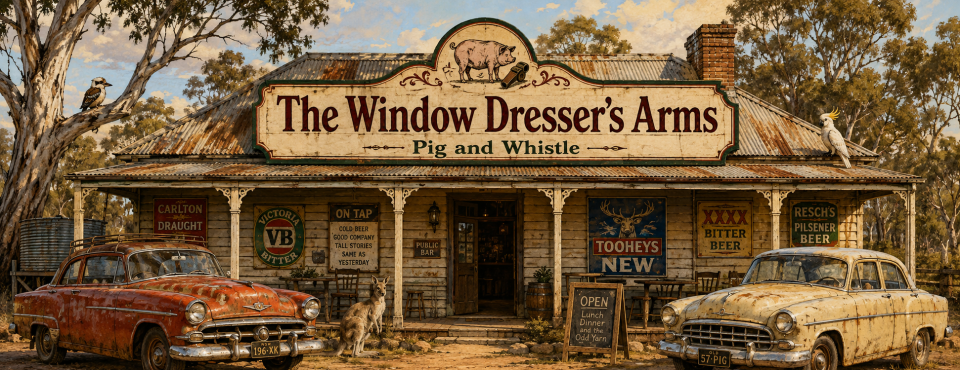
Window Dresser's Arms, Pig & Whistle

~ The Home Pub of the Famous Pink Drinks and Trotter's Ale

Window Dresser's Arms, Pig & Whistle

Tag Archives: Art

Further O’Way

21 Monday Sep 2026

Posted by Mark in Mark

≈ Leave a comment

Tags

Art, Bali, books, China, Father O'Way, Gordon O'Donnell (GOD), humour, Lords, Lourdes, photography, travel
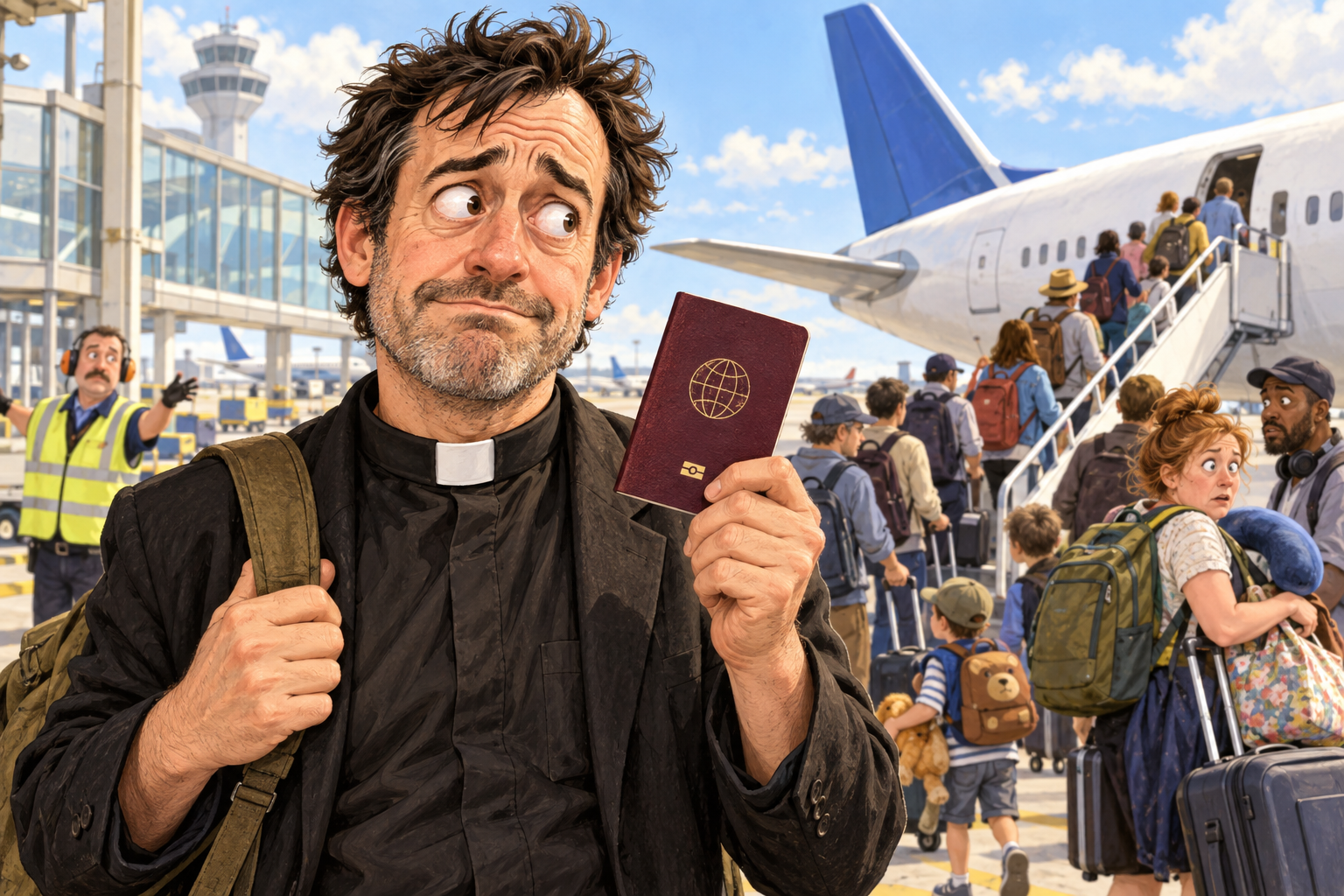
What me worry, I'm on a mission from GO'D.
What, me worry, I’m on a misson from GO’D.

A Place For Us—A melancholy musical episodic intro to the Father O’Way Chronicles

Owning a passport was the worst mistake I ever made.

At the time it seemed harmless.

A small blue booklet.

Photograph.

Date of birth.

Several pages apparently provided so that foreign governments could record the precise order in which I made a fool of myself.

I kept it in a drawer at St Generic Brand and thought no more about it.

Then Billy became Bishop Bishop.

Promotion did not improve him.

It gave him a larger office, a secretary who disliked him professionally, and access to a drinks cabinet he regarded as a sacrament.

The Bish had also taken up herbal medicine.

At least that was what he called it.

I called it smoking dope with the window open.

One afternoon I was summoned to the diocesan offices.

Billy was behind an enormous desk wearing purple robes and holding a glass containing something the colour of furniture polish.

A thin cloud hung above him.

“Incense?” I asked.

“Medicinal.”

“What’s wrong with you?”

“Administration.”

Fair enough.

He poured me a drink.

I declined.

He looked hurt and poured it for himself.

“Sandy, how would you like to travel?”

“I wouldn’t.”

“Excellent.”

Billy had retained an irritating habit from childhood of interpreting any answer he disliked as agreement.

“The Pig’s Arms needs a foreign correspondent.”

“Why?”

“Merv says international affairs are becoming important.”

“Merv is a barman.”

“He has a television.”

This was apparently sufficient qualification.

I knew the Pig’s Arms well. Officially it was the Window Dresser’s Arms Pig and Whistle, but language exists to communicate efficiently and life is too short.

“What does this have to do with me?”

Billy opened a folder.

Inside was a photocopy of my passport.

I stared at it.

“How did you get that?”

“God moves in mysterious ways.”

“You took it from my desk.”

“Mostly through unlocked drawers.”

“I’m not a journalist.”

“You can write.”

“I can write sermons.”

“No one reads those either.”

He had me there.

Billy pushed an airline ticket across the desk.

“Kerobokan.”

“Where?”

“Barley.”

“Bali?”

“That too.”

“What am I supposed to do?”

“There’s an Australian woman in jail. Shappy Corebee.”

“For what?”

“Smuggling thugs.”

“Drugs.”

“That’s what I said.”

“No, you said thugs.”

Billy looked at the file.

“Either way, Australia has plenty. Get her out.”

“And if I don’t?”

“You’re fired.”

“You can’t fire me.”

“I’m a bishop.”

“That doesn’t answer the question.”

“It usually does.”

And that was how the international career of Father Alexander Leonard Lyndhurst O’Way began.

Not with a calling.

Not with a revelation.

With a return economy ticket and a threat to my accommodation.

• • •

Barley was an island in Donesia.

Donesia had once been voted one of the most corrupt countries in the world, narrowly defeating several sporting organisations and a municipal planning department.

I landed at Nazi Goering Airport.

[Author: Sandy.]

[Sandy: What?]

[Author: You know perfectly well what.]

[Sandy: It was called that in the original.]

[Author: Carry on. I’m merely establishing an alibi.]

My instructions from the Bish gave me the names of two private investigators.

Beef Satay and his brother Chicken.

Their office was above a restaurant.

This caused confusion at lunchtime.

Beef was short and serious.

Chicken was taller and nervous.

Both came with peanut sauce.

“The Bish says you know the island,” I said.

Beef nodded.

“We know everybody.”

“Good. I need information about the prison.”

“We can get information.”

“Excellent.”

“Cost extra.”

Naturally.

The following morning Beef telephoned my hotel.

“We have uncovered high-level criminal activity, hookers, corrupt officials, money changing hands and inappropriate reporting procedures.”

“Beef, I asked you to investigate the prison, not an Australian trade union.”

There was silence.

“Ah.”

“Anything useful?”

“The governor likes money.”

“That’s hardly intelligence.”

“In Donesia it is a national philosophy.”

Eventually I arranged to meet the prison governor, Berguling Gado Gado.

His secretary answered the telephone.

“Name?”

“O’Way. Sandy O’Way.”

“Thank you, O’Way Sandy O’Way.”

“No. Just Sandy O’Way.”

“Very good, Just Sandy O’Way.”

“No, my name isn’t Just—”

I stopped.

Experience has taught me there are moments when language becomes a hole and the wisest course is not to continue digging.

Governor Gado Gado greeted me warmly.

I decided to get straight to the point.

“Governor, what would it take to have Shappy released?”

“Certainly.”

That was easier than expected.

He opened a diary.

“I can offer 27 July 1965, 8 February 1982 or 1 August 2003.”

I stared at him.

“Those dates have already happened.”

“Yes.”

“She wasn’t in prison then.”

“Correct.”

“So how can you release her?”

He smiled.

“You asked for a release date. You did not specify future.”

This was my first serious exposure to international diplomacy.

I began to understand why wars lasted so long.

We negotiated.

I pleaded.

I threatened ecclesiastical consequences, which impressed neither of us.

Finally Gado Gado leaned across the desk.

“You are priest?”

“Administratively.”

“You believe in God?”

“No.”

He blinked.

“Then why priest?”

“Accommodation.”

He considered this.

“Very sensible.”

We had found common ground.

Shappy was not released.

But I returned to Inner Cyberia with several jars of satay sauce, a wooden carving I could not identify and a receipt for expenses which the diocesan accountant refused to process because Beef and Chicken Satay appeared under “catering.”

Billy called the mission a success.

“Shappy’s still in jail.”

“You came back alive.”

“Is that the new standard?”

“It gives us room to improve.”

Then he handed me another ticket.

• • •

China.

Billy wanted me to interview a senior official named Hu.

“Who?”

“Exactly.”

“Who am I interviewing?”

“Hu.”

“That’s what I’m asking.”

“No, Hu is who you’re interviewing.”

“I know that. Who?”

“Hu.”

This continued for some time.

Belinda eventually entered the room carrying tea.

She listened for approximately thirty seconds.

“Would either of you like me to hit the other one?”

We stopped.

Belinda had become my housekeeper some years earlier.

Housekeeper was still technically accurate in much the same way that the Titanic was technically a form of transport.

She organised the rectory, organised me and had begun displaying disturbing signs of having opinions about my continued survival.

“You only just got back,” she said.

“I know.”

“And now you’re going to China?”

“Apparently.”

“Why?”

“Hu.”

She closed her eyes.

“Don’t.”

China went surprisingly well.

This worried me.

Whenever one of Billy’s assignments went well, it generally meant I had misunderstood the assignment.

I met Hu.

Or possibly Wu.

There were translators.

At one point seven officials conferred for ten minutes over whether I had asked about human rights or the correct way to cook noodles.

The answer I received appeared to cover both.

I filed six hundred words to the Pig’s Arms.

Merv published twenty-three of them beside the meat raffle results.

My career in international journalism was flourishing.

• • •

I had been home four days when the telephone rang.

“Sandy. Bish.”

“I recognised the slurring.”

“I need you in Lourdes.”

“France?”

“Yes.”

“Why?”

“Religious story.”

“No.”

“I’ve already booked you.”

This time I took precautions.

I wrote LOURDES — FRANCE in large letters.

I put the note in my pocket.

I checked it before leaving the rectory.

I checked it in the taxi.

Then I met a cricket enthusiast at the airport.

Several hours later I was standing outside Lord’s Cricket Ground in London.

I telephoned Billy.

“I’m at Lord’s.”

“Good.”

“There’s a match on.”

“What?”

“Cricket.”

There was a pause.

“Sandy, I sent you to Lourdes.”

“That’s where I am.”

“No. LOURDES.”

“Exactly. Lord’s.”

“In France.”

I looked at the cricket ground.

“Parts of the MCC are fairly conservative, Billy, but I don’t think they’ve actually annexed it.”

The line went quiet.

Then I heard him pouring something.

“Stay there.”

“Why?”

“Find a religious angle.”

I watched an opening batsman leave three deliveries outside off stump.

“I’ve just witnessed a man place enormous faith in something he cannot see.”

“Perfect. File six hundred words.”

Merv printed forty-one.

Progress.

• • •

The Tour de France assignment occurred because Billy had discovered package fares.

He rang while I was still in England.

“You’re already in Europe.”

“I’m already regretting Europe.”

“Tour de France.”

“I don’t own a bicycle.”

“You won’t be riding.”

“That’s the first good thing you’ve said.”

My journalistic brief was to investigate allegations that professional cyclists were using artificial means to improve performance.

I interviewed a rider.

“Do you take performance-enhancing drugs?”

“No.”

“Have you ever taken performance-enhancing drugs?”

“No.”

“Would you tell me if you had?”

“No.”

This was refreshingly efficient.

I sent the interview to Merv.

He published the final answer.

It became one of my most widely read pieces.

• • •

Rome followed.

I don’t remember agreeing to Rome.

I have subsequently come to believe Billy simply redirected my luggage.

The Vatican was hot.

Very hot.

My clerical shirt stuck to me.

I discovered that centuries of theological scholarship had failed to produce an adequate doctrine regarding perspiration.

There was a fountain.

I looked at the fountain.

The fountain looked at me.

[Author: Fountains don’t look.]

[Sandy: You weren’t there.]

[Author: Neither was the fountain, once you’d finished with it.]

The important thing is that I cooled down.

The less important thing is that a Swiss Guard objected.

The even less important thing is that somebody photographed it.

By the time I returned to my hotel, the photograph had been transmitted internationally under the headline:

AUSTRALIAN PRIEST TAKES REFRESHING APPROACH TO ROME

Billy rang.

“You’re on television.”

“Good television?”

“There is no good television involving a priest without trousers.”

“I had trousers.”

“Not according to Channel Nine.”

“They were wet.”

“That distinction has not survived editing.”

Back home, Belinda kept the newspaper clipping.

She claimed this was for legal reasons.

For several months it appeared mysteriously whenever we had guests.

• • •

My next assignment involved cricket.

This cheered me enormously.

Geoffrey Boycott was involved.

This cheered Geoffrey Boycott considerably less.

I had been sent to discuss batting.

I like batting.

Batting is one of the few activities in human civilisation where avoiding danger while somebody else does all the work is considered technically correct.

Boycott and I understood one another immediately.

He believed in occupying the crease.

I believed in occupying the rectory.

Neither of us saw any reason to leave voluntarily.

We talked for hours.

Mostly Geoffrey.

At some point a coat hanger became involved in a demonstration of the forward defensive.

There was an accident.

The headline said Boycott had been “hung up by Father O’Way.”

This was inaccurate.

He was not hung.

He was caught temporarily.

There is an important difference in both cricket and criminal law.

Billy congratulated me.

“You’re developing a profile.”

“I’m developing extradition problems.”

“Same thing in journalism.”

• • •

Between trips I came home.

Or, more accurately, I returned to Belinda’s supervision.

The rectory changed while I was away.

Belinda had moved things.

She called it cleaning.

I called it destruction of navigational landmarks.

“Where’s my blue shirt?”

“Wardrobe.”

“It was on the chair.”

“That’s why I put it in the wardrobe.”

“How am I supposed to find anything if you keep putting things where they belong?”

She stared at me.

Belinda was very good at staring.

Eventually she asked, “How long are you home this time?”

“I don’t know.”

The telephone rang.

We both looked at it.

“No,” she said.

“It might not be Billy.”

It was Billy.

“Sandy—”

“No.”

“The Oval.”

“No.”

“Cricket.”

I hesitated.

Belinda pointed at me.

“Don’t you dare.”

“What sort of cricket?”

She walked out.

This is how relationships develop.

• • •

The Oval assignment was different.

I noticed that almost immediately.

For one thing Billy’s instructions made even less sense than usual.

I was supposed to locate something called a Stat-o-matic.

“What is it?”

“No idea.”

“What does it do?”

“No idea.”

“Who wants it?”

Billy paused.

“A friend.”

This was new.

Billy’s friends generally wanted money, bail or access to the diocesan cellar.

“Which friend?”

“You’ll know him when you see him.”

This statement is universally made by people who have failed to provide useful information.

I went to the Oval.

There was cricket.

There were statistics.

There were men who could tell you the batting average of someone who had played two Tests in 1927 on Tuesdays following rain.

Eventually I found the Stat-o-matic.

Or it found me.

That part remains unclear.

And then I saw the man in the flat cap.

White laboratory coat.

Fingers near his mouth.

A face that tugged at something very old in my memory.

A Mintie wrapper.

A boy.

A conversation that could not possibly have happened.

The man smiled.

“Hello, Sandy.”

I stared at him.

“Do I know you?”

“Yes.”

“Should I?”

“Eventually.”

I disliked him immediately.

Not personally.

I simply dislike people who answer questions as though time is optional.

“You’re Billy’s friend?”

“He knows me.”

“That wasn’t the question.”

“No.”

That was somehow worse.

He took the Stat-o-matic.

“What do you want with it?”

“Research.”

“What sort?”

“Cricket.”

This was the first sensible thing he had said.

Then he added:

“And the universe.”

There it was.

I knew we’d been getting along too well.

“What’s your name?”

“Gordon.”

“Gordon what?”

“O’Donnell.”

He waited.

I did the arithmetic.

“G.O.D.”

“Yes.”

“Oh, piss off.”

Gordon smiled.

Then, in a manner I still cannot adequately explain, he did.

• • •

After that I went home.

Properly home.

Back to Inner Cyberia.

Back to St Generic Brand.

Back to Belinda.

Back to the Pig’s Arms, where Merv put a beer in front of me without asking.

I sat at the bar.

No airports.

No prisons.

No governors.

No bishops.

No bicycles.

No Swiss Guards.

No Geoffrey Boycott.

For the first time in months nobody required me to solve an international incident.

“This,” I told Merv, “is the life.”

Merv polished a glass.

“You reckon?”

“I am never leaving Inner Cyberia again.”

“Fair enough.”

“I mean it.”

“Good.”

“I’ve travelled enough.”

“Right.”

“I’ve seen the world.”

“Yep.”

“I’m staying home.”

Merv looked towards the door.

“Oh dear.”

“What?”

Bishop Bishop had just walked in.

He was followed by Gordon.

Billy looked delighted.

Gordon looked worried.

Gordon always looked worried.

Billy sat beside me and ordered a whisky.

Gordon declined one, accepted tea, changed his mind and asked for a whisky.

I looked from one to the other.

“No.”

Neither had spoken.

“I don’t care what it is. No.”

Billy grinned.

“Sandy, I’d like you to meet an old friend of mine.”

“We’ve met.”

Gordon nodded.

“At the Oval.”

“Unfortunately.”

Billy looked surprised.

Then pleased.

“Excellent. Saves time.”

“Billy, whatever you are about to ask me—”

“I’m not asking.”

“Even better.”

“Gordon is.”

I looked at Gordon.

Gordon put his fingers to his mouth.

“I need someone to do some field work.”

“No.”

“You haven’t heard where.”

“I’ve learned from experience.”

Gordon glanced upward.

Not towards Heaven.

Further.

Much further.

I followed his eyes.

Then I looked at Billy.

Then at the whisky.

Then back at Gordon.

“Absolutely not.”

Gordon smiled.

Billy raised his glass.

And Merv, who had been listening to the entire conversation, quietly put another beer in front of me.

I should have taken that as a warning.

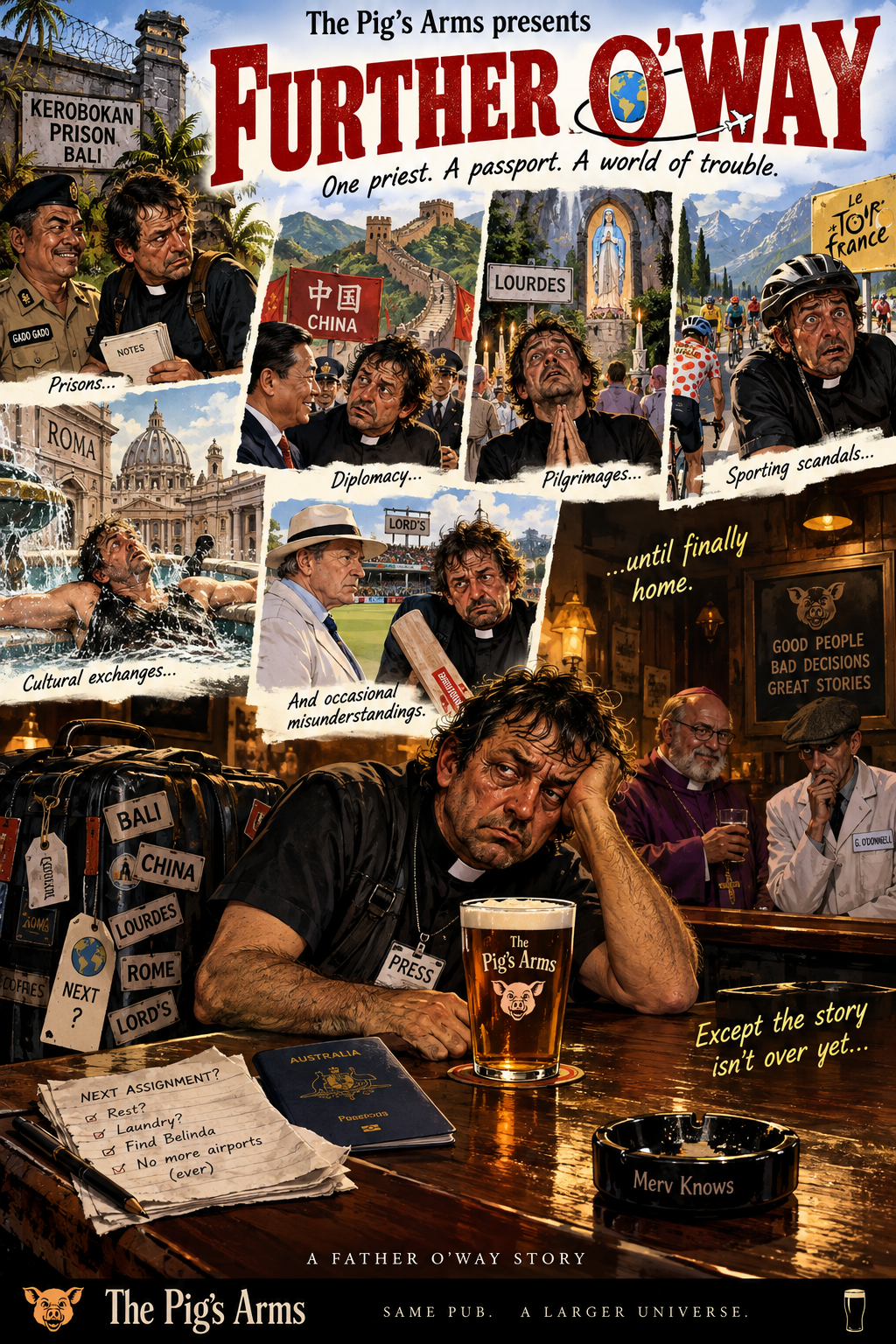
Because after Kerobokan, China, England, France and Rome, Bishop Bishop had finally found somewhere further O’Way to send me.

Space.
The Sociology of A Place To Call Home Part 14

14 Thursday Dec 2017

Posted by Mark in Sandshoe

≈ 12 Comments

Tags

Art, Christina Binning Wilson, homelessness


Me? Offensive? You must be joking.

The Sociology of A Place To Call Home Part 14
by Sandshoe

The writer apologises for the delay in presenting Part 14. Here provided is a link for readers to the previous Part 13.

The Sociology of A Place To Call Home Part 13

The accused had purchased the painting from the artist, the same one-time friend of my brother and a local resident. The artist was fearful, especially concerned he may become the next target of police attention and potential vandalism.

I had known of the artist’s intention to the painting. I critiqued it for him as he asked of me when it was completed. I thought the work was excellent, regardless a departure. The artist was a landscape painter. He did win a major award with a

Sorry, I don’t do nudes

beautiful seated female nude. This instead was of a female nude lying across a bed on her back and her head hanging back over the bed edge at the forefront of the painting; a figure barely more than a semblance visible in a doorway at some distance from the main subject I knew was female. I am unsure in recall if that could be easily determined.

I have not viewed the painting for now 47 years so I do question my memory of the exact detail , but the colour gradation and palette; however perhaps a third of the height of the canvas was painted in an almost monochromatic dark charcoal-hue other than for an implication of a source of light behind the figure in the doorway. The nude lying on the bed was a work of realism in the style of the artist’s landscape paintings. I knew he sought a Renaissance depth and perspective. Nothing is revealed of the personality of the room neither its contents. A seeming dispersal of light coated the tones of the skin. I do not remember a racial description. The hair colour was I believe dark. The artist moved about a middle third of the painting out of the dark of distance to an effect of depth beyond the bed.

My admiration of the painting remains the sense of still moment.

The painting was seized by police who searched the accused’s small wooden boat in the belief they would find drugs. They had exhibited as was anticipated of their raids little discriminatory care of his belongings. They produced no search warrant, Not finding drugs of any description and perhaps foreseeing the need to establish an alibi for their behaviour in full view on a public beach, the police alleged they were walking

Hand over your money, um paintings

not far from the water’s edge past the location of an open boat parked stern to bow facing the esplanade road. They saw the painting. They were confronted and offended.

Thus the truth was eliminated that they had pulled the accused’s belongings every which way out of a meagre forward cabin where the painting was lodged for its protection from salt encrustation and sand in a surround of clothing.

The accused was seriously frightened. The thought alone of a conviction on a charge of anything terrified anybody were they vulnerable and exposed to what was potential of being continuingly apprehended by members of the Queensland Police Force, but the accused was from the UK, not an Australian resident or citizen. Serious consequences were potential affect on his future if judgement was pronounced in favour of the prosecution, to only be deported to the UK with a highlight of a criminal prosecution for obscenity.

The criminals must have been laughing as the saying goes. Some years later, 30 years ago now the Fitzgerald Enquiry in Queensland established irrefutable proof of the long-term involvement of key figures at the highest levels of government and policing in corruption and their financing through protection rackets, gambling and prostitution.

Meanwhile, back at the beach community, resourceful individuals put their heads together as is the wont of people of integrity where community and its reputation is at stake and kin fearful of corrupt administrative governance at every level, its members living with a siege mindset, their homes in danger of ransack.

A local lawyer was engaged whose reputation met the requisite critera that his genuine interest was the accused’s welfare and social justice.

What were the qualifications of the arresting officer to establish an artwork is obscene, offensive and to whom is it offensive if so and why.

I witnessed my first life demonstration of the practical use of mathematics and

An innumerate

experienced the wonder. For anyone to see into the boat’s interior from where the police alleged they had and were concerned for the public, minors for starters were ruled out beyond reasonable doubt by trigonometry. A passer-by needed to be 12 feet tall (3.6m).

Nothing would ever cause the accused in the circumstances to even smile we were to realise. My heart went out to him as result of my assuredly announcing by way of pure instinct the next stumbling block the police would meet with was no professional artist leastwise in the immediate district would witness the painting was obscene per se. The police would present in court without that evidence. He abjectly anxious announced to me I was to remember his entire future was at stake.

The feeling of sorrowful guilt that I failed when he needed comfort to assist his anxiety has never left me, remembered of course because I nevertheless learned a valuable life lesson about the relativity of perspective.

In place of others who chose to not be recognised for fear of immediate reprisals, I attended in clothes I hoped again rendered me conservative and unrecognisable. My responsibility was to deliver my court report back to the beach community without

Shoe goes to court in disguise

being apprehended and charged on any pretence. The community’s members anticipated retaliation for what was assumed an inevitable outcome the case would be thrown out of court.

The courtroom was packed. A hotch potch of business suits and brilliantly coloured and sequinned gowns worn by people I had never in my life seen and hair styles that were glorious, dreads and shining, gleaming, beaded, braided filled the gallery standing room only and and my memory for this life time. Permission for observers to stand respectfully was further granted. Where everybody came from I do not know.

The magistrate doused periodic outbursts of guffaws. He warned contempt of court. The court fell quiet. The trigonometry was presented with grave attention to its detail by diagrammatic representation.

The accused described himself as being on holiday from the UK where he was a merchant seaman by profession. The accused made the revelation he was a former student of art at a UK art collegeof reasonable renown. The police prosecution persevered that the depiction of nudity in a public place was offensive where passers-by did not expect to view nudity; however declared the painting in the same breath as obscene. The reason was advanced that the painting showed an obscene relationship.

No apprehending police officer in their right mind would consider in my cautious viewpoint presenting themselves alone in a public courtroom as witnesses of their own assessment of an artwork. They did. Advice on the grape vine was they had tried to

A rough sketch

engage at least one local artist so what I had surmised proved true. The police officers attested when asked to having no training in art. The magistrate enquired of the arresting officer what Michaelangelo’s sculpture of David meant to him in the scheme of things. He drew an entire blank. The confused officer had no idea what that was.

The accused cross questioned by the magistrate what was the meaning to the accused of the painting advised he intended to take the painting with him on his return to the UK as a memento of his holiday in Australia. Why did he buy this painting? He bought it as a study in ochres. What did he consider was the relationship between the figures in the painting? He had not considered the subject matter of there being two figures in the painting. His interest was technical. He repeated he valued the painting as a study in ochres

The magistrate advised the accused that he, the magistrate supposed the accused would not display the painting in, say the front window of, say a department store in the main street of Cairns and the accused agreed; if the accused had not, the magistrate could not find the painting was displayed in a public place and neither intention. The accused was exonerated of the charge and free to leave the court.

I interpreted the magistrate’s inclusion of definition of a public place achieved the unexpected clarity of a finding opposed by inference to the controversial seizing of art work by the Queensland police out of display in a public art gallery and equally to its

The Magistrate

being potentially seized out of a private home or display in a private art collection. The court’s packed gallery of observers were cognisant to restrain their exuberance until they exited the court room.

In the evening I recited the court case near word for word to an assembled group sitting cross legged on the floor at my feet. My capacity with memory had been well identified as a skill of no small function. The charming detail remains in memory that the next day the accused was no longer burdened with anxiety when I commented to him that the police as I presupposed appeared no doubt perforce without an expert art witness. He asked to my surprise and in wonder how did I know.

I did not know. I interpreted the status of the intelligence and experience of the police purely on the trigonometry presented to me by the mathematicians. My immediate thought had been that if they had not thought of the detail they could not view the interior of the boat from where they had claimed the painting was visible to the public, they would have likely given little or no consideration to how difficult the next step would be of enticing a local art specialist to testify the painting was obscene.

Why did I presuppose the responsible police officers could not forward themselves as sufficient and suitable witnesses?

Perhaps it did take a local and former Queensland University student who was a victim of the Queensland Government’s Education Department to hazard an informed guess what the educational status was of the Queensland Police in 1970.

No maths. No art. No deductive reasoning. No common weal.

to be continued…
Christina Binning Wilson

Pleece HQ

Lehan Winifred Ramsay

10 Sunday Jul 2016

Posted by Therese Trouserzoff in Algernon, Lehan Winifred Ramsay

≈ 10 Comments

Tags

Art, Hakodate, Hokkaido, Japan, Lehan Winifred Ramsay, photography

Lehan Leaving

Pig’s Arms Envoy, Lehan Winifred Ramsay

A tribute by Algernon

https://www.youtube.com/watch?v=rUWYdaXwWcQ

Part of a documentary about Mt Hakodate, interviewing Lehan Ramsay about her project; an exhibition of large black-and-white photographs of people and places in Hakodate, Hokkaido, Japan. Winter 2008-9.

I found this youtube video a while back. While it’s entirely in Japanese it does give us an insight into some of her work when she was living there. We also hear her speak as part of it.

Emmjay met Lehan in Sydney between her visits to Japan but I didn’t know Lehan personally, other than by her writings here and at The Drum and her artwork she so freely shared with us at the Pig’s Arms. We all know of her struggles with depression. Her time in Japan and return to Maclean where she had trouble settling back in, going back to Japan then returning again.

Depression and mental illness has touched some of us either directly or with family members. I’m distressed that she has succumbed.

I will miss her artwork, some of which can be found here http://lehanramsay.blogspot.com.au/ and the conversations where she would write a a stream of consciousness.

I will miss having her with us at the pub and the richness she provided to all of us.

Rest in peace Lehan.

Lifeline: https://www.lifeline.org.au/ Ph.13 11 14

Beyondblue: https://www.beyondblue.org.au/ Ph. 1300 22 4636


A Little Bit More Like Everything Else – the Internet Brand

07 Monday Nov 2011

Posted by Therese Trouserzoff in Lehan Winifred Ramsay

≈ 54 Comments

Tags

Art, design

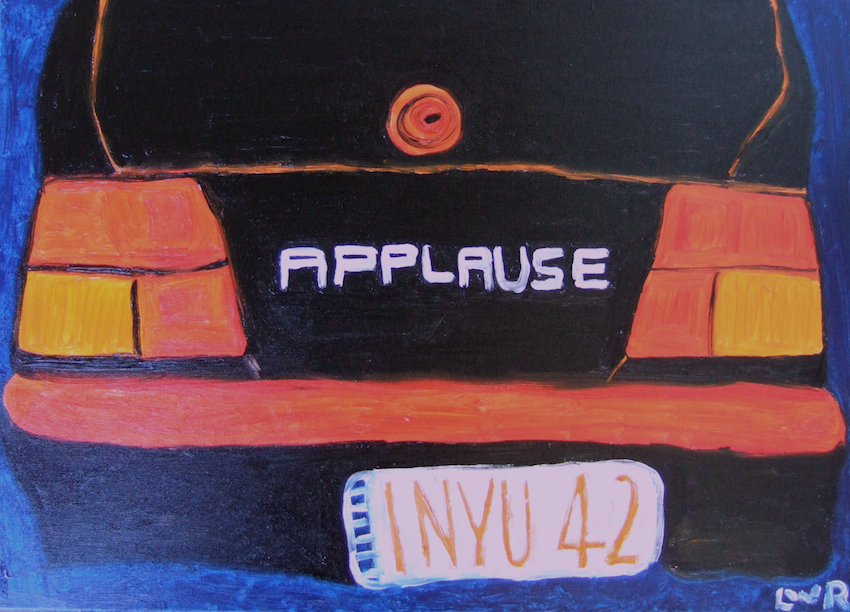
Applause

Story and Painting by Lehan Winifred Ramsay

I’ve seen it before, the early days of a system, when you can see the bare bones, the empty spaces, the potential. A horde of systematic thinkers move in and make order, covering the bare bones with regulations and Best Practice. Even for the people who have seen those bare bones it is difficult to remember where they were and how lovely it was to see them. Our Web has become systematized.

For a while there websites were a little mysterious. Difficult to know how to get the information from them. Difficult to know where to click. Unexpected things would happen. But then, people worked out that people just wanted information; they wanted to know how to most easily navigate the site. Designers backed out of their play and sat down to figure out the most user-friendly paths and formats. Sadly, though, that sensible rule-making phase does not end. People want to know how to make things pay. They work out ways to lead people through the information. People, who by this time have become other things like browsers, viewers, clicks, once educated in how things should be, can no longer see possibilities for how things could be.

I started using the internet about 1996. I used to make art on it. Not put art on it, make art on it. We played with HTML and fiddled with animation. Once things got past the initial black and white, there were no rules for how things should go. I should have known that we would quickly hit satiation of play-time and the rules would set in. Rules for how things should be placed, how things should be read. Rules that dictated what was good design and what was bad.

People worked out how to make things move, using code. Figured out how to put in layers. Perhaps that was the first interesting feature of this medium, that made it different from television, books. There was some very lovely work done. And, of course, people quickly came up with software and we all became animators. Very new kinds of design, quirky and energetic, using the limitations of the medium. The frame of a computer screen, the point of a mouse, the virtual space. With animation came movement. With increases in speed and power came more virtual space.

With more space came photographs, images. Home-made video. Which necessitated more space, and another industry sprang up to find ways to provide it. And another to find ways to use it. Digital cameras, digital video cameras. Design had been focused on text and hyperlinks to connect to other pages. But it moved back somewhat to let in embedded images. A sudden shift back to the media of newspapers and magazines. There is no doubt that the internet has affected the design of newspapers and magazines in positive ways. But I’m not at all sure that the effect of newspapers and magazines connecting to their online components has positively affected the design on the internet.

It’s easy to bemoan the passing of a beginning, it happens all the time. We don’t notice it much once it’s gone. I can’t help but feel, though, that we had great potential to develop new ways of thinking, by developing new ways of reading – and we gave that up for an easier read. I can’t help but feel that rather than giving different things a voice, the internet has caused different things to sound and look more and more like everything else.

You make a template, a format, a style. It makes it easy to keep order, to be a recognizable brand. Like The Drum. But every page starts to look alike. There is no recognizable difference between a story on children and a story on genetically modified wheat, except for the photograph. Which makes the photograph more important than the design in giving information. The design is now about not giving information regarding its contents. The design has now become a background feature, the design has lost its importance and its value. The design now has the same function as the design of a newspaper – simply to hold things together and keep the order the same, so that we can find things easily.

Perhaps its good to have The Drum as a recognizable Brand. But I’m curious about Brands, and the way they have become such an important feature of our information life. It seems to me that at some point in the development of the internet as an information source, that we had the chance to make it a deeply exploratory and meditative source. And instead, we took the other road, and made it a source of quick bites of information. Of which the Brand is the ultimate example. Perhaps, though, the Brand was helped along by that short time (short in the life of information) that we didn’t have space for more than a simple graphic on our web pages. It could be that the evolutionary process of the medium was its own downfall.

I am writing this because I don’t think I’m the only person who misses something that was here and then gone, the great exciting frontier of the World Wide Web. I cannot complain about the web, it has probably helped me more than any other connective device in my life. What it is now is an absolute playground of possibilities. Anything you want to do, it seems, is here or on its way. But what I do miss is the potential for more difference. That seemed to disappear into more of the same and more just like that. I wish that more people would take the time to see the rules and disregard them. But I guess it might simply be too late for that.

There is a time to be new, that time ends and something else gets to be new. In becoming a medium heavy in photographs and videos, the internet is losing the opportunity to be something else. But of course it goes the way of all commerce; the more functions the more money can be charged. That’s probably the simplest answer to why it went that way and not this. I hope that people are able to subvert it, remembering how it was before it became the luxurious RV it is now. I hope that there is still room for piracy.

Cheer up Man

03 Thursday Mar 2011

Posted by gerard oosterman in Gerard Oosterman

≈ 10 Comments

Tags

Art, Lehan Ramsey, National Gallery, Roman archtecture, The Hague

home sweet home

There is nothing like home. You can imagine the people’s plight on being stuck renting on a 6month lease basis. I can’t understand how anyone can cheerfully change their home being at the mercy of a 6 month lease.

Yet, before we came out here, renting was the norm and most people would spend their entire lives just in one property.  I ‘earth-googled’ our old address back in The Hague. Sure enough it is as if we left it yesterday. The street is unchanged, the doors and windows still the same, and not a brick has changed. No doubt, all those living there are renting the same as when we lived there. Perhaps, central heating and bathrooms have been added and kitchens with hot water. We lived on the top floor. At the bottom floor there were gardens and many of those lucky bottom dwellers kept chickens. A city still had chickens and veggie scraps were collected each week by horse and cart.

Yet, going back to Revesby whose architecture is far more recent, all has changed and our house hardly recognizable, the walls covered with colour bond weather board and a solid terra cotta tiled roof instead of the cement tiles that were put on when built originally… Many of the houses have had stories added, some with columns holding up little Romanesque like triangle bits of roofing or other odd bits of architecture.

Coming across some old photos of my first year here in Revesby, I can hardly believe how time has passed, and yet, I don’t think I have hurried the years unnecessarily.  Have I stood still but the houses and surroundings changed? Would this, not having moved from Holland, have produced the reverse?

You’re getting old with retrospection a sure sign, many would argue, as if years ahead for them are still numbered in multiple of decades. Yet, reading the obituaries’, it is not uncommon for people to cark it quite happily at the age some of us are in now. Makes you think, doesn’t it?

Cheer up, old man. The best is yet to come.

Painting by Lehan Ramsay

Just look at Lehan’s lovely painting of the Pig’s Arms and The Pink Drink. It graces our wall but should be hanging in Canberra’s National Gallery.

It would cheer up anyone.

Patrons Posts

  • Apollo Mission 1 October 5, 2026
  • Good Luck With That – Space Travel and How Boring It Really Is October 2, 2026
  • Further O’Way September 21, 2026
  • The Middle Ages September 15, 2026
  • The Early Days September 14, 2026
  • One More Mile August 31, 2026
  • God versus Satan August 24, 2026
  • Man on the Street August 21, 2026
  • Gordon blinds Foodge with science. August 18, 2026

We've been hit...

  • 866,980 times

Blogroll

  • atomou the Greek philosopher and the ancient Greek stage
  • Crikey
  • Gerard & Helvi Oosterman
  • Hello World Walk along with Me
  • Hungs World
  • Lehan Winifred Ramsay
  • Neville Cole
  • Politics 101
  • Sandshoe
  • the political sword

We've been hit...

  • 866,980 times

Patrons Posts

  • Apollo Mission 1 October 5, 2026
  • Good Luck With That – Space Travel and How Boring It Really Is October 2, 2026
  • Further O’Way September 21, 2026
  • The Middle Ages September 15, 2026
  • The Early Days September 14, 2026
  • One More Mile August 31, 2026
  • God versus Satan August 24, 2026
  • Man on the Street August 21, 2026
  • Gordon blinds Foodge with science. August 18, 2026

Enter your email address to subscribe to this blog and receive notifications of new posts by email.

Join 371 other subscribers

Rooms athe Pigs Arms

The Old Stuff

  • RSS - Posts
  • RSS - Comments

Enter your email address to subscribe to this blog and receive notifications of new posts by email.

Join 371 other subscribers

Archives

Website Powered by WordPress.com.

  • Subscribe Subscribed
    Window Dresser's Arms, Pig & Whistle
    Join 277 other subscribers

    Have a WordPress.com account? Log in now.

  • Window Dresser's Arms, Pig & Whistle
    View site in Reader
    Manage subscriptionsSign upLog in
    Report this content
    Collapse this bar
Loading Comments...