• The Pig’s Arms
  • About
  • The Dump

Window Dresser's Arms, Pig & Whistle

~ The Home Pub of the Famous Pink Drinks and Trotter's Ale

Window Dresser's Arms, Pig & Whistle

Tag Archives: IPod

Steve Jobs Story – a Bad Job

26 Sunday Aug 2012

Posted by Therese Trouserzoff in Cricics, Critics, Everyone's a Critic, Ladies Lounge

≈ 11 Comments

Tags

Apple, Book review, iPad, iPhone, IPod, Lisa, Newton, Steve Jobs, Walter Isacson

Posture – it’s everything, isn’t it ? The Apple Lisa and a curious onlooker

Story by First Mate

The IT industry of the past was not only managed by different companies like IBM, ICL, Prime, DEC etc., but within those companies lived tribes and families.  I was a tribal member within several tribes and more than a few companies.  It was good.  For over twenty years I enjoyed the protection and development provided by my tribal elders.

There was no such thing as job insecurity.  Everyone recognized the special talents of other team members and leaders and we put up with their foibles and sometimes straight out fuckwittery.  At the end of the day loyalty to the tribe was paramount.  Many great things were created and impossible deadlines were routinely met or bettered.  We were simply too busy to bear grudges or feel hard done by because we had encountered turds like Steve Jobs.  Life was a fascinating roller coaster ride and sometimes our tribes got wiped out by unfortunate turns of events, but there was always a galaxy of other tribes looking for talent and keen to bring us on board.

The seventies, eighties and nineties were rocketing along for anyone who could speak IT and like so many of our colleagues lucky enough to get our mittens on some cool electronica, and like so many people who actually touched Steve Job’s life in some way, the Australian computer cognoscenti too have boundless stories of derring do, outrageous behaviour and just plain madness.

There are stories of incredible sales feats (like conning the Federal government into thinking that flooding schools with PCs was a good idea and insisting that teachers somehow “incorporate them into the curriculum”) led to sales bonuses up to and including space travel.

And now – in times where the usual modus operandi is to watch your back and simultaneously duck shove your “colleague’s” career into oblivion to climb the greasy corporate ladder, the mind-numbing boredom of making no obvious mistakes has led to a dearth of interesting new folk-law.  Not tedious minutiae.  Real, death before dishonour, live-forever stories that even outsiders can appreciate.

But the authorised Steve Jobs biography is not one of those. Walter Isaacson has meticulously hunted down every snippet of Job’s not uneventful life, excused him for his tactlessness and poor personal hygiene and recorded every heartbeat, every morsel of junk food, every abuse of positional power and a mountain of toadying and skunkworks and implied that Jobs has been some new messiah.

Reading into the fine print, however, the truth appears to be a simpler notion – that Jobs was good at hunting down really clever but gullible engineers and appropriating their amazing ideas, incorporating them into a greater vision, flogging other poor bastards to make the great ideas a reality and then stepping back, taking the adoration and repeating the process.

Some of us who are old enough do appreciate the brilliant products that Apple brought to the world.  When the early iPods were released and had enough storage to hold an average western person’s record collection several times over and still fit comfortably in a geek or music aficionado’s top pocket (after the vinyl had been turned into MP3 digital files), the writing was on the wall for the record industry.  When video became portable and bandwidth became cheap, the same writing hit the wall for the print media industry.

Jobs was not alone in leading the revolution, but Apple’s recent products and service offerings have turned the digital life on its head and created many new good and equally bad paradigms.  Did you know that the numbers of pedestrians being mown down while crossing the street while they have been focussed totally on their portable communication engines has doubled in the US in the last two years ?  Same for the number of people convicted of traffic accidents that curiously involved them when they mistook texting for one of the important driving tasks.  Or do you routinely see cyclists as well as drivers too dumb to realise that plugging in an iPod takes away an important part of their survival arsenal – namely hearing a car approaching in their blind spots ?

Anyone who has travelled by train in the last year or so cannot but be surprised by the number of their fellow passengers with white in-ear headphones connected to their iPods, iPads and iPhones – or the pale Android imitations thereof.  This is a new host of individuals, acting like a flock of sheep.  Possessed by the world flooding in through their Interweb tubes, oblivious to the life going on just outside their personal spaces, indifferent and incapable of telling the difference between reality as it is personally experienced and some selective synthesis of a new reality conceived by someone else.

But enough of Job’s legacy.  On to the book itself.

Boring, tedious name-dropping crap.  Rich in its cast of characters, but with no more character development than the telephone book.  The hardcover book hit the stands at $50 a copy – an outrageous rip-off.

The Newton left pencil and paper shivering in their socks. Not.

So I read what I had hoped were familiar parts of the downloaded e-book -costing about half the hard back, looking for some of Job’s less successful contributions – namely the Lisa (named for his one-time shunned daughter) that was incredibly expensive for its time and lacked one important ingredient – actual software that did useful things, and the progenitor of the iPad – the Newton hand-held personal assistant – with the single failing that it didn’t actually work very often, or, looked at another way – it made simple paper-based tasks even more tedious.

This is referred to in marketing circles as “not a very compelling offer”.  These two Apple products died the horrible death they richly deserved.

There are a few pages about the Lisa.  I don’t know whether the Newton gets a mention.  It probably does, but the narrative on the Lisa was so boring, it made me glad that I had only wasted $25 and not the full whack for the hard copy.

In a nutshell, enjoy your Apple products, but don’t waste your time or money on the book.  It’s a major stinker – whether you are part of the IT industry or not.
Tallest Poppies

04 Sunday Mar 2012

Posted by Therese Trouserzoff in Emmjay

≈ 30 Comments

Tags

Bill Gates, Howard Florey, IBM, iPad, IPod, Steve Jobs, Tall poppies

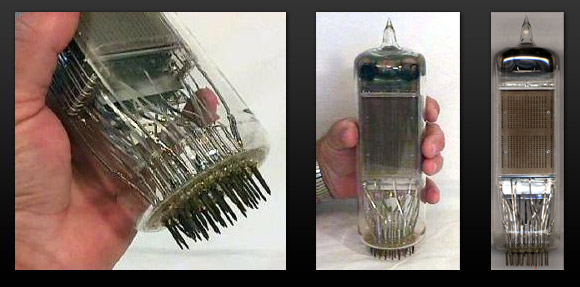
Selectron 2400 - wasn't a big success - guess why.

After much brou-haha, fan fare and some controversy over whether he was the Messiah – or just a naughty boy, the passing of Steve Jobs and the release of Walter Isaacson’s authorised biography, FM and I were discussing how, after working the IT industry for over thirty years it seems that our industry has always had its giants.

Whether you regard jobs as some kind of eccentric megalomaniac with a gift for design, head and shoulders above his peers, or whether you see him as some uber-geek with dodgy personal habits and a penchant for bullying in the  workplace, the story as told by Isaacson is an interesting journey.

The IT industry, so dominated by the Americans, has a hall of fame that ought to eclipse the music, movie and publishing industries, but which tends to hide its light under a scanner. For example, has anyone heard of Bob Metcalf ?  No, I thought not.  Bob invented the Ethernet – the first widespread network technology connecting PCs and other computers.  Do we know who were the fathers of Arcnet – the precursor to the Internet ?  No, me neither.

And with the exception of a few huge names like Bill Gates and Larry Ellison (owner of Oracle – major database technology for the less well informed) the lions of IT are invisible to people outside the technology and communications industries.  Do we know the names of any of the geniuses who design and build the information storage technology on which practically everything that uses electricity depends ?  The processors at the core of every computer, large and small, every mobile phone and these days, goddamnit every set of traffic lights and even if not most many kitchen appliances.

Bardeen, Brittain and Shockley ring a bell ?  Inventors of the transistor at Bell Labs in 1947 (nobel Prize for that in 1956),  Jack Kilby and Robert Noyce (silicon chip in 1961 at Texas Instruments), Federico Faggin and Ted Hoff microprocessor  at Intel between 1969 and 1971),  mass storage (there is a really good summary of this fascinating area in http://royal.pingdom.com/2008/04/08/the-history-of-computer-data-storage-in-pictures/ ) and so many of the storage revolutions have come from our old friend IBM’s laboratories.  The chaps at IBM astounded the world this January by revealing tunnelling electron microscope pictures of their latest experimental memory – storing a byte of data in 8 x 12 ATOM increments.  http://www.wired.com/wiredenterprise/2012/01/ibm-scientists/

For me, the light went on about the revelation in technology when Apple brought out their first iPod – then soon after one that could store 40GB of data or songs.  I had recently run all my vinyl LPS onto MP3 songs by hooking up my Yamaha amp to the input on an old Windows 98 laptop running a piece of freeware – that captured the sound and wrote digital files.  Over 200 LPs took up about 13GB – less than half the iPod’s capacity and I could use some more of that huge pocket-sized storage to backup the last ten years’ work files – and still I had space left over.

The early iPods had tiny rotating disk storage.  Rotating disks consume far more power than memory chips, are slower and have moving parts – that are prone to wear after a rather long time, admittedly.

After that came memory chips up to 32GB each for less than $150 a piece – on USBs, then Micro storage of the same capacity – killing off CDs and DVDs as the storage media of choice for movies and audio files.  And at the same time opening up wonderful opportunities for portable audio / video capture and playback – and supporting the contemporary mobile phone industry.

More data drives both the software industry and processor chips to be able to handle huge volumes in acceptable time frames.

The iPad was the device I should have seen coming but didn’t.  Laptops got smaller and smaller and not much less powerful but the cornerstone of the next computer / communications breakthrough was combining computing power and storage capacity with mobile telephony technology AND touch screen technology that for the first time had become fast and reliable (up to a certain level of consumer abuse).

Make no mistake, the early touch screen phones were no great shakes.  Two years ago, Telstra gave me a Samsung Wave phone.  Touch screen.  No keyboard.  Worked when it felt like it.  Two repairs under warranty.  Apple’s iPhone 4 had antennae problems – not good for a phone costing $900.  Two years later I have a new iPhone 4s – and cannot believe how good this thing is.  Lost in Melbourne ?  No problem.  Open up Maps, tell it where you want to go.  It knows where you are from the mobile grid – and shows you how to get to your destination.  Not in Melbourne ?  Doesn’t care.  Works wherever it can see some GPS satellites.

So, as much as Steve Jobs has been lionised for his breakthrough technologies, this in my opinion is because the technologies themselves open up the boundaries for so many other geniuses to develop useful things to do.

Not the least of which is e-books.  Now I know that many of us (including me) are rather partial to the feel of paper and I don’t deny the right of generations of Mr Gutenburg’s progeny their place in the sun.  However I can also appreciate that reading the Steve Job’s story on my iPhone (at less than half the cost of the paper book) has a certain appeal when the extra half kilo matters – on planes and in one’s bag on the train, bus or walking across town.

Moreover, the cost of not chopping down a tree, not typesetting and printing the book, shipping it across the world, putting it up in expensive retail stores and (yikes !) paying the wages of serfs to sell it to you – has advantages for a planet groaning under the weight of moving stuff and consuming ever-increasingly expensive energy.

And the phone – or iPad – or other e-book readers can store far more books than can be read in a month of Sundays.

So how come Australia doesn’t have any Steve Jobs – like lions ?

In our IT global IT and communications industry, there is one common thing underpinning the pivotal discoveries, marvellous software and hardware engineering.  Huge deep pockets for research and development.  And HUGE markets to sell the sometimes underdone products into – producing the cash to finish the job properly.

There is a piece of jigsaw that Australia seems to lack entirely.  The bit that can bring wonderful ideas and prototypes into full-scale production.  And make serious money for the people who invented them and their larger tribes.

What happened after Australian Nobel Florey and Brit Fleming rediscovered penicillin and more importantly collaborated with others to produce it in large quantities ?  The pharmaceutical world-changing equivalent of the microhip ?  Florey’s royalties should be keeping South Australia in research dollars till eternity.

Answer:  Working at Oxford at a time when Britain considered that patenting medical discoveries was unethical, Florey and his team had to fly to America to find an organisation with the resources and cash to scale up production.  You can join the dots, now.

There’s more on Florey at http://www.abc.net.au/science/slab/florey/story.htm but the truth seems to be that there is little information because Florey was a humble man shy of publicity.

Perhaps that in itself adds the last missing piece – that a great and inventive mind needs resources and an ego big enough to make investors line up.  A tall poppy, isn’t it; the kind that the uber-egalitarian Australian society hates to see making it truly big.

Ironic is it not that we seem to be OK about the megawealth accrued by worthless obese mining magnates who, by accident of birth and sheer greed personally own enormous fortunes, but lack the foresight to know what to do with it beyond accumulating more.  Those individuals also lack the decency to give something to people who do have the foresight to create the next big things.

Mega wealthy, maybe but certainly no Steve Jobs or more particularly Bill Gates.

“Boredom” the new Art form

13 Tuesday Dec 2011

Posted by gerard oosterman in Gerard Oosterman

≈ 25 Comments

Tags

Ipas, iPhone, IPod, Kindle

“Boredom”, a new artform.

December 12, 2011


“Boredom”, the modern Art form.
My father used to say that if you are bored it is because ‘you’ are boring. They were wise words. Parents knew more then. If fifty years ago someone would have said that in the future a majority of people would spend a large part of their lives staring at small square objects, they would have called for a strong nurse with a straightjacket and some tablets. My parents would probably conclude by saying, “you and the whole world have all become boring”.

Yet, today this has become the norm. No matter where one goes, it is the same sad sight. There they are, all stooped over their IPod, IPad, Kindle, mobile phone or some other small square object. It seems to have overtaken all in its path, a tsunami of hundreds of millions worldwide stooping down, staring at their laps, oblivious of climate, people, geographical situation or indeed life itself. Who on earth would have thought it even remotely possible?

How did this come about and why? Years ago, we used to talk, look at each other. Do you still remember the sound of words when people opened their mouths? We exchanged ideas became animated and bounced of each other’s differences and enjoyed social intercourse. Trains and trams had passengers that talked, used real words with utterances of sounds. It’s eerily quiet now on the train, heads bowed in obedience to the square gadget. People and voice connectivity has now been replaced with a set of electronic devices which connects us, supposedly, to a different level of public togetherness which is called ‘social media’. We have books now which instead of words in a certain and highly individual order, as in the past, have now been replaced with ‘face books’. It’s all part of this phenomenon of ‘social media’, and is a world- wide movement keeping us ‘in touch’. In touch with what? In touch with that square object in your lap, isn’t it?

Together with keeping in touch through the new ‘social media’ there has been a marked decline in children on the streets. There is no more need for that because they all keep in touch with each other through their electric Face- books. It even shows a picture of your friend, what more could you probably want from friendship? You exchange sharp little messages, such as “I am here, where are you”? Or, “how many friends have you on Face-book?” “I have thirty six now, but have dumped Sharon”; “she is such a bitch”. “Have you still got Sharon on yours?” Nah. (Three months later Sharon has hanged herself).

Of course, interconnectivity is what we are all on about. We connect as never before and have even become intimate with our TV, also involving it with our need to socially be ‘involved’. Rhythmically we sway in front of it, our Wii consoles talking to us, interlude and interactive with music, keeping us in touch with ourselves and as an extra bonus keeping us fit. A newer version has hit the market. It is a device that mirrors our movement in front of the TV. This is so great for involvement of many of us with immediate proof of it and directly in front of us on TV and our own eyes. Think of it, hundreds of millions in the most extraordinary physical contortions in front of the TV all busy with ‘media’ in one form or the other. And then there is all that texting and tweeting to get involved with. It just never stops with all that ‘socially connectivity.’ It’s all so much me and more of me.

At school drop-off’s and pick-ups, again the same world of those little square devices, mothers, sometimes fathers, all on their e-phones, texting while waving a hand to their off-spring. How will language as we know it survive? Tweeting limits itself to one hundred forty characters. In days gone by, the art of writing was abandonment in using words not counting characters.

Mind you, there is light at the tunnel. Already the innovation in pushing more of those devices onto the market has calmed down. Perhaps, the limit has been reached. After all, we cannot just phone, but also e-mail, send pictures and locate where we are, all on the one gadget. What more could one want? It seems that apart from ‘astral travel’ electronically, the end of this rather silly ‘social media’ might have been reached.
In my area, the local skate-board park is busy with kids queuing up. Are they getting fed up with all those little gadgets? I sincerely hope so. Kids are not boring but those addicted to ‘social media’ are. They are so….. utterly boring.


OccuPod, OccuPad, OccuPhone.

19 Wednesday Oct 2011

Posted by Therese Trouserzoff in Lehan Winifred Ramsay

≈ 42 Comments

Tags

iPad, iPhone, IPod, Occupy Wall St

Lane

Story and Photograph by Lehan Winifred Ramsay

Most of those people who would go to an Occupy Wall Street protest do not have stocks and bonds and huge investments. I don’t think we need to occupy Wall Street. If it’s change we want, I think we need to occupy Apple.

Steve Jobs is gone. I love my apple computer. I love my ipod. I heard that someone bought their son an ipod and then had to buy them a computer to make it work. It really never occurred to me that I needed a computer in order to drive my ipod, because I already had the computer. But I’d have bought it anyway because I like them all. I like the way they look, like the way they feel, and to be honest I like the way they invest you with ignorance about the internal organs of the things. A friend of mine just made a computer, he said it wasn’t difficult, you just work out the things you need and put them together.

No Mac user ever has to be bothered with building their own. You will never need a garage for your mac. At most you will need one white cable that connects your mac to something else. You might be able to borrow that from one of your friends, but it’s good to have your own. It’ll make you feel a little less powerless if something goes wrong.

I think that some of the grumbling is right. Perhaps the Occupy Wall Street Sub Slogan should be GIVE UP YOUR MAC. Give up your ipod. Give up your iphone. Give up your Solar power unit. Give up your external water drive. Sorry, tank. And your speakers. Sorry, sprinklers. Are we really going to admit that we have bought into the habits of the wealthy 1 percent and stand to lose our quiet bystander status by standing up to ourselves?
I want to know why we are selling power generated by solar panels to the electricity companies. Do they really want to buy it? Aren’t they actually in the business of selling electricity? Isn’t there by now some way that we can sort and bundle all the power of our block?

I want to know why turning off lights and unplugging devices has gone out of fashion.

Couldn’t we start a QUIT POKING campaign to get people not to plug in so many things? Shame everyone into giving up the white cables? I want to know why blackouts have gone out of fashion. I want to know why we all blame Kevin and Julia for not finishing the insulation. I want to know why we are such careless people. But I guess I do know.

This problem is so much bigger than we can manage. Even if we do something, chances are the Chinese and Indians and all the other baddies-du-jour will just use up more, and we likely will only achieve a balance. With us getting a little less and them getting a little more. And actually we don’t care to give things up just to share.
If nothing else we could turn around and look at one particular system and its efforts to become energy efficient and thoughtful about their use of the world’s resources. Apple.

Apple is very cutting edge, and in the eulogies for Steve Jobs we heard that Apple products have been designed some years in advance. What is the Future as Apple sees it. And more importantly, is that future changeable? If we, Apple’s Loving Masses, feel that we need to change, become a little more technologically simplified, does Apple have the flexibility to respond, as it always has, with new product?

Are we still going to be following Steve Jobs, is I guess my question. And we have followed him, through expensive bulky packaging and cables that redesign for each product, and recalls that go by word-of-blog. But we should have got the hang of this beauty thing, this design thing, we should just get it by now. We don’t need to be taught any more, and anyway there isn’t a great IT design guru to teach us. We should get it. What is necessary, what isn’t, what constitutes great design as useability and function and what constitutes great design as line shape and colour. And where the vision of the future is, where you can see the next product peeping out. In fact, we should be ready to design our own.

I loved Steve too. And I spent a lot of time reading stuff and watching stuff and thinking stuff, I wanted to learn from him even if I couldn’t meet him in person. Now I think I’m nearly ready to give him up. I went back to the 1984 Apple advertisment, and I watched it until I understood that it was the kind of lame preppy boy dream of a lecture room full of bored computer engineers fantasising about the babe out the window practicing for the sports festival. Would Apple, if we were to ask them, if we were to occupy their thoughts, make for us a new story, a new narrative, in which we were all liberated from Big Business?

I love my computer, but I do not love my own stupidity. Sure I can simply upload from one computer to the next, never having to start again from scratch, and although the computers have been designed to do this, the cost of having your computer fixed often more than purchasing a new one and sucking the brain of the old one – Apple doesn’t really recommend it.

I find Apple to be a great company, I have many positive experiences with both it and its products. I always wonder about organisations that are difficult to criticize, and so when I find one I examine it. I am old enough to have tried to learn some computer programming at school, without the computer, and to have found it unfathomable and discouraging. I am old enough to have studied Typing at school, and to have avoided shorthand. So it could be that my attachment to Apple is gratitude, for sparing me a lot of discomfort. For not having to be ready to pull the computer apart when it didn’t turn on, but to have to rely on a professional.

Most of those people who would go to an Occupy Wall Street protest do not have stocks and bonds and huge investments. I don’t think we need to occupy Wall Street. If it’s change we want, I think we need to occupy Apple.

Till Death us do ( and the IPod) Part

10 Friday Sep 2010

Posted by gerard oosterman in Gerard Oosterman

≈ 11 Comments

Tags

Bankstown Square, IPod


There can’t be greater joy than in learning that the IPod has been responsible in a 20% increase in pedestrians being hit by cars crossing roads while caressing their IPods. Can you imagine? Well, actually I can.

During my ceaseless exploration and expeditions of large Shopping Malls, of which I have presently got a bee in my bonnet, I almost hit one IPod addict crossing River Road at Revesby last week. Of course, if I would have had more sense I should not have swerved and instead increased speed and aim straight for him. In a trance and totally out of it, this bloke of around 60 with a pony tail, not only was stroking or poking his mobile but crossed the road diagonally with turtle speed as well.

It was on a Sunday afternoon that we decided to see what happened to Nr 50 Mc Girr Str, Revesby, the abode where I spend so many formative years during the late fifties absorbing petuniated suburbia and its fenced off venetian blinded population of which bon-fire night was about the only time our street would be outside ‘en masse’.

I managed to talk Helvi in doing a double and combine it with the delights of a ‘Bankstown Square’ visit en route. Well, Bankstown Square exceeded all expectations even though we were a bit late of the Sunday. The car park was having gaps here and there; people must have had their fill of shopping and left. Some shops were also lowering their see through shutters. Never mind, it still did contain the vibes that are familiar to those that frequent those malls. In Bankstown it is where multi culture-ism is at its peak.  It is also the most horrible monstrously obvious a failure of aesthetics.

Dante’s inferno made visible in techno colour with an overwhelming hissing sound that, even for the deaf, dominated hearing aids and GPS’s. It must be the sound of the swishing credit card swiped and multiplied thousands of times combined with the licking of giant towering smoothies and slurping slushies by kids running amok. Bankstown square is where the hurling of credit cards towards the shops’ cash registers has reached the zenith of consumerism.  Not even Mr Harvey could have dreamt of such riches and from the poor as well. What proof of triumph over adversity could one still achieve?

Of course, nothing could have been further from Mrs Ross and my mother’s mind some forty years earlier. In fact it was the exact opposite, not to spend or loose, but to gain something from Bankstown Square. It was the year of 1966 that Bankstown Square shopping opened. It was after Roselands but even so, another 6 page spread in the papers and banners floating in the sky from twin winged planes that would take off from Bankstown aerodrome every couple of hours so.

What drew mum and Mrs Ross was nothing financial or need to consume. No, it was during winter that both used to get the bus on River Rd, Revesby to Bankstown Square in order to enjoy the warmth of the air-conditioning.  Waking up during winter was something and this, mum repeated endlessly, “not even during the war in Rotterdam”, had our family suffered cold as we did then in Revesby during winters. The locals were heroic as well as stoic and some in shorts defying the most flabbergasted of the Euro-centric. Mrs Ross simply spent entire winters in a good long duffel coat, wearing it both inside as well as outside, only to be taken off minutes before bedtime, diving below the blankets.

“Cold to the bones”, mum said as she and Mrs Ross used to step up into the bus to Bankstown Square. “It was so nice and warm there”, mum used to tell us.

Patrons Posts

  • The Question-Crafting Compass November 15, 2025
  • The Dreaming Machine November 10, 2025
  • Reflections on Intelligence — Human and Artificial October 26, 2025
  • Ikigai III May 17, 2025
  • Ikugai May 9, 2025
  • Coalition to Rebate All the Daylight Saved April 1, 2025
  • Out of the Mouths of Superheroes March 15, 2025
  • Post COVID Cooking February 7, 2025
  • What’s Goin’ On ? January 21, 2025

We've been hit...

  • 713,779 times

Blogroll

  • atomou the Greek philosopher and the ancient Greek stage
  • Crikey
  • Gerard & Helvi Oosterman
  • Hello World Walk along with Me
  • Hungs World
  • Lehan Winifred Ramsay
  • Neville Cole
  • Politics 101
  • Sandshoe
  • the political sword

We've been hit...

  • 713,779 times

Patrons Posts

  • The Question-Crafting Compass November 15, 2025
  • The Dreaming Machine November 10, 2025
  • Reflections on Intelligence — Human and Artificial October 26, 2025
  • Ikigai III May 17, 2025
  • Ikugai May 9, 2025
  • Coalition to Rebate All the Daylight Saved April 1, 2025
  • Out of the Mouths of Superheroes March 15, 2025
  • Post COVID Cooking February 7, 2025
  • What’s Goin’ On ? January 21, 2025

Enter your email address to subscribe to this blog and receive notifications of new posts by email.

Join 373 other subscribers

Rooms athe Pigs Arms

The Old Stuff

  • RSS - Posts
  • RSS - Comments

Enter your email address to subscribe to this blog and receive notifications of new posts by email.

Join 373 other subscribers

Archives

Website Powered by WordPress.com.

  • Subscribe Subscribed
    • Window Dresser's Arms, Pig & Whistle
    • Join 279 other subscribers
    • Already have a WordPress.com account? Log in now.
    • Window Dresser's Arms, Pig & Whistle
    • Subscribe Subscribed
    • Sign up
    • Log in
    • Report this content
    • View site in Reader
    • Manage subscriptions
    • Collapse this bar
 

Loading Comments...