
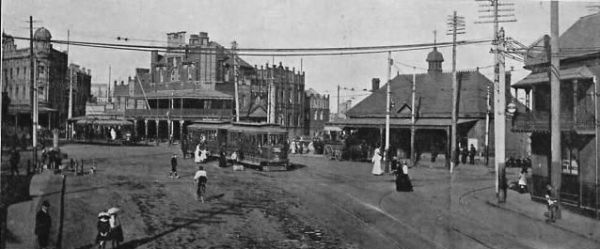
Newtown is one of Sydney’s most extensively explored suburbs and has yielded some surprising archaeological finds in the last hundred years.
Recent economic strictures imposed by the municipal equivalent of the Greece monetary crisis – the Marrickville Council new economic program “Doing Less With Less” include a fundamental policy of discarding vital archival material, closing the public library and selling off museum storage spaces to Kennards – for hiring out to yuppies to store the shit that they can’t fit into their trendy new pieds a terre in the precinct.
The Friends of Newtown Archaeology (FONAy) are fighting back by meticulously sieving through the treasure trove and these are two of our amazing finds.
In 1907, two great disturbances rocked the world of Newtown Archaeology – the discoveries under the very main street, the artery of our borough – King Street revealed a rich and truly amazing prehistory of Newtown.
The first – was the unearthing of a fossilised prehistoric human – a giant of a man almost two and a half metres tall – named at the time, the King Street Giant.
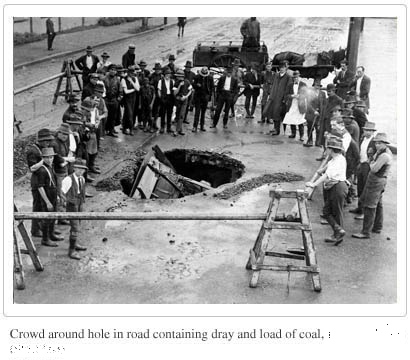 In August of 1907, a nasty and curious accident happened in front of what was to later become the Newtown Bridge – after the construction of the reailway and the re-blocking of the tram tracks leading from King Street into Enmore Road.
Mr Halliwell Diddicomb-Holme, didn’t come home that day. The dray of coal he was driving disappeared – Halliwell, horse and all into a hole that opened up in the road. Incredibly, the horse was only slightly injured, but Diddicomb-Holme had to be put down. Records do not reveal the fate of the load of coal, but it is not difficult to imagine that it was put to good effect by the less-well heeled parishioners of the borough.
Not wanting to see a repeat of the accident, the Town Council started excavations in an urgent attempt to prevent further catastrophic collapse of the carriageway. This was particularly pressing with the imminent introduction of the first trams – weighing considerably more than Mr Diddicomb-Holme’s load of coal.
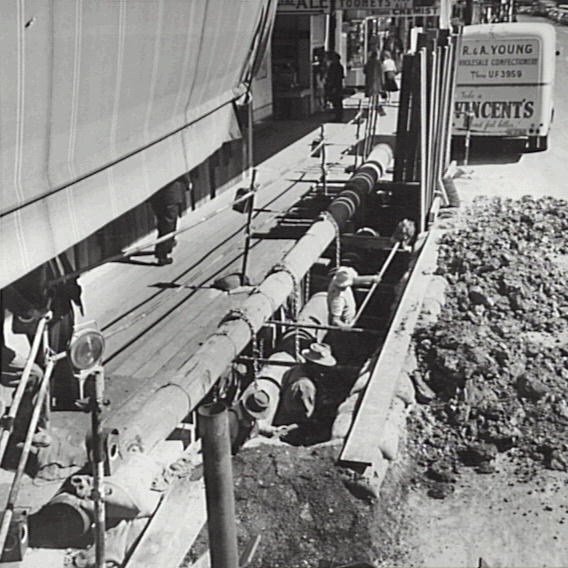
Work was progressing apace by January 1908 as the above photograph shows – with some serious excavatorial effort being put into the carriageway proximate to the Bank Hotel. But an accidental discovery by a Mr Phillip McAvity brought the work to a sudden halt when his No. 4 Speer & Jackson shovel struck a very solid and hard object in the sandy loam typical of the soils overlaying the Hawkesbury sandstone in the County of Cumberland.
As was his wont, Mr McAvity took leave to consult the foreman – a Dutchman with a keen interest in archaeology Mr Peeg Sarmes. Mr Sarmes cordoned off the area and began a re-inforced wooden trenching approach to protect the object until it could be fully exposed.
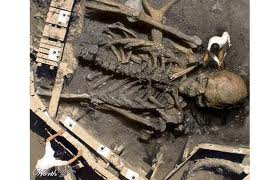
The broad light of day revealed a truly extraordinary find – a 4.0 metre fossilised human (13 feet tall in Imperial feet). The creature was immediately named the “King Street Giant” – for the obvious reason that he was extremely tall – as well as being fossilised in a limestone suit.
With the inducement of free beer, the publican of the adjacent Bank Hotel (the sister pub to the Pig’s Arms) – a Mr Barney Ancoke persuaded the diggers to haul the giant into the public bar where they draped him in a Newtown Bluebags flag and the curious and incredulous public paid three pence a head to observe the King Street Giant on the quarter hour. He was the first, but certainly not the last giant to expose the cods in Newtown.
As you can possibly see from the photograph, the King Street Giant was modestly laid to rest with a hand discreetly covering his wedding tackle and the dissolved limestone flowing through the water table did the rest.
Barney Ancoke made a small fortune (eight guineas) exhibiting the King Street Giant, purchased a racing ferret from a Miss Uve Beenad and pursued a life in slow decline from the toxic effects of eating excessive amounts of rabbit from dubious sources. He died penniless and unmourned and was buried in the pauper’s section, courtesy of the state, in a grave situation at Rookwood.
It is not recorded what happened to the actual King Street Giant, however it was later discovered that a faulty and inaccurate tape measure was used to establish the dimensions of the giant and the Dutch excavation engineer, Peeg Sarmes was charged with the crime of using tiny children for excavation work without pay and on a promise that there would be sandcastles later.
But the King Street dig was not done yet in revealing the mysteries of the past.
With the coming of the railway through Newtown, it was necessary to re-block the tram lines. This occurred later the same year – in 1908. Workmen were removing the tarmac and the fishplates under the rails and replacing the wooden blocks with the newly-discovered James Hardly asbestos-concrete suspension system.
The site engineer, a Mr Len Bovine noted in his day log of April 1, 1908 that his men “Were removing curious objects apparently manufactured by an obscure brickworks they called ‘Tellstar”.
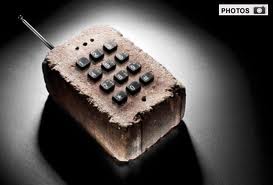
More recent work with one of these found objects has revealed the incredible possibility that it is a fossilised version of a neo-pre-counciliar communication device. Experts agree that it definitely predates Alexander Graham Bell, but there is dispute over whether it was merely an artefact used in some religious ceremony (perhaps involving a pre-Camperdown or Newtownian SP bookie) for the placing of wagers on marsupial races, or whether it is in fact the only surviving example of Tellstar’s first mobile phone.
Electronic engineers (and masons) have been engaged in in-depth analysis of the object and have reported promising early progress. They have been able to extract numbers from the object’s memory, but attempts to dial through on those numbers have been fruitless with the exception of a retired GPO maintenance man who reported that he was hearing strange ring-tones from the back of a home-made brick barbecue. Tellstar representatives have been unavailable for comment, mainly because they cannot or will not answer their phones.
 Window Dresser's Arms, Pig & Whistle