• The Pig’s Arms
  • About
  • The Dump

Window Dresser's Arms, Pig & Whistle

~ The Home Pub of the Famous Pink Drinks and Trotter's Ale

Window Dresser's Arms, Pig & Whistle

Tag Archives: Recipes

Pig’s Arms Bumper Christmas Edition 2102 – Vivienne’s Tapas

25 Tuesday Dec 2012

Posted by Therese Trouserzoff in The Dining Room, Vivienne

≈ 19 Comments

Tags

Recipes, Tapas, Vivienne

Vivienne's Tapas

Vivienne’s Tapas

This is how I wrote the recipe down 20 plus years ago.  It was Maria’s dish from the Philippines.

500g of rump steak sliced thin and marinated in – vinegar, garlic (1 tsp), pinch of salt – for 12 hours or overnight.   Drain and dry off meat by cooking in frypan.  Remove and add cooking oil – fry up with some thick sliced onions and serve with dip.

Dip:  vinegar, garlic (half teaspoon), white sugar (1 tsp), pepper, salt and a little chilli.

The method was a bit too brief and needed some working on.  When Maria cooked the meat I thought my whole kitchen was going to go up in flames.  The temperature was so high that smoke obliterated the stove.  It tasted great but for indoor cooking it needed toning down.

Half a kilo of rump gives enough for everyone to have a snack, as in tapas.  However, we loved it too much to settle for a snack, so I do at least one kilo for four people.  The marinate mix needs to be just enough to barely cover the meat in a glass bowl.  I put in more minced garlic and a bit more salt.   I do this the day before.

When meal time comes around, preheat the oven or warming tray and serving dish.

Peel and thickly slice the onions (3 or 4 large ones).

Dry fry off the meat in batches in a large flat bottomed pan – the meat will be cooked and a bit dry.  Drain off any liquid which accumulates in the pan.  Then add some oil and fry in the oil – mix up some of the onion with the meat each time, doing this in say four lots, each time adding a little oil.  It is done when the onions are just done (not limp).

The dip can be done hours before – put into a screw top jar and give it plenty of good shakes.  I used to add chilli powder but have also used a little sweet chilli sauce and I add more garlic.  But the basic taste is vinegar with oomph.   Serve with dish surrounded by a few little bowls of the dip for each person.  Use fingers or a toothpick and dunk in dip and pop in mouth.

Have a lovely Christmas everyone.  With very best wishes from Vivienne.


Vivienne’s Dhal – a Special One

13 Sunday Nov 2011

Posted by Therese Trouserzoff in Vivienne

≈ 43 Comments

Tags

Dhal, Recipes

Darker, more lush simulation of Vivienne's dhal

Quantity for a small village –  2 cups of  raw brown/green lentils – but works the same for 1 cup of raw lentils.

Preferably use a large cast iron pot with a lid:

To about one tablespoon of melted ghee add:

  • 1 finely chopped onion
  • 3 finely chopped cloves of garlic (depends on how big they are)
  • 1 square inch chunk of fresh ginger finely chopped

Sauté, but do not brown, then add:

  • 3 teaspoons of ground coriander
  • 1 ½  teaspoons of ground  cumin
  • ¾          “                 turmeric
  • ½         “                  cinnamon
  • ½          “                 cardamom
  • ½           “                chilli powder
  • 1 teaspoons of salt       (all my teaspoons are heaped)

Cook for a minute or two then add two chopped fresh tomatoes (I peeled them), simmer and then add equivalent of one sachet of tomato paste, simmer and stir well then add a cup of water.

Then add the lentils (remember to rinse them first).  You can first cook them separately by boiling and draining.   I add them raw  but make sure you have plenty of time to cook them as this mix is simmered and it takes nearly 3 hours for it to be properly cooked.

Stir and check water level regularly,  adding water each time.  Test taste – it will probably  need a bit more salt.

 Final notes:  all these quantities can be varied a bit.  For instance if you have an abundance of home grown tomatoes add four.  A bit more garlic won’t matter.  It is all a case of near enough is good enough.  This is not a sponge cake !

This should be accompanied by naan or any Indian style bread.

Apologies, Viv…… missing ingredients no longer …..

VIVIENNE’s Thoughts and Recipes for Autumn

27 Sunday Feb 2011

Posted by Therese Trouserzoff in The Dining Room, Vivienne

≈ 39 Comments

Tags

honey duck, lamb kebabs, pork spare ribs, Recipes


I feel that Autumn is a time for being re-inspired in the kitchen.  If it has been too hot and humid for a long time, cooking (for me anyway) often becomes a bit of a chore in as much as I really would like a magic wand.  Sometimes I find myself making a potato salad (with cream and mayo and spring onions), throwing together a tossed salad and then cutting up a bought chicken or just cooking a decent piece of steak.  Sometimes I ask my husband ‘what would you like to cook tonight darling?”

Right now the hot and humid days have finally gone and energy is coming back.  Here are some of my favourites for weekend family eating.

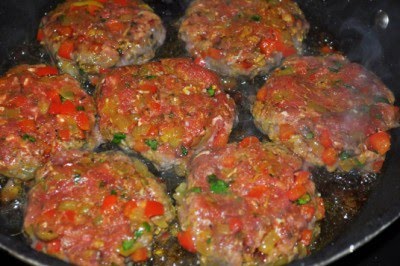
Shami Kebabs (lamb meatballs)

For this I suggest you ask your butcher to bone out a leg of lamb, skin it and put it through the coarse mincer (not fine).   About 600g will make plenty as a snack for 4. (The remainder goes in the freezer.)

Put 3 slices of white bread (crust removed) in a bowl and add milk to soak until it is mush.  Pour off any milk and squeeze till bread no longer drips.   Mix the meat and bread together and add the following:

  • 1 medium onion, very finely chopped
  • 3 cloves of crushed garlic
  • 1 inch chunk of fresh ginger, grated
  • 2 teaspoons of garam masala
  • 1 teaspoon of chilli powder
  • 1 teaspoon salt
  • ½ teaspoon black pepper
  • 1-2 tablespoons of fresh chopped mint
  • 1 egg
  • 1 tablespoon of plain flour

Mix very well.   Form into small balls about the size of a walnut (definitely no more than 3cms diameter).   Traditionally about three of these would be threaded onto a metal or bamboo skewer and then deep fried.  However, I think it is easier (and possibly safer) to just shallow fry individual balls in peanut oil, fairly quickly.   It doesn’t take long.  Drain on absorbent paper and keep warm until you have finished doing a number of batches (you can’t do them all at once).

Great eaten hot, warm or cold – as a snack or part of a bigger spread.  Mango chutney goes well as does a minty yoghurt.

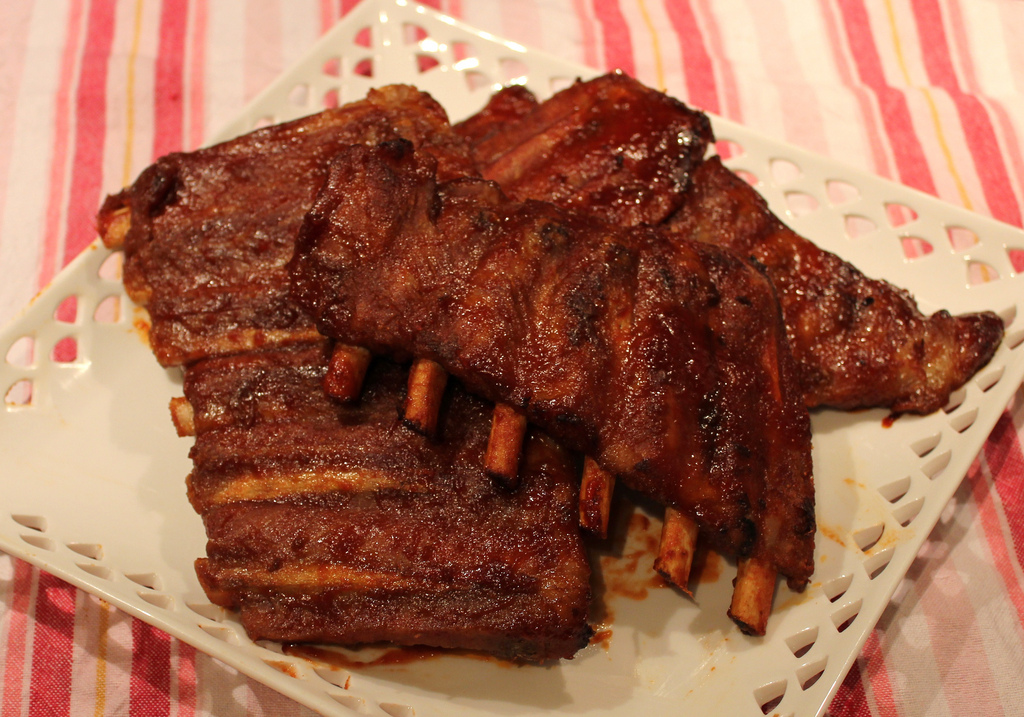
American style Pork Ribs

The trick to this dish is finding the right spare ribs.  I really do mean RIBS – they don’t have a lot of meat on them so you need to be fairly discerning in picking out the best.  My butcher doesn’t have them but I usually find them at the Safeway meat section.  Ridiculously expensive at $5-7 for just one slab of them.  To feed four people I need five or six packets.

Place ribs in a large baking dish and pop into medium hot oven to cook about ¾ through.  Add nothing, just the ribs.  The purpose is actually to cook out any fat.  Take pieces out and cut into sections of 4 or 5 ribs each.  Clean out the baking dish and arrange rib pieces side by side.   Mix the following together in a bowl:

  • About 150 ml of golden syrup
  • ½  teaspoon of cayenne pepper
  • ½  teaspoon of salt and a little pepper
  • 2 cloves of crushed garlic (more if you like)
  • 2 tablespoons of tomato paste
  • 1 ½ tablespoons of dijon mustard

Coat the top side of the ribs with this mixture and cook in oven till it becomes sticky.  Turn ribs over and coat the other side and cook again till sticky.

The mixture can be increased proportionately to fit the quantity of ribs you are cooking.  The above amount probably is just enough for 4 sets of ribs.

Serve with a little boiled rice and salad or whatever takes your fancy.


Duck de Chirico

Duck with Muscat-Honey Sauce

Buy a good duck such as Luv-a-Duck (size 20-22) which is sufficient for four people.

Place in baking dish, sprinkle with salt and then into medium hot oven.  Cook for about three hours, turning occasionally, sprinkling more salt and pricking here and there to release fat.  About 2/3rds of the way through reduce oven temperature a little.  You want the duck well cooked but not ruined.  This is a sort of confit style.

While duck is cooking boil at least one potato per person until at least half done.  Peel and cut into large cubes.  About 30 minutes before you are ready to eat, heat a large pan and add butter and the potatoes plus salt (Murray River flakes if you have them).  Turn about every now and then till crisping up.     Also prepare whatever other vegetable you might like or preferably make a really good mixed greens salad with cherry tomatoes, slices of pear, shaved real parmesan etc.

Now for this part you need to take care – remove duck to large plate and then drain off the fat in the pan into a jar for use later.   You should wind up with at least half a cup of total duck juices.   Put these juices into a small saucepan on the stove top.  Add equal quantities of Muscat (about $10 for a bottle of Chambers regular muscat) and honey (about the same quantity as the juices you have saved).

Cook and stir till it starts to foam.  Remove from heat and let settle so you can test taste.  It should be about right – sweet and yum.

Cut duck up into quarters or carve if you prefer.  Carefully share out the sauce for each serving.    Make your plate look nice and have an appropriate good wine to accompany (my favourite sparkling Shiraz-Durif goes down particularly well).

—ooo—

Vivienne on Cookbooks

10 Monday Jan 2011

Posted by Therese Trouserzoff in Vivienne

≈ 48 Comments

Tags

Cookbooks, Recipes


Pictures and Story by Vivienne

These are my favourite cookbooks and I write about them in no particular order – I love them all.

The Cook’s Companion by Stephanie Alexander (1996 and 816 pages) – This really is a ‘must have’ cookbook and that is exactly what I said to myself when I heard that it had just been published.  It is almost an encyclopaedia and very much Australian.  There is a lot of cross referencing (Stephanie is a trained librarian) and it works its way alphabetically – anchovies, apricots, bacon, coriander, lamb, melons, rabbit, sage, trotters, yabbies etc.  So, for example,  if you happen to have a big crop of X vegetable here you will find how to store, prepare and cook it.    Want to know what to do with a duck?  Stephanie gives you all you need to know to cook it chinese style, french style, in a salad or with fruit.  Her marinated boned leg of lamb is a little ripper.  This too has some basics but it is so much more and it is written with a lot of love.

Mediterranean Food by Elizabeth David  (a Penguin paperback, reprinted 1970) – This is the first cookbook I bought for myself and it is now in six pieces held together with a rubber band.  Elizabeth includes quotes from such people as Henry James regarding a lunch he had at Bourg in France – these are all fascinating and reflect her own attitude to food and eating.  Her section on eggs is amazing – two pages on the details of cooking an omelette.  Some of her recipes omit certain details but commonsense usually overcomes that and the results are always delicious.  Many recipes are remarkably short and simple (five lines on how to cook a stiphado).  Elizabeth David was a pioneer cook and ahead of her time (she also loved oysters).  A must have book.

South East Asian Cookbook by Charmaine Solomon (hardback, 1972).  Over the years I have found that even if you don’t think one of Charmaine’s dishes is ‘for you’ give it a go and trust her.  All the recipes are very good and taste great.  She takes you through India, Ceylon, Burma, Thailand, Indonesia, Malaysia and Singapore, China and Japan in just 120 pages.  If you like ‘asian’ food you can have it all in just one book – it is like a best of the best.  There is an introduction to each country but the one on Burma is significant as that was where she spent her childhood.

Wogfood – an oral history with recipes by John Newton (1996) – and my copy is autographed!  John came to Albury for a festival and I had a lovely chat with him.  When he wrote Short Black for the Sydney Morning Herald I won his competition for an original regional dish and he sent me Australia, the Beautiful Cookbook (a very big book).  Wogfood is a story of migrants from the Mediterranean and what happened to them in Australia.  Quite a number of them lived and prospered in North East Victoria as well as Melbourne.  You can read about people like Greg Malouf and his kitchen at O’Connell’s Hotel in South Melbourne.  It is 240 pages including old family photos and a good sprinkling of recipes (duck confit, fennel salad, harissa, kapamas, Italian tomato sauce etc). Wonderful reading.

Greek Cookbook by Tess Mallos – my copy from 1978.  It is an A4 paperback which starts with 26 pages on their regional specialties and the joy of sipping an ouzo while enjoying mezethakia.  The recipes are focused on soups, sauces, seafood, meats, pastries etc and they are easy (uncomplicated) and work.  If I want to do something Greek this is my first port of call.  I spent three weeks in Greece and this book reflects my experience there – all good and a lot of fun.

Lebanese Cookbook by Dawn, Elaine and Selwa Anthony – also from 1978 (A4 hardback).  It has a similar format to the Greek Cookbook.  There are suggested menus for breakfast, lunch and dinner followed by mezza, pastries, soups, fish, meats, stuffed vegetables, salads, pickles etc.  It contains the only recipe for stuffed grape vine leaves which, when I cooked it, tasted terrific and better than any I have had elsewhere.

Note:

I have a lot of cookbooks and some are only used for inspiration, others contain a few recipes which I regularly use and then there are those which contain vital information on such things as how to kindly kill a crayfish.  The last cookbook mention here is included as a basic best book – not a favourite but highly recommended.

The Australian Women’s Weekly Original Cookbook by food editor Ellen Sinclair (reprinted 1989) – a must for some people because of the fact it is excellent if you haven’t a clue how to make a pavlova or a good scone.  Follow the recipe and you’ll be very happy (Cream Scones recipe a total winner and was made often when I had plenty of homemade raspberry jam).  I don’t actually refer to this book very often but it is an excellent reference for anyone who knows little about how to cook anything.  It covers all one would need if you only ever bought one cookbook and didn’t want something which one might call ‘modern Australian cooking’.

For those who don’t care much for cookbooks, here is a photo of another part of our driveway, taken in December 2010 and proving you can grow jacarandas in frost prone areas.

VIVIENNE’S Summer Suggestions

16 Tuesday Nov 2010

Posted by Therese Trouserzoff in The Dining Room, Vivienne

≈ 23 Comments

Tags

Gado Gado, Recipes, Smoked Trout

GADO GADO

Prepare the Sauce:

To do enough for a meal for two:

In a small saucepan heat just enough oil to fry half a chopped onion and one crushed clove of garlic.  Don’t overcook it – you need to stay with the pan for the whole process.

Add chilli powder to taste (half a teaspoon say) and juice of good half lemon.  Smash an anchovy up and add to the mix.  Then stir in crunchy peanut butter (about half a small jar) and a few teaspoons of brown sugar.  Stir well and cook on slow heat for a little while.  Taste it.  When you are ready to have the Gado Gado for dinner, add a very small can of coconut milk to the sauce and mix well.  I prefer to serve the sauce warm up.

Gado Gado mix (the food to go with the sauce)

Hard boiled eggs (quartered), lightly blanched beans, raw cucumber pieces, cabbage (cut chunky) and carrots sticks.   I think bean curd (tofu) would probably go well with this so add some cubes if you like tofu.  I do believe you can use whatever vegetables you prefer including potato and perhaps the stalks of broccoli.  Arrange decoratively on an oval plate.

You can either dunk the vegetables in the sauce or pour it over.  I prefer dunking.  (Dedicated to Gerard)

PEANUT SAUCE FOR SATAYS

Version one:  same as for Gado Gado but add 2 tablespoons of tamarind and some sambal badjiak and a couple of splashes of water.

This is to go with beef or pork satay which is marinated in dark sugar, crushed garlic, salt, soy sauce and a little cummin and a little oil.  Cooked over charcoal.

Version two: Roast 200g of unsalted raw peanuts for a few minutes, cool a bit and rub off the skins.  Blend peanuts in blender and add 3 red chillies, 3 garlic cloves, salt, one chopped onion and a little oil.  Mix to a paste and then add enough water to make a workable consistency.  Heat mixture in a saucepan, adding a little more water for right consistency.  Taste and if desired add more soy sauce and lemon juice, or salt.  Serve hot with chicken satay.

Comment re Satay dishes:   my favourite one is Malay  which I do with lamb and I don’t serve it with any peanut sauce at all as it just doesn’t need it.  I’ll give you the recipe another time.

LAMB WITH EGGPLANT AND CAPSICUM
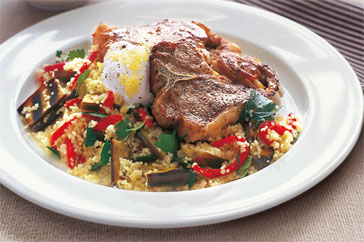
For the vegetables

  • One large eggplant cut crosswise into slices 1 cm thick.
  • 75 mls olive oil
  • 2 large red capsicums halved lengthwise.
  • 2 teaspoons finely chopped fresh oregano
  • 1 fresh red chillli, seeded and chopped  (or use chilli powder)
  • salt and pepper – grounded – to taste.

For the Lamb and sauce

  • Splosh or two of virgin olive oil
  • Cut lamb rump from the leg into four or so thick slices looking like backstraps
  • ground salt and pepper
  • 80mls of dry red wine
  • 4 – 8 teaspoons of cranberry jelly
  • half cup of chicken stock.

To cook vegs – brush eggplant with little oil and grill both sides.  Cool and cut into long strips.  Do the same with capsicums but remove skin and then cut into long strips.

In a heavy frying pan heat a little oil and add vegies and herbs and chilli and stir until well mixed and almost falling apart, then season to taste and  keep warm on a separate plate.  Add a little more oil and sear the lamb, season and cook to your liking for a few minutes.  Remove to a plate and keep warm.  (Handy if your oven has a warming tray.)

With the remaining juices in the pan, heat and stir and get all bits nicely mixed and add wine and jelly, stirring until melted, then add stock and reduce till saucy consistency.  Taste and adjust seasoning.  I often add more jelly.

To serve, cut lamb at an angle and arrange on serving plate.  Add vegies and sauce and serve at once.

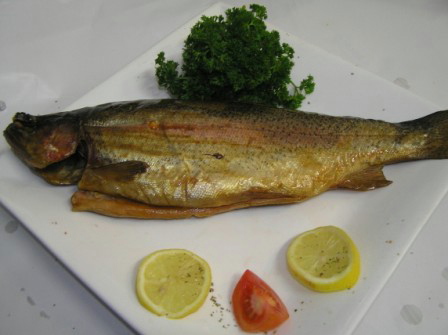
SMOKED TROUT SERVED WITH PICKLED WATERMELON RIND
To Make the ‘Pickled’ Watermelon Rind

You need watermelon with a thick white rind.  Slice off the green skin and make sure that no red melon is left on the rind.  Slice it up into pieces about 1cm by 3cm.  Simmer the pieces in pot of water until just a little soft.  Drain.  Prepare a ‘pickling syrup’ of a little white vinegar (a good dash), cup of hot water, about 3 teaspoons of sugar, 6 slivers of lemon skin and about 4 cloves.

This is cheap to make as you get to eat the watermelon and have a byproduct.  I store in a large well cleaned empty vegemite jar.  One cup of syrup will do about two jars worth.  Put syrup in jar and add the pieces of rind.   Okay to eat the next day but better after a few days.   The rind should taste a bit sweet.

I first had this with smoked trout 30 years ago at a wine and food group’s outing beside a river up the mountains.   It was totally glorious.

The Smoked Trout

First catch your trout ……  ha ha.   Seriously though – where I live you can catch and smoke your own and right now the fishing in Lake Hume and the rivers is so good.  But, better still is the fact we have the best smoked trout available at Butts Smokehouse – you can buy it whole or skinned and filleted.  Arrange trout on a platter with little bowls of the watermelon rind and those little crunchy bread squares or water biscuits.    This is a great starter to a casual lunch party picnic and goes so well with a crisp white wine.

In the Kitchen with Vivienne – Seafood – Part 1

15 Wednesday Sep 2010

Posted by Therese Trouserzoff in The Dining Room, Vivienne

≈ 23 Comments

Tags

prawn oyster, Recipes, seafood

Recipes by  Vivienne

OYSTERS  – indulge yourself every now and then

Right now oysters are in fine form as they are best during the colder months.  Oysters are low fat, low cholesterol and full of vitamins and minerals.  Treat yourself to a dozen every week or so but have them at home, not eating out!

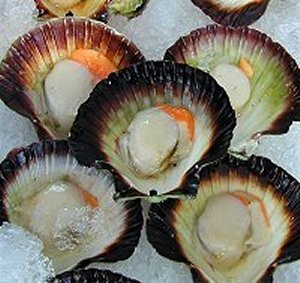
SCALLOPS

Also in season now and the Aussie ones are well worth spending $28 for a kilo.  Always trim the little tiny muscle bit off and sit on absorbant paper to soak up moisture.  They can be eaten many ways and require very little cooking time.   One of my favourites is crumbed scallops.

Place two or so tablespoons of plain or wholemeal flour in a plastic bag.  Add a little salt and pepper and a pinch of cayenne pepper.  Shake to coat.  Beat an egg or two very well and drench.  Then coat in regular breadcrumbs.  For gluten free you can buy corn crumbs which are just fine.   Heat peanut oil in a deep saucepan (safer if there is any spitting which is usually completely unforeseen).  Pop in about 8 or 10 at a time, turn once – they should look light to medium golden – only takes a minute.   Serve with tartare sauce and your favourite salad.   A kilo will feed four.  (While you are cooking the 2nd, 3rd batches etc keep the cooked ones in your warming tray or pre-heated low oven.)

BURMESE STYLE PRAWN CURRY

From Charmaine Solomon’s book 1972  (slightly altered by me though as I think blachan smells bloody awful).

To serve two:

  • 16 large raw (Australian) prawns  – sauce will do up to 20 prawns if you want more.
  • 1 tbspn  ghee
  • 1 medium to large onion – finely chopped
  • 3 cloves of garlic – very finely chopped
  • 1 inch piece of fresh giner – very finely chopped
  • 1 teaspoon ground tumeric
  • 1 teaspoon ground chilli
  • 1 teaspoon paprika
  • 1 teaspoon ground coriander
  • 2 tomatoes – chopped
  • 1 and half teaspoons salt
  • Water

Heat ghee in good size saucepan.  Add onion, garlic and ginger and gently cook till just starting to turn pale gold.   Add spices and tomatoes and salt and stir well.  Cook on low heat, add about half a cup of water.  Allow the sauce to bloop bloop for at least half an hour.  When you first taste it will seem rather hot but it mellows as it bloops (put lid on).  You can do this earlier and turn off till you want dinner.  (You might want to add a bit more water later – you should be able to judge this.)

Prepare prawns by peeling and deveining and slit the back so the prawns will curl when cooked.

Gently reheat sauce and add the add the prawns to it.  Cook very very slowly for about half an hour. During this time cook basmati rice.  The prawns will have curled and taken on a lot of the colour and flavour of the sauce.

Serve with rice in a circle on plate and add prawns and sauce to centre.    Eat.

For serving with gluten free pasta instead of rice?  Well I think it will work okay.

PORK & PRAWN WONTONS

Mince up pork and raw prawn meat, mix with finely chopped onion, 4 chopped water chestnuts, 3 chopped spring onions and some cornflour, salt, pepper, tiny dash of sesame oil and a dash of soy.   Quantities depend on how many people you are feeding, but a ratio for 2 people would be about 200 grams of pork and 6 large raw prawns.

Mix till more like a paste.

Place a walnut size amount on each wonton wrapper and fold appropriately (triangle or parcel)..

Cook in boiling water for a few minutes, remove and serve in flavoursome homemade chicken broth or have solo with perhaps a dipping sauce.  Top the broth with shredded skinny egg omelette, chopped garlic chives or blanched snow peas.

ADVICE for seafood lovers

If the above seems a bit too daunting …… just go out and buy some oysters and cooked prawns and get stuck into them.

All dishes should be served with a cold Trotters ale or a chilled bottle of white wine of your choice.

Patrons Posts

  • The Question-Crafting Compass November 15, 2025
  • The Dreaming Machine November 10, 2025
  • Reflections on Intelligence — Human and Artificial October 26, 2025
  • Ikigai III May 17, 2025
  • Ikugai May 9, 2025
  • Coalition to Rebate All the Daylight Saved April 1, 2025
  • Out of the Mouths of Superheroes March 15, 2025
  • Post COVID Cooking February 7, 2025
  • What’s Goin’ On ? January 21, 2025

We've been hit...

  • 713,786 times

Blogroll

  • atomou the Greek philosopher and the ancient Greek stage
  • Crikey
  • Gerard & Helvi Oosterman
  • Hello World Walk along with Me
  • Hungs World
  • Lehan Winifred Ramsay
  • Neville Cole
  • Politics 101
  • Sandshoe
  • the political sword

We've been hit...

  • 713,786 times

Patrons Posts

  • The Question-Crafting Compass November 15, 2025
  • The Dreaming Machine November 10, 2025
  • Reflections on Intelligence — Human and Artificial October 26, 2025
  • Ikigai III May 17, 2025
  • Ikugai May 9, 2025
  • Coalition to Rebate All the Daylight Saved April 1, 2025
  • Out of the Mouths of Superheroes March 15, 2025
  • Post COVID Cooking February 7, 2025
  • What’s Goin’ On ? January 21, 2025

Enter your email address to subscribe to this blog and receive notifications of new posts by email.

Join 373 other subscribers

Rooms athe Pigs Arms

The Old Stuff

  • RSS - Posts
  • RSS - Comments

Enter your email address to subscribe to this blog and receive notifications of new posts by email.

Join 373 other subscribers

Archives

Website Powered by WordPress.com.

  • Subscribe Subscribed
    • Window Dresser's Arms, Pig & Whistle
    • Join 279 other subscribers
    • Already have a WordPress.com account? Log in now.
    • Window Dresser's Arms, Pig & Whistle
    • Subscribe Subscribed
    • Sign up
    • Log in
    • Report this content
    • View site in Reader
    • Manage subscriptions
    • Collapse this bar
 

Loading Comments...