• The Pig’s Arms
  • About
  • The Dump

Window Dresser's Arms, Pig & Whistle

~ The Home Pub of the Famous Pink Drinks and Trotter's Ale

Window Dresser's Arms, Pig & Whistle

Tag Archives: solar power

Open Letter to Elon Musk

12 Tuesday Oct 2021

Posted by Therese Trouserzoff in Emmjay

≈ 3 Comments

Tags

Elon Musk, Lebanon Blackout, Philanthropy, solar power

https://www.cnbc.com/2021/10/11/lebanon-suffers-24-hour-blackout-food-poisoning-business-closures-amid-fuel-crisis.html

G’day, Elon. Emmjay here.

Today CNBC reported that there was a 24 hour blackout in Lebanon.

That’s catastrophic for a bankrupt nation with severe food shortages and as the CNBC report says, this caused food spoilage and food poisoning and God herself knows how anyone can operate a Covid hospital under those conditions.

So I thought I’d check up and see how you’re going cash wise, because, let’s face it, nobody wants to embarrass themselves by putting the bite on a pauper.

Boy was I relieved to see that you have $2 billion dollars. No wait, that was $202 billion. So I guess you’re probably not wandering around with the backside out of your pants and holes in your socks.

And then I remembered that the good people of Lebanon are out of cash and out of electricity. However, being in the Middle East, I’m guessing that they do have a fair bit of sunlight.

And I remembered that your company is in the business of generating electricity from sunlight and storing it in huge batteries.

Now you’re a famously smart guy and I’m betting that you can see where I’m going with this.

So what about you join the dots and show some magnificent global philanthropy. Nobody’s going to call you a mug for stepping in.

And I’ll be happy to put in a good word for you with the Nobel people. If they have’t got a category for single-handedly saving a failed national state, I’ll ask them to make one.

After all, you saved South Australia as a warm up for the major league.

Your friend,
Emmjay

Power By the People

17 Sunday May 2015

Posted by Therese Trouserzoff in Politics in the Pig's Arms

≈ 9 Comments

Tags

economy of a domestic solar system in Sydney, Elon Musk, lithium storage, PowerWall, solar power, Tesla

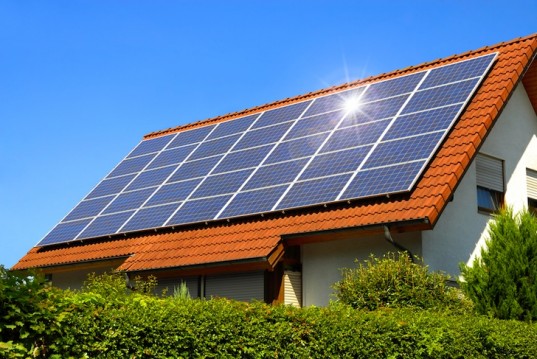
SolarPanels_600x399

Simulation only – this house has a LOT of panels for a domestic dwelling !

A Powerful Story by Emmjay

So we’ve had our solar power installation for about six months now – in Sydney, on a  fairly flat second storey roof with no shading – until late afternoon.  It’s a 5 KW rated system with 20 panels, but it’s got to be a super sunny day to get much over 4 KW… AND if its a stinking hot day, the panels become less efficient and so there are limits in how much juice we can expect even on a good day.

Wet and rainy ?  Lucky to be making 1 KW.  That’s not completely tragic, but it’s not a massive win.

I’ve seen the power production fluctuate significantly with even a single cloud passing – dropping the power from 3.5KW down to 1.5KW.  But the rises and falls happen pretty quickly.

How do the economics look ?  Twenty panels is a fairly meaty system for a domestic dwelling – many houses you will see in the inner west of Sydney have seven panels ~ making about 1.5KW. This isn’t going to roll back climate change, but provides a good feeling, if not much actual juice.

The cost for FM and I off the bat was just under ten grand.  But there was a rebate that brought the cost down to about $6,500 – that went straight onto the mortgage.  For most Sydney mortgages, an increase of this size results in an almost undetectable increase in the monthly payout.

Here’s a table that tells our solar story.
Power

When we’re out, and the house is using very little power, on a bright sunny day, we sell power back into the grid (no cash, just a reduction in our bills).  We make about 20c per hour.  So no Ferrari coming before I die, but over the summer quarter we reduced our power bill by about 40% – and remember this was a pretty wet, rainy time – not a great solar opportunity.  Power we put back into the grid reduced the bill by about 10% – so the rest of the savings came from displacing purchased power.  If we can maintain these savings the system will pay for itself in three years or less.  Maybe two years if the coming El Nino is a bad one.

You can guess that the best strategy is to try to balance our consumption with either our production and shift usage into the lower cost shoulder – or best – off-peak if we can.   If we’re making say 3 KW /hr , that covers a many of our appliances, but it would be foolish to imagine that it would be OK to run the dishwasher, washing machine and drier all at once. Pick one – and there’s a good chance we will not need to buy power.  Note, we have gas hot water – if you have electric hot water, the whole game changes.

Of course the elephant in the room is that the peak rate is still in force when we get home from work and the solar system has put on its jamies and gone to bed.  Solution – battery storage !

Not, not yet, friends.  Had we gone to a system with lead acetate batteries, the whole show would have cost around $30,000.  Not ever going to be economical.

But there is a glimmer of hope. Last week Elon Musk – the billionaire boss of Tesla (those wonderful fully electric cars that can get down the standing quarter as fast as a Ferrari – and when driven reasonably can go for up to 400km on a charge.  They aren’t cheap $90-110,ooo AND the charge takes hours – and costs about $25 at home – but they ARE beautifully engineered and look the part.  Sorry, where was I – oh yes batteries – and Tesla. Tesla is building a massive fully self-powered lithium battery plant – and they will start selling the domestic Tesla PowerWall later this year.

These are brilliant !  Most families will need one or two domestic models – there are also industrial models.  There is a lot of speculation about actual pricing in Australia, but the suggestion that seems to be sticking is that the lithium storage will cost about one third of the cost of lead acetate batteries.  And be smaller, easier to maintain and a lot more environmentally friendly.

And this will give consumers the choice of whether they go off-grid (maybe not on day one, I suggest) – or whether they use the PowerWall to store solar power for use when it’s dark – or even to charge itself up at off-peak rates.

The nay sayers (heaven forbid to suggest they are apologists for big coal) are going ballistic about the thought that this will cause a massive hit on the coal-fired generators – who have engineered their businesses for peak loads that (if the domestic and commercial storage economics work out) will leave the generators high and dry with a disappearing peak rate market.  They are bagging Tesla out because they say that Tesla is not yet profitable – but one suspects that Elon Musk does have pretty deep pockets – and big ideas that will continue to be game changers.

I have this sincere hope that the days of big coal – even peak coal – are coming to an end-  an end that is in sight – hoping again that it’s in time to slow climate change.  And of course, I hope the declining power bills will keep on keeping on.

Enjoy this article for free – no charge.

Power to the People

07 Monday Jul 2014

Posted by Therese Trouserzoff in Uncategorized

≈ 15 Comments

Tags

Father O'Way, Organsm Energy, solar power, unfair electricity rates

rooftop-solar-array-537x359

Story by Emmjay

“Fucking bastards !” said Merv, peering at his electricity bill.

“My son !” said Father O’Way.

“No, MY effing sun, Father” said Merv.

“Pardon ?” said FOW.

“It’s the pub electricity bill, Father” said Merv, handing over the offending epistle.

“Mother of all power bills !” said the good father.

“Telling me”, said Merv.

“Look at this, Father” said Merv, pointing to two little pieces of malfeasance on the part of Orgasm Energy.

“First”, continued Merv, “The bastards jack up the hourly rates EXCEPT for the middle of the night when everyone’s asleep cuddling up to the missus and generating their own electricity”

“Well, for SOME”, said FOW.

“Sorry, Father, I forgot” said Merv. “And check this out… you know how we put in solar power on the roof of the new ballroom and bowling alley….. well the mongrel bastards cut the rate they pay us for generating more power than we need in the peak period”.

“Seems unfair” said the good father.

“UNFAIR !” Merv was wound up and under full power himself now. “Check this out, Father. “Peak rate they charge me when Granny fires up the wedge frier – is 45 cents per kilowhatsit. The only rate they pay me is 4.7 cents per kilowhatsit – and the bastards reduced that from a whopping 5.1 cents, said Merv.

“Fuck them. Pardon me, Father”, said Merv.

Father O’Way took out his rosemary beads, looked into the middle distance and had a silent word with his boss. More accurately, his boss’ boss.

“Father ?” said Merv, pouring the shepherd of St Generic Brands another Trotter’s Ale.

There was a huge distant rumble. The lights flickered and the pub emergency generator sprung into life, keeping the vital supplies of Trotter’s Ale in an appropriately chilly state.

“Phew,” said Father O’Way. “For a minute there I didn’t think you had a prayer”.

Alternative Energy Sources: With Will There’s A Way

23 Wednesday Feb 2011

Posted by Therese Trouserzoff in Warrigal Mirriyuula

≈ 9 Comments

Tags

alternative energy sources, solar power, wind power

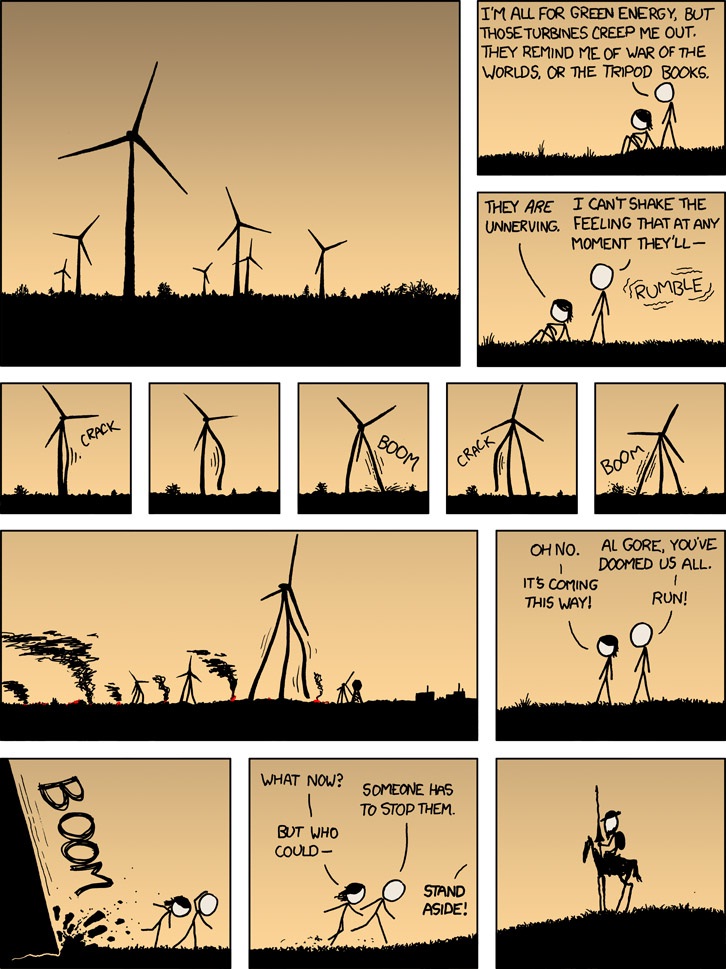
© XKCD (I borrowed this cartoon from: http://xkcd.com/556/)

Story Edited by Warrigal

It’s been a matter of some perplexity to me that governments and industry the world over have failed to pick the low hanging alternative energy fruit. While solar rebates and subsidies for domestic solar cell installation have enjoyed mixed success here in Australia and similar schemes operate globally, there seems to be a general blindness to the full potential of these existing technologies.

So if I said that a recent paper from no less august an institution than Stanford sets out a clear path to an alternative green energy future that would save perhaps as many as 3 million lives a year and simultaneously halt global warming, reduce air and water pollution and develop secure, reliable energy sources; nearly all with existing technology, and at costs comparable with what we spend on energy today you’d have to be pretty interested wouldn’t you. Further we can achieve all that according to this study by converting the world to sustainable and renewable energy sources and completely obviate the need for burning fossil fuels.

The new study co-authored by Stanford researcher Mark Z. Jacobson and Mark A. Delucchi sets out a scheme for achieving exactly that.

“Based on our findings, there are no technological or economic barriers to converting the entire world to clean, renewable energy sources,” said Jacobson, a professor of civil and environmental engineering. “It is a question of whether we have the societal and political will.”

Jacobson and Delucchi, of the University of California-Davis, have written a two-part paper in the publication Energy Policy, in which they assess the costs, technology and material requirements of converting the planet, using the plan they developed.

The world they envision would run largely on electricity. Their plan calls for using wind, water and solar energy to generate power, with wind and solar power contributing 90 percent of the needed energy.

Geothermal and hydroelectric sources would each contribute about 4 percent in their plan (70 percent of the hydroelectric is already in place), with the remaining 2 percent from wave and tidal power.

Vehicles, ships and trains would be powered by electricity and hydrogen fuel cells. Aircraft would run on liquid hydrogen. Homes would be cooled and warmed with electric heaters — no more natural gas or coal — and water would be preheated by the sun.

Commercial processes would be powered by electricity and hydrogen. In all cases, the hydrogen would be produced from electricity. Thus, wind, water and sun would power the world.

The researchers approached the conversion with the goal that by 2030, all new energy generation would come from wind, water and solar, and by 2050, all pre-existing energy production would be converted as well.

“We wanted to quantify what is necessary in order to replace all the current energy infrastructure — for all purposes — with a really clean and sustainable energy infrastructure within 20 to 40 years,” said Jacobson.

One of the benefits of the plan is that it results in a 30 percent reduction in world energy demand since it involves converting combustion processes to electrical or hydrogen fuel cell processes. Electricity is much more efficient than combustion.

That reduction in the amount of power needed, along with the millions of lives saved by the reduction in air pollution from elimination of fossil fuels, would help keep the costs of the conversion down.

“When you actually account for all the costs to society — including medical costs — of the current fuel structure, the costs of our plan are relatively similar to what we have today,” Jacobson said.

One of the biggest hurdles with wind and solar energy is that both can be highly variable, which has raised doubts about whether either source is reliable enough to provide “base load” energy, the minimum amount of energy that must be available to customers at any given hour of the day.

Jacobson said that the variability can be overcome.

“The most important thing is to combine renewable energy sources into a bundle,” he said. “If you combine them as one commodity and use hydroelectric to fill in gaps, it is a lot easier to match demand.”

Wind and solar are complementary, Jacobson said, as wind often peaks at night and sunlight peaks during the day. Using hydroelectric power to fill in the gaps, as it does in our current infrastructure, allows demand to be precisely met by supply in most cases. Other renewable sources such as geothermal and tidal power can also be used to supplement the power from wind and solar sources.

“One of the most promising methods of insuring that supply matches demand is using long-distance transmission to connect widely dispersed sites,” said Delucchi. Even if conditions are poor for wind or solar energy generation in one area on a given day, a few hundred miles away the winds could be blowing steadily and the sun shining.

“With a system that is 100 percent wind, water and solar, you can’t use normal methods for matching supply and demand. You have to have what people call a supergrid, with long-distance transmission and really good management,” he said.

Another method of meeting demand could entail building a bigger renewable-energy infrastructure to match peak hourly demand and use the off-hours excess electricity to produce hydrogen for the industrial and transportation sectors.

Using pricing to control peak demands, a tool that is used today, would also help.

Jacobson and Delucchi assessed whether their plan might run into problems with the amounts of material needed to build all the turbines, solar collectors and other devices.

They found that even materials such as platinum and the rare earth metals, the most obvious potential supply bottlenecks, are available in sufficient amounts. And recycling could effectively extend the supply.

“For solar cells there are different materials, but there are so many choices that if one becomes short, you can switch,” Jacobson said. “Major materials for wind energy are concrete and steel and there is no shortage of those.”

Jacobson and Delucchi calculated the number of wind turbines needed to implement their plan, as well as the number of solar plants, rooftop photovoltaic cells, geothermal, hydroelectric, tidal and wave-energy installations.

They found that to power 100 percent of the world for all purposes from wind, water and solar resources, the footprint needed is about 0.4 percent of the world’s land (mostly solar footprint) and the spacing between installations is another 0.6 percent of the world’s land (mostly wind-turbine spacing), Jacobson said.

One of the criticisms of wind power is that wind farms require large amounts of land, due to the spacing required between the windmills to prevent interference of turbulence from one turbine on another.

“Most of the land between wind turbines is available for other uses, such as pasture or farming,” Jacobson said. “The actual footprint required by wind turbines to power half the world’s energy is less than the area of Manhattan.” If half the wind farms were located offshore, a single Manhattan would suffice.

Jacobson said that about 1 percent of the wind turbines required are already in place, and a lesser percentage for solar power.

“This really involves a large scale transformation,” he said. “It would require an effort comparable to the Apollo moon project or constructing the interstate highway system.”

“But it is possible, without even having to go to new technologies,” Jacobson said. “We really need to just decide collectively that this is the direction we want to head as a society.”


Jacobson is the director of Stanford’s Atmosphere/Energy Program and a senior fellow at Stanford’s Woods Institute for the Environment and the Precourt Institute for Energy.

Story Source:

The above story is reprinted (with editorial adaptations) from ScienceDaily.

Source materials provided by Stanford University. The original article was written by Louis Bergeron.

Journal References:

1. Mark Z. Jacobson, Mark A. Delucchi. Providing all global energy with wind, water, and solar power, Part I: Technologies, energy resources, quantities and areas of infrastructure, and materials. Energy Policy, 2010; DOI: 10.1016/j.enpol.2010.11.040

2. Mark A. Delucchi, Mark Z. Jacobson. Providing all global energy with wind, water, and solar power, Part II: Reliability, system and transmission costs, and policies. Energy Policy, 2010; DOI: 10.1016/j.enpol.2010.11.045


 

Patrons Posts

  • The Question-Crafting Compass November 15, 2025
  • The Dreaming Machine November 10, 2025
  • Reflections on Intelligence — Human and Artificial October 26, 2025
  • Ikigai III May 17, 2025
  • Ikugai May 9, 2025
  • Coalition to Rebate All the Daylight Saved April 1, 2025
  • Out of the Mouths of Superheroes March 15, 2025
  • Post COVID Cooking February 7, 2025
  • What’s Goin’ On ? January 21, 2025

We've been hit...

  • 713,792 times

Blogroll

  • atomou the Greek philosopher and the ancient Greek stage
  • Crikey
  • Gerard & Helvi Oosterman
  • Hello World Walk along with Me
  • Hungs World
  • Lehan Winifred Ramsay
  • Neville Cole
  • Politics 101
  • Sandshoe
  • the political sword

We've been hit...

  • 713,792 times

Patrons Posts

  • The Question-Crafting Compass November 15, 2025
  • The Dreaming Machine November 10, 2025
  • Reflections on Intelligence — Human and Artificial October 26, 2025
  • Ikigai III May 17, 2025
  • Ikugai May 9, 2025
  • Coalition to Rebate All the Daylight Saved April 1, 2025
  • Out of the Mouths of Superheroes March 15, 2025
  • Post COVID Cooking February 7, 2025
  • What’s Goin’ On ? January 21, 2025

Enter your email address to subscribe to this blog and receive notifications of new posts by email.

Join 373 other subscribers

Rooms athe Pigs Arms

The Old Stuff

  • RSS - Posts
  • RSS - Comments

Enter your email address to subscribe to this blog and receive notifications of new posts by email.

Join 373 other subscribers

Archives

Website Powered by WordPress.com.

  • Subscribe Subscribed
    • Window Dresser's Arms, Pig & Whistle
    • Join 279 other subscribers
    • Already have a WordPress.com account? Log in now.
    • Window Dresser's Arms, Pig & Whistle
    • Subscribe Subscribed
    • Sign up
    • Log in
    • Report this content
    • View site in Reader
    • Manage subscriptions
    • Collapse this bar
 

Loading Comments...