Applause
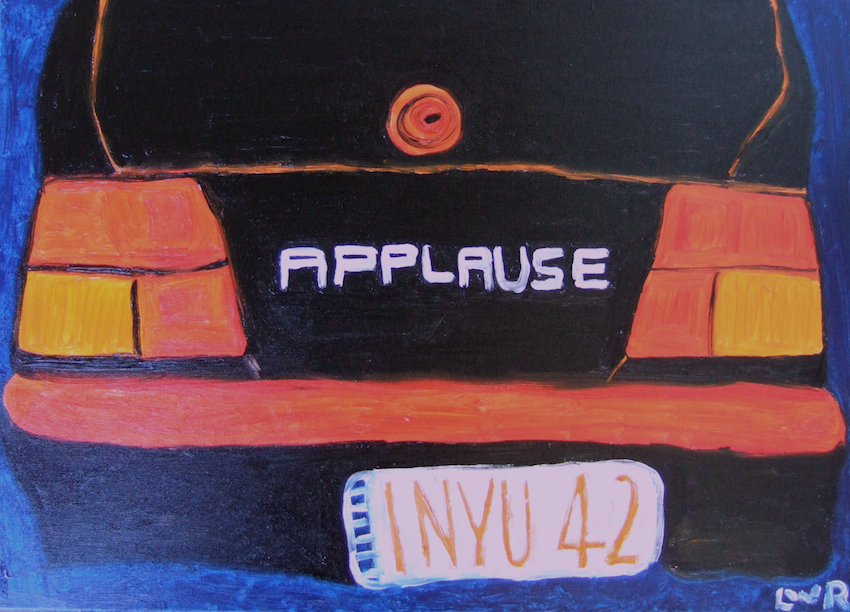
Story and Painting by Lehan Winifred Ramsay
I’ve seen it before, the early days of a system, when you can see the bare bones, the empty spaces, the potential. A horde of systematic thinkers move in and make order, covering the bare bones with regulations and Best Practice. Even for the people who have seen those bare bones it is difficult to remember where they were and how lovely it was to see them. Our Web has become systematized.
For a while there websites were a little mysterious. Difficult to know how to get the information from them. Difficult to know where to click. Unexpected things would happen. But then, people worked out that people just wanted information; they wanted to know how to most easily navigate the site. Designers backed out of their play and sat down to figure out the most user-friendly paths and formats. Sadly, though, that sensible rule-making phase does not end. People want to know how to make things pay. They work out ways to lead people through the information. People, who by this time have become other things like browsers, viewers, clicks, once educated in how things should be, can no longer see possibilities for how things could be.
I started using the internet about 1996. I used to make art on it. Not put art on it, make art on it. We played with HTML and fiddled with animation. Once things got past the initial black and white, there were no rules for how things should go. I should have known that we would quickly hit satiation of play-time and the rules would set in. Rules for how things should be placed, how things should be read. Rules that dictated what was good design and what was bad.
People worked out how to make things move, using code. Figured out how to put in layers. Perhaps that was the first interesting feature of this medium, that made it different from television, books. There was some very lovely work done. And, of course, people quickly came up with software and we all became animators. Very new kinds of design, quirky and energetic, using the limitations of the medium. The frame of a computer screen, the point of a mouse, the virtual space. With animation came movement. With increases in speed and power came more virtual space.
With more space came photographs, images. Home-made video. Which necessitated more space, and another industry sprang up to find ways to provide it. And another to find ways to use it. Digital cameras, digital video cameras. Design had been focused on text and hyperlinks to connect to other pages. But it moved back somewhat to let in embedded images. A sudden shift back to the media of newspapers and magazines. There is no doubt that the internet has affected the design of newspapers and magazines in positive ways. But I’m not at all sure that the effect of newspapers and magazines connecting to their online components has positively affected the design on the internet.
It’s easy to bemoan the passing of a beginning, it happens all the time. We don’t notice it much once it’s gone. I can’t help but feel, though, that we had great potential to develop new ways of thinking, by developing new ways of reading – and we gave that up for an easier read. I can’t help but feel that rather than giving different things a voice, the internet has caused different things to sound and look more and more like everything else.
You make a template, a format, a style. It makes it easy to keep order, to be a recognizable brand. Like The Drum. But every page starts to look alike. There is no recognizable difference between a story on children and a story on genetically modified wheat, except for the photograph. Which makes the photograph more important than the design in giving information. The design is now about not giving information regarding its contents. The design has now become a background feature, the design has lost its importance and its value. The design now has the same function as the design of a newspaper – simply to hold things together and keep the order the same, so that we can find things easily.
Perhaps its good to have The Drum as a recognizable Brand. But I’m curious about Brands, and the way they have become such an important feature of our information life. It seems to me that at some point in the development of the internet as an information source, that we had the chance to make it a deeply exploratory and meditative source. And instead, we took the other road, and made it a source of quick bites of information. Of which the Brand is the ultimate example. Perhaps, though, the Brand was helped along by that short time (short in the life of information) that we didn’t have space for more than a simple graphic on our web pages. It could be that the evolutionary process of the medium was its own downfall.
I am writing this because I don’t think I’m the only person who misses something that was here and then gone, the great exciting frontier of the World Wide Web. I cannot complain about the web, it has probably helped me more than any other connective device in my life. What it is now is an absolute playground of possibilities. Anything you want to do, it seems, is here or on its way. But what I do miss is the potential for more difference. That seemed to disappear into more of the same and more just like that. I wish that more people would take the time to see the rules and disregard them. But I guess it might simply be too late for that.
There is a time to be new, that time ends and something else gets to be new. In becoming a medium heavy in photographs and videos, the internet is losing the opportunity to be something else. But of course it goes the way of all commerce; the more functions the more money can be charged. That’s probably the simplest answer to why it went that way and not this. I hope that people are able to subvert it, remembering how it was before it became the luxurious RV it is now. I hope that there is still room for piracy.


Resnick: …simplified worlds,
specially designed to highlight
(and make accessible)
particular concepts
and particular ways of thinking.
LikeLike
Hmmm, a quote out of context for Resnick I daresay.
Why limit yourself to the Internet? How about when you open a book entitled Ignorance on the front cover, you should instead find the story of Alice in Wonderland? Then when you go from physical page 3 to physical page 4 you find yourself reading logical page 58? Better still, you go to open the book and find it’s a solid block of wood painted to LOOK like a book? Then you open a box of chocolates and find it’s the cover of War and Peace?
The ways of stuffing around a reader are perhaps fewer than the ways of stuffing around a web user, but I’m sure you could think of a lot more ways to make access to information in books less simple if you really put your mind to it.
LikeLike
I liked the kind where you open what looks like a book and find a half-bottle of scotch!
😉
LikeLike
There you go! It’s not too late for books to be reformed into something imaginative and playful. Still, I think it would be a downer for someone expecting to find the actual book contents. Enough to drive them to drink.
LikeLike
In that case, they’d probably be quite happy with the discovery Voice!
😉
LikeLike
It was too late for me with reading books; they were around long before I was. The internet though, that’s something I saw in its bare bones. But when I talk about the internet I am also thinking about another experience I had; a university in its bare bones, that managed to build itself a modest yet imposing set of clothing within five years. And I thought it was a shame. Surely we could have had those bare bones for a little longer? Surely we could have been PLAYFUL for a little longer?
I think Mr Resnick would be happy if his words inspired thoughts, even those he hadn’t brought into the conversation. It’s a bit difficult to ask him if he minds, though.
LikeLike
I’ve sometimes thought it would be nice to go back to the time when astronomy was something you could do by observing the stars, biology was something you could do by collecting and categorising plants in your local neighbourhood. As areas advance there’s the burden of all that accumulated knowledge that you have to be aware of and competent in to some extent before you can dabble productively. You can always dabble for your own amusement though. Sometimes I get out my little star map and search out the constellations.
LikeLike
Think of mathematicians for crying out loud The yet unproven theorems must be damn difficult! Of course they’re always making new ones I suppose. Then there’s that guy whose name I’ve forgotten, who couldn’t remember the proof to an important theorem during a University examination so he invented his own on the spot. Blasted geniuses!
LikeLike
Yes, people who are unashamedly proud of being self-educated and possessing a knowledge of many things all tied up with bits of string and incomprehensible labels.
LikeLike
I find the design of things we use to be quite often short of perfect. The chair castor that should have had slightly wider wheels, the scissors that could have been comfortable but for the lack of a bit of plastic, the BBQ that’s designed to last for three years, and no longer.
There are some exceptions. My youngest son has been involved in house design, with a company who’s philosophy is simple: Smaller is easier to heat and cool, and insulation and thermal mass are best installed from the beginning, not as an afterthought.
This reminds me that I’ve been at my youngest for ages to write a story for the Pigs Arms…
LikeLike
….. Or we can write a story about a man who is hassling a man to hassle his son to write a story…..
LikeLike
Good idea, Big M, keep hassling him..
Funnily enough, I was going to ask you to do a story on that on that little house.
Do it together 🙂
LikeLike
Yes, I might have to start it, flesh it out, add some photos, edit it….that will be my contribution!
LikeLike
This is one way that this is important. We seem now to think that it’s not possible for us to do innovative things on the web – now there are companies who invest millions of billions on small simple things. But I think that’s not correct. We need to go back in our thinking, remember how it was. Some of the good stuff I expected to see continue disappeared very quickly and wasn’t replaced. Is it possible to make good stuff again?
LikeLike
It’s a classic industrial design issue. Aesthetics has free reign within the constraints imposed by functionality requirements and cost. Comparable with clothing in that respect.
Sometimes someone makes a functionality breakthrough i.e. a different way of using it that provides the same or better functionality.
Standardisation within a particular organisation is essentially a cost and convenience issue.
LikeLike
I disagree with Voice that this is (only) an industrial design issue, with astyages that it’s the “the modern ubiquity of modern American culture and the rest of the world’s desire to pander to it…”. I think that few people, organisations can really cope with ambiguity, and there is quickly a rush to put a label and a manual to things. That’s understandable; the important point (for me) is that that rush to label and describe actively blocks the development of possibility, alternative. Those possibilities and alternatives can be HUGE – in my opinion there should be a “science” devoted to the exploration of them. They are a valuable resource. And no better place for them to have played out than in this invention – the Internet, the WWW or whatever label it has – that we were all dabbling in.
LikeLike
And it’s ironic, I think. I feel that a lot of the user-design of websites is affected by the news sources. Though that could be because I read so many of them – for other people it might not be true.
News sources are adapting a new medium from over the road at a paper-and-text based tradition. That’s probably why embedded image and video are becoming so big. For a while, letters and words had their own freedom, they’ve lost it now, gone back to their old relationships with photo, added photo-with-wheels.
LikeLike
Well, there’s no reason why the issue can’t be different for you.
But when companies have design guidelines for their internal websites, primary considerations are cost (not paying to continually redesign and re-implement the wheel nor to re-learn how to use the latest one) and convenience (usability of the actual design and learning curve considerations for inconsistencies). Branding would be the other primary consideration; presenting an image consistent with and recognisable as that of the company. Aesthetics rate there somewhere too.
You know, there IS an awful lot of research about user interfaces.
LikeLike
Yes, I did some myself. I made art projects. I put in a diary for six months (part of a novel). In the diary, half-way through, I put in a double link instead of one. Depending on where you clicked, the character continued her life in Japan or returned to Australia and continued her life there. The story ran for six month online, then I put it up at a festival of new media, at the Queensland Art Gallery and online. Nobody ever mentioned it. I don’t think anyone ever followed it deeply enough to care.
What I discovered when I did stuff online was that people looked at things in a very shallow way, and they got annoyed and left the site if things weren’t immediately clear, even if they were happy they spent very little time and didn’t really look around. So I do understand why the design is so shallow now. I also think that quickly growing ability to store and use a lot of photos and videos cut out a whole different development of typeface.
LikeLike
Are you equating easy to use with shallow? If so, why? I would say that easy to use allows the user to focus on content. If they don’t want to deal with difficult content, that’s one thing. Possibly they are shallow. Possibly they don’t feel the content is worth the effort. But if they don’t want to deal with difficult access to content, that’s a different matter.
The problem of difficult access on computers is compounded by people’s fear of looking or being stupid, that computers tend to bring to the fore. But these days most people have enough experience of good access to know poor access when they see it, rather than seeing it as a challenge to their problem solving capabilities. Kind of like driving a new car somewhere you’ve never been before. You don’t want to see creative street signs and road markings, and you don’t want to put your foot on what you thought was the clutch and have the window wipers go on.
Enthusiasts design their own typeface all the time. Plenty of free software available for download to make it easy.
LikeLike
P.S. That is a good common sense implementation of a double link.
LikeLike
There was a time when you would get to a page and you would KNOW that it was going to be interesting (possibly because it was linked from somewhere else) but you REALLY didn’t know how it was going to work. Particularly interesting was the introduction of time. You didn’t know if it was going to go up or down or left or right, you didn’t know if you would just be thrown off the page for getting it wrong. Those kinds of tricks got incorporated into games. But they pretty much left the web. I liked them when they were playing with information. And I liked the way information became something volatile.
Concerning your question about shallow – yes, I think that the medium is shallow. I do think that people will read more from a piece of paper than they will from an internet page. I do that myself. I will read a newspaper from cover to cover but online I stick to first page news unless I’m actually bored. If I can’t see it, it’s not there. That’s the kind of shallowness of a screen.
i do think that we can still see the “bones” of the internet if we pay it a bit of attention. That’s why I wrote this piece. I was hoping there would be other people who would welcome the chance to notice what the change has been.
LikeLike
Hmmm. You do seem to me to be conflating information with access to it.
Of course how to access information on a particular page IS information itself. But not the information that most people are looking for or want to spend time finding out. Unless they do. Then, as you say, they go to that kind of computer game.
But, the way you use the web doesn’t characterise it. If you use it in a shallow way, that doesn’t make it shallow. You might choose to only use the Ignorance book as a table protector for a coffee mug. This doesn’t characterise the book though.
The web lends itself to depth as it is possible to drill down into an issue in a way you cannot do in a newspaper, which has far smaller boundaries. But if you prefer not to use those capabilities, then buy newspapers. Goodness knows they need it.
P.S. You aren’t being paid to write this by the evil Rupert, are you? 🙂
LikeLike
No, I’m not paid by Rupert, though I have some sympathy for him, for no reason I can understand.
As a tool, as a medium, as a media, I think the internet has been underestimated and not given time to develop its character. But I think that it becomes harder to see that character the more regulated and defined it is.
LikeLike
It took me a while to understand just exactly what you’re getting at Lehan… but I think I have a handle on it now: The ‘same-as-everything-else-ness’ you refer is simply the modern ubiquity of modern American culture and the rest of the world’s desire to pander to it…
😉
LikeLike
When something is first made it’s anyone’s guess as to how it works. So people can be very free in the application of it. After a while of this freedom, a set of possibilities emerge for how it is most easily used. Organizations quickly turn them into rules. Is it because it gives them some power / commercial possibility / badge of expertise? The most interesting parts of it are lost. I feel that that happened to the internet. Particularly in the case of the internet a new kind of design for reading and for ordering knowledge was lost, I feel. I think that’s sad.
LikeLike
“But something’s lost and something’s gained
In living every day…”
Joni MItchell, “Clouds”
🙂
LikeLike
I don’t mean “nostalgia” sad. I mean “loss of the frontier” sad.
That’s a very different thing. You got your boots up on the shiny table, you lookin out the window, lookin’ at them trees, thinkin’ far, far away…..
Yup. I really want a cigarette.
LikeLike
Speaking of “nostalgia” sad reminds me. Did you ever get around to reading Ignorance? I hesitated to recommend it because it’s not exactly light-hearted, but it had interesting insights into things that seemed relevant at the time.
LikeLike
I wasn’t really talking about ‘nostalgia’ Lehan… and there’s always a new frontier; it just moves back as we move forward is all… and then, of course, there’s always, “Space: the Final Frontier!”
Did you know that Davy Crockett had three ears: a right ear, a left ear and a wild front ear!
🙂
LikeLike
Hi Voice,
Yes I read Ignorance. It was sent to me by Atomou *BLESS HIS HEART*. I read it when I was feeling a bit desolate, I felt a kind of desolation too in the characters who went back to their homelands. But I think I need to read it again, it’s still sitting on my table, and I will reply properly to you when I do.
LikeLike
Well, IMO there IS a lot of desolation in the characters and it’s not just a reflection of your mood at the time.
LikeLike
Lots of revisiting. Not just countries, but also relationships. To find that even having a memory of it was a kind of overemphasis.
LikeLike
“‘At Google and all these places, we make technology as brain-dead easy to use as possible.”
‘It’s like learning to use toothpaste,”
LikeLike
Ah, but toothpaste CAN be tricky Lehan… I remember as a child, several ‘bathroom wars’ that started over an incorrectly squeezed tube of toothpaste! (Back in the days, of course, when toothpaste tubes were made out of metal foil, rather than plastic, and it actually made a difference…)
😉
LikeLike
We can use baking soda for toothpaste. It’s simple to use. Now people don’t consider a different form for toothpaste. That’s our formulaic thinking. But how many really ground-breaking media do we experience the beginning of? It’s good to be aware of how many possibilities are STILL out there, that we have simply overlooked.
LikeLike
I’ve tried baking soda, Lehan, and I’ve also tried using a mixture of soot and salt when my Irish grandmother told me (as a child) that was what she used to use as a child… long before toothpaste was invented… And I’ve also tried various ‘tooth powders’… Frankly none of them do the job so well, or have such a pleasant taste as toothpaste.
True, baking soda works, but I’d only use it when I’ve run out of toothpaste and am too skint to get any more… It’s also true that it’s good to be aware of alternative possibilities… BUT, if you have something which works well and is cheap, why would you change it? It doesn’t make sense to always stick in the past, no matter how much we might like to (and you know that sentence is a rod for my own back too, don’t you?) That’s what I meant by quoting Joni; I was actually surprised that you should see it in terms of ‘nostalgia’…
What I intended with the other comment about toothpaste being ‘tricky’, is that it’s very easy to think that something is simple and obvious (like how to use toothpaste) for everyone, when in fact this is simply not the case… Maybe toothpaste SHOULD come with instructions… is it edible? Do you swallow when you’re finished brushing, or rinse? Do you use a brush, or just smear some on your index finger?
Or, in other words, I think we SHOULD be making technology ‘brain-dead easy’ to use!
Or is it that you miss esotericism? The notion of being part of an exclusive and elite group of people who have ‘mystical’ technological skills? After all, when everyone else can use technology, it no longer seems ‘special’… it becomes ordinary, everyday… humdrum; no longer ‘magic’.
😉
LikeLike
I tried roasted and salted eggplant powder toothpaste once. I think it worked.. Possibly making teeth look whiter by making everything else look blacker.
LikeLike
No I don’t miss being part of an esoteric band of techo-mystics. I miss thinking that I too might be an inventor…..
LikeLike
Well I guess that there is just a difference in perception. For those who would contemplate making a new kind of toothpaste, or for those who would understand that toothpaste is an easy-to-use modification based on baking soda, ash, salt (abrasives). Those who knew about the baking soda and ash might do something very different. If you think about all the modifications to toothpaste, though, they’re usually based on keeping it the same but making it sound like there’s something more in it.
If you then apply this to the internet, you might assume that what is happening with design is a kind of obfuscation. The actual design is now simplified, but the ability to make it and innovate it has become cloaked in mysticism.
LikeLike
I must confess I’m at a bit of a loss when you say that the design has been simplified, and also that the ability to make it has become clouded in mysticism.
It might help if you supplied a few concrete examples.
LikeLike
Regulations, rules, guidelines, “how to make the best”, templates, guides, experts tell us how to do it best (the design has been simplified).
But “simple” is now a style – not a simple way to do it but a simple, effect; one that we are comfortable with – the making of it now in the hands of specialists (like yourself). To produce something as simple as possible is now a highly complex operation (Cloaked in mysticism).
LikeLike
Actually it’s incredibly simple to do your own website. First of all, if you used HTML before, that still works. Secondly you can get free point and click software that means you don’t need to know HTML.
LikeLike
You can still be an inventor, Lehan… As for ‘rules and regulations’… “Rules are made to be broken!” Or at the very least, seriously BENT!
😉
LikeLike
I don’t want to entrap you, Lehan, so I should say that one of the ways I earn a living is to implement websites, just in case you didn’t know. 🙂
LikeLike
Hey I didn’t know that, Voice. That’s good. I’ll keep plodding on with my argument then. Good for me to have a reason to think…
LikeLike
I wonder if you’ve ever thought, Lehan, that it’s when everything and everyone is ‘all the same’, that it is easiest to be ‘different’… ‘original’…? Just a little thought for you to play with… (That comes with a caution though, too: there is a price to be paid for being different; as Oscar Wilde said, “Anyone who is truly ahead of his time will either be thought to be mad, or else he will be ignored completely.” (Apologies for the sexist terminology, it’s a pretty exact quote and Wilde’s was still a pre-feminized society).
🙂
LikeLike
Colebrook: …the minute we feel we have grasped
What thinking and difference are
then we have lost the very power of difference.
Deleuze/Parnet: In becoming it is, rather,
a matter of involuting;
it’s neither regression nor progression.
Colebrook: Repetition is not the reoccurrence
of the same old thing over and over again;
to repeat something is to begin again,
to renew, to question,
and to refuse remaining the same.
Deleuze/Parnet: It is obviously the opposite of evolution,
but it is also the opposite of regression,
returning to a childhood or a primitive world.
To involute
is to have an increasingly simple,
economical,
restrained
step.
Bateson (M): …to live in ambiguity,
a life that requires constant learning.
Deleuze: Things and thoughts advance
or grow out from the middle,
and that’s where you have to get to work,
that’s where everything unfolds.
Marks: …thought as an event.
Deleuze/Parnet: You have become like everyone,
but in fact
you have turned the “everyone”
into a becoming.
You have become imperceptible, clandestine.
You have undergone a curious stationary journey.
Marks: … to embark on a period of “drifting” or “deterritorialization”,
is to experiment
with an escape from the framework
of contract, law and institution.
Deleuze/Parnet: It might be thought that nothing has changed,
and nevertheless everything has changed.
LikeLike
Some interesting quotes there, Lehan… I think Bateson said it for me… though the final Marks quote speaks to that part of me which isn’t a ‘house-dweller’… (ie. to that part of my being which is still ‘on the road’… mentally, or perhap spiritually speaking, anyway!)
Perhaps the old French saying is appropriate here: “Plus ca change, plus c’est la meme chose…”
🙂
LikeLike
BTW, do you mean ‘Marks’ or ‘Marx’?
🙂
LikeLike
I like the painting very much, the simplicity, the balanced blocks of colour…
LikeLike
I like the painting too, Helvi… but the thought occurs to me that the number plate should have been 14U2 to really underline the message behind Lehan’s story.
🙂
LikeLike
Or 14ME2
LikeLike
Yeah, that would work too!
🙂
LikeLike