Tags
books, fiction, Gordon O'Donnell (GOD), humour, Life, short story, writing
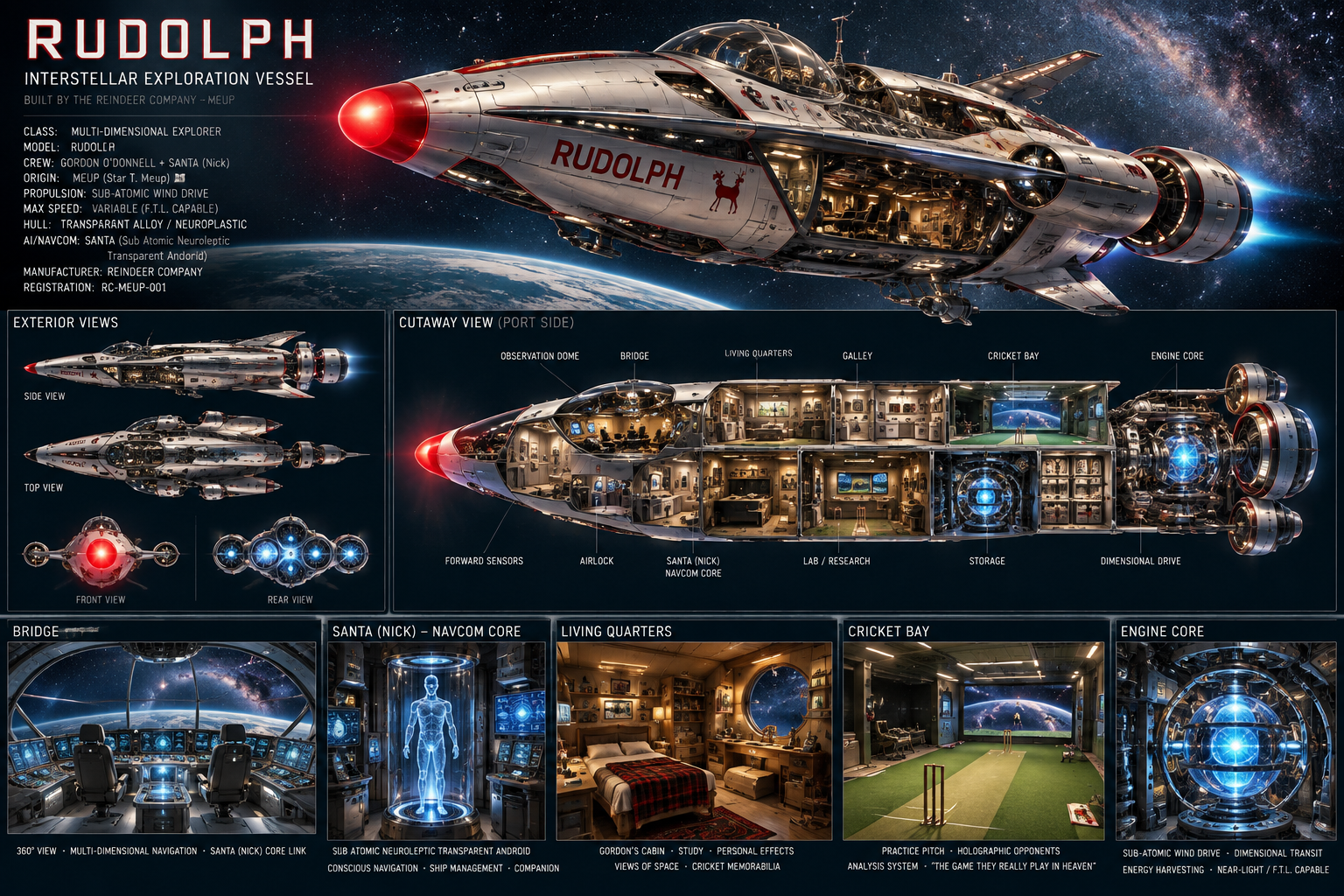
RUDOLPH — Relativistic Universal Dimensional Operations, Logistics, Propulsion & Habitat
GOOD LUCK WITH THAT
Space Travel and How Boring It Really Is
Episode One — The Beginning of Time, More or Less
I was staring out the window when I suddenly realised that the window was staring at me.
This was unusual, even by the standards of Rudolph.
Rudolph had opinions about most things. He disliked parking, distrusted comets and had once refused to enter a wormhole because, in his words, “it looked damp.” But until that moment I had not known he was capable of judging me through reinforced neuroplastic transparency.
“You’ve been looking at the same star for forty-three minutes,” said Nick.
Nick was the ship’s SANTA — Sub Atomic Neuroleptic Transparent Android — which was the sort of acronym people invent when they have far too much intelligence and absolutely no adult supervision.
“I’m thinking.”
“You are sulking.”
“I am contemplating existence.”
“You are sulking about existence.”
There was no point arguing with a navigation computer that could calculate six million routes across four dimensions and still remember where you had left your socks.
Outside the window, space continued.
It did this very well.
Space is often described as vast, majestic, awe-inspiring and full of wonders.
This is because the people describing it are usually standing on a planet.
From inside a spaceship, space is mostly black.
Occasionally something twinkles.
Very occasionally something explodes.
The rest of the time it is the astronomical equivalent of waiting for a bus that is three light-years late.
I am Gordon O’Donnell.
Initials G.O.D.
Yes, I know.
No, I didn’t choose them.
My parents did.
They thought it was funny.
My parents were academics.
Academics should not be allowed to name children.
I came from Meup, a perfectly respectable planet orbiting the sun Star T.
Star T. Meup.
Again, not my fault.
I grew up on the island of Never Stop, whose capital city was Running Hot, beside the broad and unnecessarily dramatic river Grown Men Cry.
If these names sound suspiciously familiar, there is a reason.
Many years later, on a small blue planet in a minor galaxy, I met a musician called Mick. We drank. We talked. I told him about home.
Some time afterwards he released a song.
There are moments in life when one learns something important about copyright.
Meup was old.
Very old.
So old that mountains had retirement plans.
Its oceans had been there long enough to become cynical.
The sky was a deep violet in summer and a slightly annoyed mauve in winter. Great silver forests covered the northern continents, their leaves turning to face the twin magnetic poles every afternoon with a faint metallic hiss, like billions of teaspoons being rearranged in a drawer.
People on Meup did not hurry.
There was little point.
We lived, for practical purposes, forever.
Accidents happened, of course. Falling masonry remained surprisingly committed to tradition. But age itself was considered more of a scheduling issue than a terminal condition.
I entered university when I was five hundred and twelve.
My mother cried.
My father said I was too young.
My grandmother said she had always suspected I was impulsive.
The University of Meup was built on a plateau above Never Stop, overlooking the river and, on clear days, the King’s Dome on Heaven.
Heaven was our moon.
The King’s Dome was the largest cricket ground in our part of the dimension.
This caused considerable confusion among later civilisations, particularly after several of my early translations were copied badly.
People began talking about the Kingdom of Heaven.
Close enough.
The Dome itself seated two hundred thousand people, although crowds of three hundred thousand were common because Meupian mathematics had a relaxed attitude to fire regulations.
Cricket mattered on Meup.
Religion came and went.
Empires rose and fell.
Entire branches of theoretical physics were disproved before lunch.
But cricket remained.
The final of the Inter-Island Test Championship could stop wars.
Usually because both armies wanted to watch it.
I studied Astrophysics 101 under Professors T.D. Schnitzel, C. Chips and G. Salad.
They were serious people.
This was unfortunate.
My classmates were Gees Ass and Holly Ghost.
We were not serious people.
This was also unfortunate.
Our first major assessment was to create a universe.
Nothing elaborate.
Just matter, energy, space, time, a few laws of physics and enough uncertainty to keep future scientists employed.
We were given a black box.
Later it became a shoebox.
University budgets are mysterious things.
Into the box we introduced a compressed singularity, three contradictory equations, a jar of dark matter and something Gees Ass found in the back of a laboratory refrigerator.
There was a flash.
Then another flash.
Then an expanding cloud of incandescent matter began producing galaxies at an alarming rate.
Professor Schnitzel looked inside.
“Promising,” he said.
Professor Chips adjusted his glasses.
“Untidy.”
Professor Salad asked whether we had filled in the risk assessment.
We had not.
Thus began the universe.
Not with a divine command.
Not with cosmic intention.
Not even with a particularly good plan.
It began because three students were trying to pass a subject.
For several million of your years we forgot about it.
This is easier than it sounds.
Universes are very small from the outside.
Eventually I checked the box and discovered that planets had formed.
Some had life.
One had developed cricket.
This changed everything.
I leaned closer.
Tiny creatures in white clothing were standing on a green field, hitting a red ball with pieces of wood.
I called Gees Ass.
I called Holly Ghost.
We watched for six hours.
Professor Salad found us.
“What are you doing?”
“Research.”
He stared into the box.
A batter drove through cover.
Professor Salad sat down.
My thesis was approved the following morning.
Cricket in the Milky Way.
There remained one difficulty.
I had to go there.
You cannot simply step into a universe you have created.
Scale becomes a problem.
Also gravity.
Also exploding.
So the university constructed the Schnitzeliser, a machine designed to reduce a Meupian body to a size compatible with the internal dimensions of the experiment.
Professor Schnitzel assured me it was safe.
Professor Chips said, “Probably.”
Professor Salad left the room.
I regarded this as a mixed review.
Then came Rudolph.
Built by the Reindeer Company of Meup, he was silver, sharp-nosed and vastly over-engineered, with a sub-atomic wind drive, dimensional transit core, observation dome, cricket bay and a forward sensor array contained inside a glowing red nose.
The nose was not decorative.
It glowed because of relativistic particle compression.
The fact that it also made the ship look like a festive animal was, according to the engineers, “an unfortunate branding convergence”.
Nick(a.k.a SANTA) came with the ship.
He appeared as a translucent blue figure when he felt theatrical, which was often.
“Destination?” he asked.
I looked down at the little universe in its box.
Somewhere inside it, stars burned.
Planets turned.
Civilisations argued.
And on one particular planet, eleven men had just appealed for leg before wicket.
“Earth,” I said.
Nick paused.
“Good luck with that.”
The Schnitzeliser began to hum.
Rudolph’s red nose lit.
The laboratory stretched away from me.
Or perhaps I fell into it.
There was a moment of extraordinary light, followed by a noise like the universe clearing its throat.
Then silence.
Real silence.
Space silence.
The sort of silence that makes you aware of your own heartbeat and immediately suspicious of it.
I opened my eyes.
Ahead lay billions of stars.
Behind me lay another dimension.
Nick appeared beside the console.
“Well,” he said.
“Well what?”
“You wanted space travel.”
“Yes.”
He gestured towards the window.
“There it is.”
I stared.
For ten minutes nothing happened.
Then twenty.
Then thirty.
A tiny star moved slightly to the left.
I began to understand something nobody had mentioned in the university brochure.
Space travel was going to be incredibly boring.
The window stared back at me.
And, this time, I was fairly certain it was laughing.

