• The Pig’s Arms
  • About
  • The Dump

Window Dresser's Arms, Pig & Whistle

~ The Home Pub of the Famous Pink Drinks and Trotter's Ale

Window Dresser's Arms, Pig & Whistle

Tag Archives: Life

Good Luck With That – Space Travel and How Boring It Really Is

02 Friday Oct 2026

Posted by Mark in Mark

≈ Leave a comment

Tags

books, fiction, Gordon O'Donnell (GOD), humour, Life, short story, writing

RUDOLPH — Relativistic Universal Dimensional Operations, Logistics, Propulsion & Habitat

GOOD LUCK WITH THAT
Space Travel and How Boring It Really Is


Episode One — The Beginning of Time, More or Less


I was staring out the window when I suddenly realised that the window was staring at me.
This was unusual, even by the standards of Rudolph.


Rudolph had opinions about most things. He disliked parking, distrusted comets and had once refused to enter a wormhole because, in his words, “it looked damp.” But until that moment I had not known he was capable of judging me through reinforced neuroplastic transparency.


“You’ve been looking at the same star for forty-three minutes,” said Nick.
Nick was the ship’s SANTA — Sub Atomic Neuroleptic Transparent Android — which was the sort of acronym people invent when they have far too much intelligence and absolutely no adult supervision.
“I’m thinking.”
“You are sulking.”
“I am contemplating existence.”
“You are sulking about existence.”
There was no point arguing with a navigation computer that could calculate six million routes across four dimensions and still remember where you had left your socks.


Outside the window, space continued.
It did this very well.
Space is often described as vast, majestic, awe-inspiring and full of wonders.
This is because the people describing it are usually standing on a planet.
From inside a spaceship, space is mostly black.
Occasionally something twinkles.
Very occasionally something explodes.
The rest of the time it is the astronomical equivalent of waiting for a bus that is three light-years late.


I am Gordon O’Donnell.
Initials G.O.D.
Yes, I know.
No, I didn’t choose them.
My parents did.
They thought it was funny.
My parents were academics.
Academics should not be allowed to name children.
I came from Meup, a perfectly respectable planet orbiting the sun Star T.
Star T. Meup.
Again, not my fault.
I grew up on the island of Never Stop, whose capital city was Running Hot, beside the broad and unnecessarily dramatic river Grown Men Cry.
If these names sound suspiciously familiar, there is a reason.
Many years later, on a small blue planet in a minor galaxy, I met a musician called Mick. We drank. We talked. I told him about home.
Some time afterwards he released a song.
There are moments in life when one learns something important about copyright.


Meup was old.
Very old.
So old that mountains had retirement plans.
Its oceans had been there long enough to become cynical.
The sky was a deep violet in summer and a slightly annoyed mauve in winter. Great silver forests covered the northern continents, their leaves turning to face the twin magnetic poles every afternoon with a faint metallic hiss, like billions of teaspoons being rearranged in a drawer.
People on Meup did not hurry.
There was little point.
We lived, for practical purposes, forever.
Accidents happened, of course. Falling masonry remained surprisingly committed to tradition. But age itself was considered more of a scheduling issue than a terminal condition.
I entered university when I was five hundred and twelve.
My mother cried.
My father said I was too young.
My grandmother said she had always suspected I was impulsive.
The University of Meup was built on a plateau above Never Stop, overlooking the river and, on clear days, the King’s Dome on Heaven.
Heaven was our moon.
The King’s Dome was the largest cricket ground in our part of the dimension.
This caused considerable confusion among later civilisations, particularly after several of my early translations were copied badly.
People began talking about the Kingdom of Heaven.
Close enough.
The Dome itself seated two hundred thousand people, although crowds of three hundred thousand were common because Meupian mathematics had a relaxed attitude to fire regulations.
Cricket mattered on Meup.
Religion came and went.
Empires rose and fell.
Entire branches of theoretical physics were disproved before lunch.
But cricket remained.
The final of the Inter-Island Test Championship could stop wars.
Usually because both armies wanted to watch it.


I studied Astrophysics 101 under Professors T.D. Schnitzel, C. Chips and G. Salad.
They were serious people.
This was unfortunate.
My classmates were Gees Ass and Holly Ghost.
We were not serious people.
This was also unfortunate.
Our first major assessment was to create a universe.
Nothing elaborate.
Just matter, energy, space, time, a few laws of physics and enough uncertainty to keep future scientists employed.
We were given a black box.
Later it became a shoebox.
University budgets are mysterious things.
Into the box we introduced a compressed singularity, three contradictory equations, a jar of dark matter and something Gees Ass found in the back of a laboratory refrigerator.
There was a flash.
Then another flash.
Then an expanding cloud of incandescent matter began producing galaxies at an alarming rate.
Professor Schnitzel looked inside.
“Promising,” he said.
Professor Chips adjusted his glasses.
“Untidy.”
Professor Salad asked whether we had filled in the risk assessment.
We had not.
Thus began the universe.
Not with a divine command.
Not with cosmic intention.
Not even with a particularly good plan.
It began because three students were trying to pass a subject.


For several million of your years we forgot about it.
This is easier than it sounds.
Universes are very small from the outside.
Eventually I checked the box and discovered that planets had formed.
Some had life.
One had developed cricket.
This changed everything.
I leaned closer.
Tiny creatures in white clothing were standing on a green field, hitting a red ball with pieces of wood.
I called Gees Ass.
I called Holly Ghost.
We watched for six hours.
Professor Salad found us.
“What are you doing?”
“Research.”

He stared into the box.
A batter drove through cover.
Professor Salad sat down.
My thesis was approved the following morning.
Cricket in the Milky Way.
There remained one difficulty.
I had to go there.
You cannot simply step into a universe you have created.
Scale becomes a problem.
Also gravity.
Also exploding.
So the university constructed the Schnitzeliser, a machine designed to reduce a Meupian body to a size compatible with the internal dimensions of the experiment.
Professor Schnitzel assured me it was safe.
Professor Chips said, “Probably.”
Professor Salad left the room.
I regarded this as a mixed review.


Then came Rudolph.
Built by the Reindeer Company of Meup, he was silver, sharp-nosed and vastly over-engineered, with a sub-atomic wind drive, dimensional transit core, observation dome, cricket bay and a forward sensor array contained inside a glowing red nose.
The nose was not decorative.
It glowed because of relativistic particle compression.
The fact that it also made the ship look like a festive animal was, according to the engineers, “an unfortunate branding convergence”.


Nick(a.k.a SANTA) came with the ship.
He appeared as a translucent blue figure when he felt theatrical, which was often.
“Destination?” he asked.
I looked down at the little universe in its box.
Somewhere inside it, stars burned.
Planets turned.
Civilisations argued.
And on one particular planet, eleven men had just appealed for leg before wicket.
“Earth,” I said.
Nick paused.
“Good luck with that.”
The Schnitzeliser began to hum.
Rudolph’s red nose lit.
The laboratory stretched away from me.
Or perhaps I fell into it.
There was a moment of extraordinary light, followed by a noise like the universe clearing its throat.
Then silence.
Real silence.
Space silence.
The sort of silence that makes you aware of your own heartbeat and immediately suspicious of it.
I opened my eyes.
Ahead lay billions of stars.
Behind me lay another dimension.
Nick appeared beside the console.
“Well,” he said.
“Well what?”
“You wanted space travel.”
“Yes.”
He gestured towards the window.
“There it is.”
I stared.
For ten minutes nothing happened.
Then twenty.
Then thirty.
A tiny star moved slightly to the left.
I began to understand something nobody had mentioned in the university brochure.
Space travel was going to be incredibly boring.
The window stared back at me.
And, this time, I was fairly certain it was laughing.

The Middle Ages

15 Tuesday Sep 2026

Posted by Mark in Mark

≈ 2 Comments

Tags

family, Father O'Way, fiction, humour, Life, love, Mark, writing

THE MIDDLE AGES

A Place For Us—A melancholy musical episodic intro to the Father O’Way Chronicles

Becoming a priest turned out to be considerably easier than I had expected.

Staying one was easier still.

This came as something of a relief because, as previously discussed, I had never been burdened by ambition. Ambition requires effort, planning and, in extreme cases, getting up before nine.

St Generic Brand suited me perfectly.

I had a house. I had food. There were people who knew how to cook the food. I had somewhere to sleep and, once a week, I had to stand in front of a group of people and say generally pleasant things about being nice to one another.

God hardly entered into it.

[Author: He’s still an atheist.]

[Sandy: I know.]

[Author: Just checking.]

The church was run by Bishop Veri Bent, universally known as the Bish, although not usually while he was within earshot unless you wanted to spend the following week helping Billy unblock the drains.

Veri was an unusual churchman.

He believed the best way to help poor people was to help poor people.

This radical theology had prevented him from rising much further in the Church.

Every Monday morning at eleven we held the St Generic Brand staff meeting under a large marquee behind the church. Eleven suited Veri because it gave him sufficient time to wake up, read the paper, drink several coffees, apply a nicotine patch, have a bath, eat breakfast and contemplate whether attending his own meeting was absolutely necessary.

Billy, on the other hand, had been awake since dawn.

There was something wrong with Billy.

At one end of the table sat Bishop Veri Bent.

At the other sat Sister Horribleness.

The rest of us sat wherever survival seemed most likely.

Sister Horribleness was a woman of formidable faith, formidable dimensions and formidable hearing. She could detect a whispered obscenity through two brick walls and a lawnmower.

I once suspected she could hear thoughts.

I stopped having them around her.

On this particular Monday I made the mistake of muttering something while she was speaking.

Her head turned slowly.

“Did you have something to say, Father O’Way?”

“No, Sister.”

“You appeared to be speaking.”

“I was praying.”

“You don’t pray.”

Bugger.

She knew me too well.

“Would you care to address the chair?”

I looked at my chair.

The chair offered nothing.

It was wooden, unsympathetic and, judging by previous meetings, probably outranked me.

“No, Sister. Thank you, Sister.”

There. I had stood my ground.

Firmly.

Silently.

While retreating.

It is a skill.

People sometimes mistake cowardice for weakness. This is unfair. Cowardice has kept me alive through situations that bravery would have made considerably worse.

Veri cleared his throat.

“All right, troops. Jobs for the week.”

This was the part of St Generic Brand I actually liked.

We didn’t spend much time saving souls. Souls, as Veri once explained, were difficult to locate and impossible to invoice.

People were easier.

Someone needed food, we found food.

Someone needed somewhere to sleep, we found somewhere to sleep.

Someone was lonely, we visited them.

Someone needed a wheelchair ramp, Billy built one, usually stronger than the building it was attached to.

Proselytising was discouraged.

“You can give a bloke a sandwich,” Veri used to say, “without making him listen to a bloody sermon first.”

For a bishop, he had his moments.

That week Billy had been asked to organise access ramps for a centre helping children with disabilities.

I was given a refugee family who needed somewhere to live.

The money came from the congregation.

No television appeal.

No giant cheque.

No photograph of Veri handing the cheque over while looking concerned.

People put money in. People needed help. The money went out.

It was almost as though religion could work if you removed most of the religion.

[Author: Careful, Sandy.]

[Sandy: What?]

[Author: You’re becoming sincere.]

[Sandy: Sorry.]

Services were held every Sunday, except for two particularly sacred occasions during the year when St Generic Brand closed completely.

One was around New Year.

The other was Good Easter Day.

I never understood why it was called Good Easter Day, but Veri insisted this was because the staff had worked hard all year and deserved a day off.

There may have been a theological explanation as well.

Nobody asked for it.

The rest of the staff were mostly women.

This was another unexpected advantage of my calling.

[Author: Sandy.]

[Sandy: I’m just establishing the cast.]

[Author: You were about to establish something.]

[Sandy: I resent the implication.]

There were eight Citizen sisters: Juanita, Jacinta, Melinda, Rosita, Edwina, Sophia, Cassandra and Belinda.

There was also Glenda, although Glenda had escaped the family business and opened an establishment next door called Glenda’s House of Pain.

I never asked exactly what happened inside.

Billy did.

Billy wouldn’t tell me.

He would only stare into the distance and whisper, “Mate.”

The Citizen sisters did most of the things that caused St Generic Brand to function while the male clergy took credit for having a successful organisation.

I say this with some authority because I was one of the male clergy.

Then there was Belinda.

Belinda Citizen.

I had seen her around the place but had not yet actually spoken to her.

This arrangement suited me.

From a distance I was intelligent, articulate and occasionally charming.

At close range, particularly in the presence of an attractive woman, I had the conversational ability of damp carpet.

Belinda was beautiful.

There. I’ve said it.

[Author: You said it twelve times in the original.]

[Sandy: I was younger.]

[Author: You wrote it years later.]

[Sandy: Get out of my brackets.]

She wasn’t beautiful in the way magazines insist women are beautiful. She wasn’t standing under perfect lighting while someone held a reflector under her chin.

She was just… Belinda.

Dark, intelligent eyes. A smile that seemed to arrive a fraction before she did. The sort of face that made you want to think of something clever to say approximately ten seconds after the opportunity had passed.

I watched her walking across the courtyard.

Not staring.

Observing.

Pastorally.

She came towards me.

This was unexpected.

I considered escape.

Too late.

“Hi, Sandy.”

She knew my name.

This was serious.

“Hello.”

Excellent start.

“My name’s Belinda.”

“I know.”

Too enthusiastic.

“I mean, I’ve heard. Your name. Not heard your name speaking. People have said it. Your sisters. Not all at once.”

She smiled.

I considered taking a vow of silence.

“I believe you’ve met most of the family.”

“Yes.”

“Except Glenda?”

I glanced towards the building next door.

A sign in the window read:

GLENDA’S HOUSE OF PAIN
BY APPOINTMENT
WALK-INS MAY REGRET IT

“I haven’t had the pleasure.”

Belinda laughed.

“You might not call it pleasure.”

I liked her immediately.

This was inconvenient.

“Well,” she said, “I’d better get back to work. Nice meeting you, Sandy.”

“Meet to glad you.”

There was a pause.

A very small pause.

But long enough for several civilisations to rise and collapse inside my head.

Then Belinda laughed.

Not at me.

Well, probably at me.

But kindly.

I laughed too.

And just like that, something extraordinary happened.

Nothing.

No choir sang.

No sunlight burst through the clouds.

God did not speak, which was fortunate because I still didn’t believe in Him and the paperwork would have been horrendous.

Belinda simply walked away.

I watched her go.

For pastoral reasons.

[Author: Get on with it.]

[Sandy: I was getting on with it.]

[Author: Very slowly.]

[Sandy: These things take time.]

I didn’t know where it was going.

Not then.

All I knew was that I had somehow become Father Sandy O’Way of St Generic Brand: atheist priest, reluctant social worker, professional coward and, apparently, a man capable of saying “Meet to glad you” to the most beautiful woman he had ever seen.

The priesthood had given me a home, three meals a day and very reasonable working hours.

It was now about to complicate my life considerably.

I should have known there was a catch.

On Life, Crime and Parenthood

25 Tuesday Sep 2012

Posted by Therese Trouserzoff in Gregor Stronach

≈ 4 Comments

Tags

COPS, Crime, Life, Parenthood


No Sleeping Here !

Story by Gregor Stronach

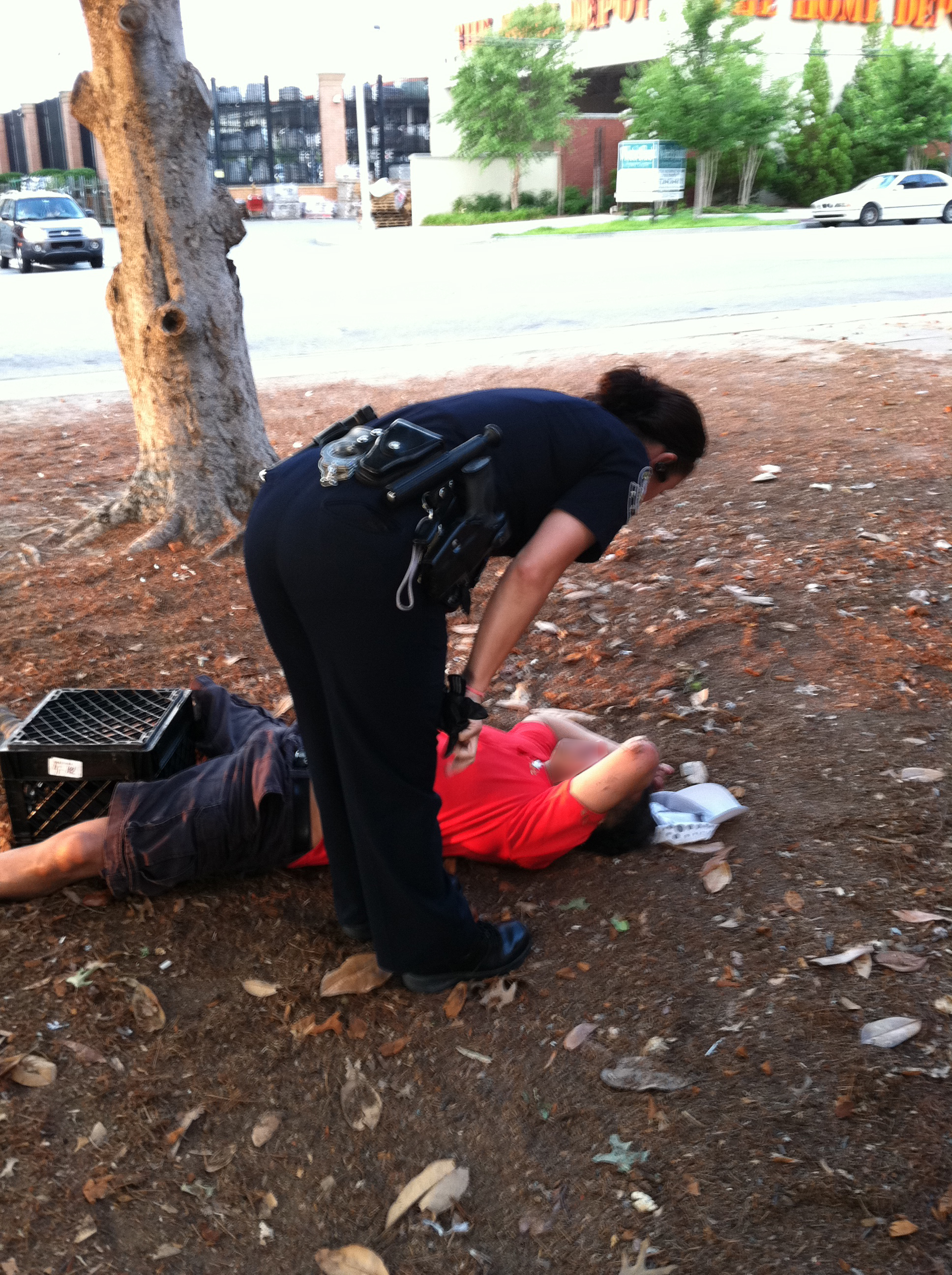
I have two children.

I can remember a time when I had none. It was a blissful time of late nights, binge drinking and being glued, zombie-like, to the TV watching COPS with the sound down so as not to wake my wife.

These were Good Times.

But now, I have two children. My life is now overtaken with late nights spent feeding Son No. 2, and scoffing whisky in the Golden Hour between Son No. 1 being placed comatose in his cot, and my own bedtime, only to be woken a few precious hours later with the beginnings of the dreaded Scottish hangover, so I can sit on the couch like a zombie, and watch COPS with the sound down so as not to scar Son No. 2 for life.

So… nothing much has changed.

I like watching COPS. Actually, I love it. It’s not the gritty realism, nor is it the unbridled machismo of the heavily-armed “men and women of law enforcement” dealing with the life and death situations that they call ‘work’.

It’s the elevated feeling of self-worth that comes from watching the slack-jawed denizens of the US of A as they show the world precisely what a vacuum of infinite stupidity and hopelessness looks like. Black holes of idiocy, so tremendously dumb that not even irony can escape their gravitational pull.

COPS isn’t a TV show. It’s a funeral procession – a 30-minute long parade, casket held aloft on the shoulders of police and sheriff’s uniforms. And in that casket is the Great American Dream, embalmed in a blend of 40-ounce bottles of rot-gut liquor, cranked up by a liberal sprinkling of crack cocaine and methamphetamine shards.

From the shambling, mumbling hookers who hawk their tawdry wares along the hard shoulders of the interstate, to the inevitable Angry Young Man with a bad haircut and a drug habit that would put Elvis to shame, it’s a free-wheeling circus of violence and crime.

Gap-toothed, and desperate, they are. You can see the fear, and occasionally rage, in their eyes as they gawp gormlessly at the camera, before breaking every single cardinal rule about being arrested. Not only do they speak openly about their crimes to the police, but they do so on camera – filmed to be broadcast, and have their immeasurably dim brains beamed into the living rooms of people around the world.

People like me. People who watch them for entertainment. People who watch them for sport. I feel like a Roman, watching slaves being put to the sword in a coliseum. And I feel no regret.

I only share the surge of adrenalin that the officers clearly feel, as they huff and puff like unfit wolves in pursuit of society’s little pigs. Miked up for the camera, they produce noises not unlike poorly stuffed punching bags, accepting punishment at the hands of Ju-Jitsu masters. Oof oof oof, with a staccato jangle of handcuffs that mimick the chains that hold Everlast bags aloft in gymnasiums throughout the world.

Invariably, the pursuit ends with a wrestle. A solid, manly, no-holds-barred-and-definitely-not-gay struggle for freedom. The police fight with tactical weapons – they fell the felons with long-range electrical probes, tenderize those fallen with night sticks and batons, before flavouring them with capsicum spray and trussing them up with metallic adornments designed specifically to deny freedom, and steal dignity – like a Thanksgiving turkey bound for the oven of justice.

Those hell-bent on decamping the scene fight like cornered wolverines, amped up by alcohol and whatever pharmaceuticals their dealers have managed to cook in the bathtubs and bottle-labs, bagged up and sold. Their eyes roll wildly in their sockets, arms pinwheel and legs flail.

The script is more often than not, the same.

“Stop hurting me!” they will shriek.

“Stop resisting!” comes the reply.

“I’m not resisting! You’re breaking my arm!”

“Stop. Resisting.” – this is universally uttered through gritted teeth, often punctuated by insistent grunts that signify the landing of a non-fatal blow to a part of the body known for being both soft and exquisitely painful when tampered with.

The police then stuff their prey into the back of their vehicle with the care and attention of a postal worker stacking a warehouse of boxes marked “Fragile” – indeed, if the felons bore stickers crying “This Way Up”, they too would be cheerfully ignored.

And then suddenly, it is over. A strange calm befalls the living room, while the officer in charge drones on about how much he loves his job. The magic, like the drugs that fuel one half of the combatants, wears off – the spell broken by the sudden and shocking insistence of a white-toothed, well-groomed idiot practically begging me to purchase not one, but two steam mops that I know I will never use.

Then the bottle clamped between the rosebud lips of my infant son makes a sound: Pfuff Pfuff Pfuff, it goes. That tells me he’s done. The bottle is dry.

I hoist him to my shoulder, and through a semi-conscious limp satiety he lets roar a thunderous belch, blasting foul, milky air past my ear and depositing the glug of half-digested breastmilk down the shoulder of my only clean pyjamas.

I wrap him – swaddle him like an infant messiah – and gently, oh-so-quietly, we tiptoe together to his room.

I place him with all of the care and love I can muster. My precious, precious cargo. A brush of my lips across his forehead to let him know I love him. One last glance stolen as I creep from the crib.

A sly shot of whisky. A warm bed awaits.

I remember when I didn’t have children. They were, indeed, Good Times.

But nothing – absolutely nothing – will sway me from the understanding that my life, right now, is blessed beyond belief by the presence of my two little boys.

And on the days I feel run down – neglecting myself, and feeling near death through fatigue, the antidote is simple.

“I’ll feed Tobias tonight, my love,” I’ll say. He’s a well-trained boy.

He wakes for his feed when COPS is on. And the circle of life turns once more.

Patrons Posts

  • Apollo Mission 1 October 5, 2026
  • Good Luck With That – Space Travel and How Boring It Really Is October 2, 2026
  • Further O’Way September 21, 2026
  • The Middle Ages September 15, 2026
  • The Early Days September 14, 2026
  • One More Mile August 31, 2026
  • God versus Satan August 24, 2026
  • Man on the Street August 21, 2026
  • Gordon blinds Foodge with science. August 18, 2026

We've been hit...

  • 867,434 times

Blogroll

  • atomou the Greek philosopher and the ancient Greek stage
  • Crikey
  • Gerard & Helvi Oosterman
  • Hello World Walk along with Me
  • Hungs World
  • Lehan Winifred Ramsay
  • Neville Cole
  • Politics 101
  • Sandshoe
  • the political sword

We've been hit...

  • 867,434 times

Patrons Posts

  • Apollo Mission 1 October 5, 2026
  • Good Luck With That – Space Travel and How Boring It Really Is October 2, 2026
  • Further O’Way September 21, 2026
  • The Middle Ages September 15, 2026
  • The Early Days September 14, 2026
  • One More Mile August 31, 2026
  • God versus Satan August 24, 2026
  • Man on the Street August 21, 2026
  • Gordon blinds Foodge with science. August 18, 2026

Enter your email address to subscribe to this blog and receive notifications of new posts by email.

Join 371 other subscribers

Rooms athe Pigs Arms

The Old Stuff

  • RSS - Posts
  • RSS - Comments

Enter your email address to subscribe to this blog and receive notifications of new posts by email.

Join 371 other subscribers

Archives

Website Powered by WordPress.com.

  • Subscribe Subscribed
    Window Dresser's Arms, Pig & Whistle
    Join 277 other subscribers

    Have a WordPress.com account? Log in now.

  • Window Dresser's Arms, Pig & Whistle
    View site in Reader
    Manage subscriptionsSign upLog in
    Report this content
    Collapse this bar
Loading Comments...