• The Pig’s Arms
  • About
  • The Dump

Window Dresser's Arms, Pig & Whistle

~ The Home Pub of the Famous Pink Drinks and Trotter's Ale

Window Dresser's Arms, Pig & Whistle

Author Archives: Therese Trouserzoff

THE ROLLING STONES – 50 YEARS

01 Sunday Jul 2012

Posted by Therese Trouserzoff in Algernon

≈ 17 Comments

Tags

Rolling Stones

Playlist by Algernon

This year marks 50 years since the Rolling Stones formed. This list is a selection of singles that have been released over much of that time. There are many more, please feel free to add your favourite Rolling Stones.

http://www.youtube.com/watch?v=M91uWDUeYX0

Little Red Rooster

http://www.youtube.com/watch?v=BzZHmHqEE7k

The Last time

http://www.youtube.com/watch?v=m6Ts8XS_UO4&feature=related

I can’t get No satisfaction

http://www.youtube.com/watch?v=jgWUi-ozMAU

Get of My Cloud

http://www.youtube.com/watch?v=fPVUa29kHu8

Paint it black

http://www.youtube.com/watch?v=6DVCgKsqn30

Ruby Tuesday

http://www.youtube.com/watch?v=e9XKVTNs1g4

Jumping Jack Flash

http://www.youtube.com/watch?v=5e1_K-JDfOk

Honky Tonk Women

http://www.youtube.com/watch?v=vBecM3CQVD8

Sympathy for the Devil

http://www.youtube.com/watch?v=Rx07A9LWBJA

Brown sugar

http://www.youtube.com/watch?v=JMkFjYRWM4M

Angie

http://www.youtube.com/watch?v=aMuGvaIntRA

Miss You

http://www.youtube.com/watch?v=XW4DPIBO5OU

Start Me Up

http://www.youtube.com/watch?v=hOkIU8BCxgU

Harlem Shuffle


The Late Great Aussie Moore – Chapter 3 Eureka Days

28 Thursday Jun 2012

Posted by Therese Trouserzoff in Neville Cole

≈ 5 Comments

Tags

Ballarat, Eureka, gold mining

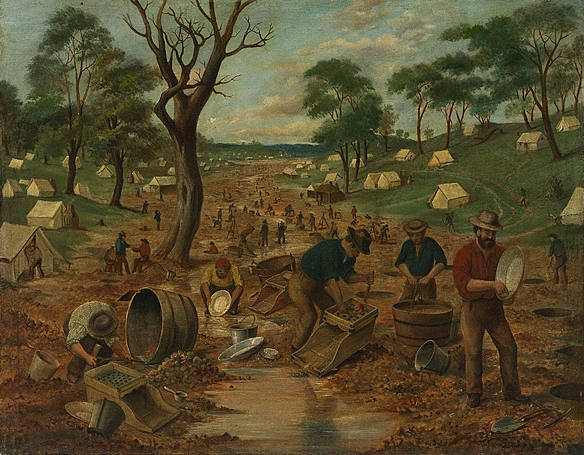
The Diggings

By Neville Cole

The beautiful English home on the hill that had been my grandfather’s pride and joy was gone. All that remained was the stone hearth and chimney that my father rebuilt and tended to as if it were my mother’s earthly tomb. The years that followed, my brothers recalled, were unrelentingly difficult without a hint of a woman’s touch. Although my father still had money remaining from his father’s glorious golden days, we, his kin, lived as feral outcasts in a one-room miner’s shack by the tapped out stream at the bottom of the hill. My father brought a goat to replace the mother’s milk my colicky lungs cried out for and later he purchased a few hundred head of sheep and turned my brothers into unwilling shepherds. The parties, gaiety, and gatherings of neighbours ceased and we became known collectively as the “wild Moores of Ballarat.”

My father turned quickly to drink as his only consolation. His chief bursts of productivity coming once a year at shearing time when he worked almost around the clock until all the wool had been clipped and bagged. Then he would be gone, sometimes for weeks at a time, to Melbourne to sell his measly wares for the best price he could muster. But later, on quiet evenings in the shack, before the spirits turned his heart as dark and cold as a mid-winter storm, he would tell us stories of his father Samuel, the lucky Moore from Kilmarnock.

Kilmarnock

 “Your grandfather came from the land of Robert Burns and Walker’s Kilmarnock Whisky,” he would always start as if the jug in his hand was drawing the story from the depths of his soul. He was the luckiest man who ever lived,” he would add with the bitterest of smiles. “He turned his back on the land of the true Moores and laid plans to come to this godforsaken plot as soon word of Edward Hargraves’ find at Ophir spread across the globe. Of course, by the time he made it to these shores, Ballarat was the center of the universe and the lure of golden riches drew him here as surely as the sun holds us all in orbit. He was barely twenty years at the time with little education and no discernable skills but he soon learned he had a nose for gold to go along with his limitless yearning for adventure. He was also the unsung hero of the Eureka stockade, lost to history, but were it not for your grandfather we may not be now be living in a free Australia. For you see, it was your grandfather who saved the life of one Peter Lalor.”

How my grandfather Samuel came to the rescue of the first outlaw to make it to parliament is a story of reckless bravery and frankly impossible luck. It all began soon after his arrival when he fell in, quite literally, with another young Scottish miner named James Scobie. The two met, as most miners do, at a hotel when Samuel stepped between James and the hotel’s proprietor, a Mr. Bentley, during a confrontation over an apparently unpaid tab. Samuel was knocked unconscious and woke up later outside in the dirt being tended to by a grateful James Scobie. Now you may think that was a rather unlucky beginning to what I proposed was a story of remarkable luck; but taking a billy club for a stranger can tend to forge a quick friendship and James and Samuel became mining partners shortly thereafter and thus my grandfather began his trek down the often hazardous path of the gold miner in earnest.

James Scobie was a fine miner but as pig-headed as the day is long. He and Samuel continued to frequent the Eureka despite the constant threat of bodily harm from Mr. Bentley. As the months and years passed, Samuel began to suspect that the reason for their almost nightly visits to the Eureka was due to more than just a taste for whiskey and rum; he noted that James attentions often fell upon the proprietor’s comely wife, Catherine. These attentions, Samuel recognized most likely accounted for Mr. Bentley’s simmering fury every time this usually free spending and frankly mostly trouble-free customer walked through his doors.

Lucky for him, Samuel was not with James as he wandered past the Eureka hotel during the early morning of October 6, 1854. If he did it is quite possible he too would have been found face down in the dirt with a fatal battleaxe wound to his head. Samuel attended the hasty trial that took place that very afternoon when the local magistrate acquitted Mr. Bentley for lack of evidence, even though witnesses saw Mr. Bentley on the street with three other men and a woman at the time of the murder. It was noted that a woman, believed to be Catherine, was heard to exclaim “how dare you break my window.” It would not be until many years later that Samuel would wonder just what caused James Scobie to break Catherine Bentley’s window at two o’clock in the morning. At the time of the trial all he could think of was revenging his good friend’s death.

It was Samuel that took the lead ten days later when a reported 10,000 miners took to the streets and burned down the Eureka hotel while James and Catherine Bentley fled for their lives. Again, due mostly to luck and partly to his quiet, unassuming nature, Samuel was not among the nine miners arrested over the next few days for starting the fire.

The miner’s anger turn quickly to political revolt and Samuel too was present at Bakery Hill to vote in the resolution “that it is the inalienable right of every citizen to have a voice in making the laws he is called on to obey, that taxation without representation is tyranny“. The group also resolved that day to secede from the United Kingdom if the situation did not improve.

The mood of the Ballarat miners reached its feverous peak on 16 November 1854 when Governor Hotham appointed a Royal Commission on goldfields problems and grievances. But as history has shown us, authority rarely bows out of a bad situation gracefully and Commissioner Rede’s response the governor was to ignore the grievances and instead increase the police presence in the gold fields and summon reinforcements from Melbourne.

The Oath

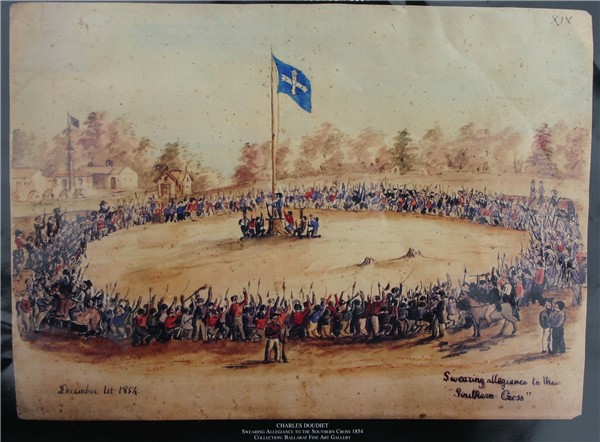
How Samuel avoided arrest and death during those revolutionary days can only be attributed to pure luck. After all, he was one of the first of the miner’s to pledge open rebellion and burn his mining license and he was among the mob that surrounded arresting officers conducting a license search the very next day. He was present at the unfurling of the rebel Eureka Flag and part of the mob who swore the oath of allegiance to it. “We swear,” they spoke as one, “by the Southern Cross to stand truly by each other and fight to defend our rights and liberties.”

Eureka Stockade

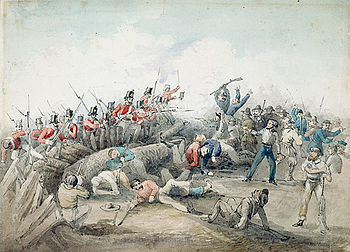
The tragic events of the battle of the stockade have been well documented; it is now known how what had at one time been a force of 1700 men dwindled to a mere 150 miners on December 3rd, 1854 when most of the miners at the stockade returned to their tents under the assumption that the Queen’s military forces would not be sent to attack on the Sabbath.

Samuel was one of the 150 who remained when a party of 276 police and military personnel under the command of Captain J.W. Thomas approached the Eureka Stockade and a battle ensued. The ramshackle army of miners was hopelessly outclassed by the well-trained military regiment and was routed in about 10 minutes. But it is his actions during that 10 minute battle for which Samuel ought to be legend; for it was he who hid Lalor, arm shattered by musketshot, under a pile of timbers. Samuel then somehow managed to stay nearby undetected while the victors removed the dead from the stockade. He could see blood trickling from beneath the pile of slabs where he had Lalor hid; but while soldiers, keen to capture Lalor were still in the stockade, Samuel dared not make a move. That is, until the last of soldiers had left. Then he quickly stepped back into the fray and smuggled Lalor away, put him on a horse, and sent him off to eventual safety.

Now, I’m not here to pretend that it was an easy escape for Lalor. We all know well that over the following weeks he had to survive several near captures and undergo two amputations before he would be truly free; but the fact remains that, without my grandfather, Samuel Moore, he never would have survived the stockade. Without my grandfather, Samuel Moore, the near 50 year trudge to independence that followed would have surely been without one of its most passionate and influential leaders. For the lucky Moore from Kilmarnock it was just one of a hundred such times during which he tempted fate and won. If only my own father had just one tenth of his father’s good fortune my early life would have been quite different indeed. Then again, perhaps luck, like many other genetic traits, tends from time to time to skip a generation.

Blue-Eyed Soul

22 Friday Jun 2012

Posted by Therese Trouserzoff in Algernon

≈ 22 Comments

Tags

blue-eyed soul, play list

Playlist by Algernon

http://www.youtube.com/watch?v=xEkB-VQviLI

You’ve lost that loving Feeling – The Righteous Brothers

http://www.youtube.com/watch?v=Oy625sZAHN8

Good Lovin’-The Rascals

http://www.youtube.com/watch?v=U-7QSMyz5rg

Green Onions –Booker T & the MG’s

http://www.youtube.com/watch?v=9MK8F5BHvgE

Gimme Some Lovin – The Spencer Davis Group

http://www.youtube.com/watch?v=VUFxj59Fa9o

What is Hip-Tower of Power

http://www.youtube.com/watch?v=65EoK4OelZU

Lowdown – Boz Scaggs

http://www.youtube.com/watch?v=KSHY1_ux8rs

Young Americans – David Bowie

http://www.youtube.com/watch?v=NRgr9h2iO40

Sara Smile – Hall & Oates

http://www.youtube.com/watch?v=gvmpfTQTbZY

Cut the Cake – Average White Band

http://www.youtube.com/watch?v=HVzAH0FtNwg

Church of the poison mind – Culture Club

http://www.youtube.com/watch?v=ZlCCva6rr-s

Speak like a child – The Style Council

http://www.youtube.com/watch?v=t7E2a3efr3w

Missionary Man – Eurythmics

http://www.youtube.com/watch?v=yG07WSu7Q9w

Holding Back the years – Simply Red

http://www.youtube.com/watch?v=Ua_ODg0FmzQ

Mel Torme – Comin Home Baby

http://www.youtube.com/watch?v=KCkm1ZAQQPY

Footie – Wigan’s chosen Few

http://www.youtube.com/watch?v=dp4339EbVn8

Son of a Preacher Man – Dusty Springfield

The Great Aussie Moore Chapter Two: The Fire

22 Friday Jun 2012

Posted by Therese Trouserzoff in Neville Cole

≈ 14 Comments

Tags

1901 fire, Aussie Moore


Melbourne before the storm

By Neville Cole

The summer of 1901 was unreasonably hot and windy and, though I need not add this, excessively dry. This was especially difficult on my slowly recovering mother. Doctor Lockett did finally arrive on the morning of my birth to attend to my mother. He praised Mr. Webb for his surgical efforts but nevertheless administered a dose of opiate and did what he could to clean the wound and stop the bleeding. He wanted to have my mother moved to the new hospital in town but she would not hear of leaving her family and instead my father hired a Chinese nursemaid from the goldfields who was known for working miracles with injured miners.

I, of course, was too young to remember any of this – being but a mewling and puking babe at the time – but during a recent visit the State Library in Melbourne I happened upon some articles written over the summer of my birth.

HEAT AND GALES the headline read and DUST STORM IN THE CITY; but the one that struck the clearest chord simply noted LOSS OF LIFE AND PROPERTY.

The Argus scribe wrote on February 7th, 1901 that shortly after 6 o’clock “one of the most violent dust storms that has ever been experienced in Melbourne swept over the city, and came as a fitting climax to a day of almost unprecedented heat.” He described the “rushing, mighty wind” as seemingly “converting the city into a gigantic railway train, rushing with headlong speed into a tunnel.” He also wrote that storm formed an “impenetrable grey wall causing vehicles to come to a standstill, and that the trams, after endeavoring to maintain snail’s pace motion amid the incessant clanging of warning bells, finally gave up the attempt”. But perhaps the most telling description I read pointed to the fates of innocent bystanders caught up in this furious whirlwind: “Luckless pedestrians clutched their hats and made for the nearest portico or doorstep, or clung to verandah-posts, burying their faces in their hands to escape the blinding cloud of dust and pebbles. The tornado swept through the metropolis in a few minutes, warning messages of its approach being sent over telegraph wires from places it had just left, though, as a rule, the recipients had no time to make use of the warning given to them.

1901 fire

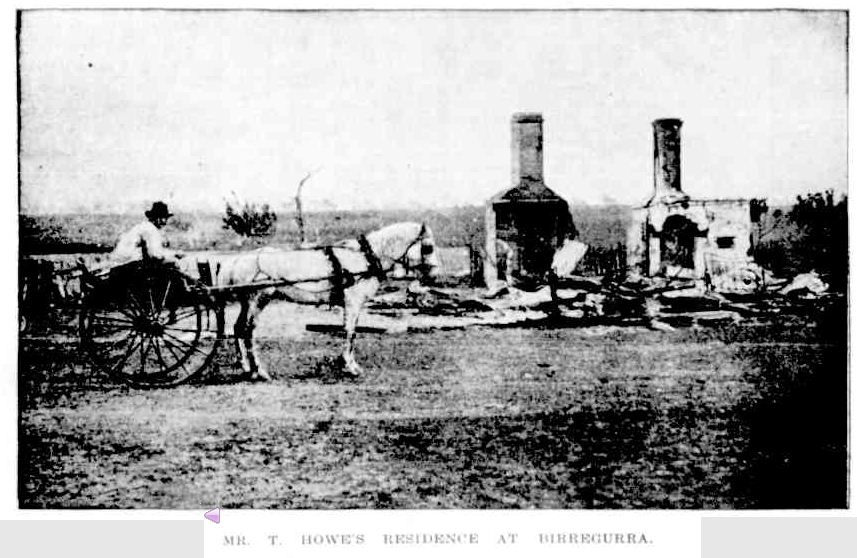
Melbourne was smothered by dust that day but spared the flame. We country folk were not so lucky. We had not only hurricane force wind and dust but also faced fires travelling at a terrific rate in front of that wind. Account after account in the Argus noted the devastation.

In Lower Byeduk, for example, “three houses alone stood out of the original fifteen. Nothing was saved, not a stick of furniture, and women and children, who had dashed out of their houses, just in time to save their lives had to stand by and see a mass of flame lick up their houses. People,” he went on, “with clothing burning, rushed to the creeks and dams, and many stood therein, while with hurricane force and cyclonic speed the fire swept past them actually singing their hair.”

While engaged in the act of reading these accounts I could not help but to imagine my dear mother, still partially invalid from the trauma of my birth sitting by me in my cot trying to formulate an escape from the fiery darkness that raced toward her like a headlong train.

No one ever told me an exact account of that day; but from snippets I did take in it appears that even in the days leading up to the great fire my father was often heard to curse his own father’s name. “Who but an arrogant fool,” he was said to exclaim, “would build his house on a hill instead of next to a cool and comforting stream?” What man would rather watch over his dominion than allow his family to live in comfort and safety?”

All of which is to explain why my father and my two young brothers were down by the creek in the heat of the day on February 7th. They were gathering water to cool my mother’s brow. The flames I am told blew up suddenly and without warning from the valley behind our house. By the time, my father even saw the smoke, the wind and dust was on top us and we were blanketed within that impenetrable wall of grey. It is not known what took place inside the house and I certainly don’t recall a thing but, as my brother told it, my father took off toward the flame but became disoriented in the wind and dust; and then, when the storm had passed as quickly as it arrived, out of the maelstrom staggered the Chinese nursemaid clutching me to her yellow breast.

My brother’s watch in silent horror as my father ripped me from her grip and beat her to the ground with back of his free hand. The Chinese girl, Clarry once whispered, managed to heft herself to her feet and ran off into the falling ash that was already decorating the plain like some snowy English Christmas scene. Like my mother, the Chinese girl was never seen and rarely spoken of again.


Here to Help

17 Sunday Jun 2012

Posted by Therese Trouserzoff in Emmjay, Politics in the Pig's Arms

≈ 19 Comments

Tags

Archbishop Jensen, arsonists, Cardinal Pell, Chris Uhlmann, crown of thorns starfish, Fatty O'Barrel, Gina Rhinestone, Humboldt Numan, James Packer, Joe Hockey, Julie Bishop, Mark Scott, Nick Darcy, paedophiles, people who abuse small animals, rabbits, Sarah Palin, shock jocks, Silvio Berlusconi, Sophie Mirabella, Ted Baillieu, the Burmese military junta, Tony Abbott, Tony Jones

Quite a few patrons at the Pig’s Arms complain about the ABC’s “The Drum” closing off comments so quickly after an article has been posted, that they cannot get a comment in.

In the spirit of co-operation championed at the Salon de Porc, herewith is a viable solution.  Copy it into your clipboard and fire it off BEFORE the article is published – or use it on any of the remaining open posts there.

I’ve seen some seriously dubious positions put here at the Drum in my time, but surely (insert author’s name if you have time), this one takes the cake.  Never before have we been treated to such an unmitigated neo-fascist rant, completely devoid of substantive evidence and totally without cogent argument.  It would be funny except it clearly wasn’t intended as a joke.

To suggest that even the fundamental premise  of the article (if in fact one can be identified) has any validity, demonstrates a woefully inadequate understanding of social etiquette and the physical laws of our universe.

I abhor ad-hominum attacks and such disgraceful behaviour must not be tolerated. 

Sadly the era of burning people like  (insert appropriate name or remove any of the following that do not apply) James Packer, Tony Jones, Sophie Mirabella, Tony Abbott, Joe Hockey, Fatty O’Barrel, Humboldt Numan, Ted Baillieu, Sarah Palin, Nick Darcy, Gina Rhinestone, the Burmese military junta, Julie Bishop, Cardinal Pell, Archbishop Jensen, Silvio Berlusconi, people who abuse small animals, crown of thorns starfish, rabbits, arsonists, paedophiles, shock jocks, Mark Scott, Chris Uhlmann at the stake is over.

Such is what we laughingly call progress.

—ooo—

Hope this helps !


The Nature of Co-operation

17 Sunday Jun 2012

Posted by Therese Trouserzoff in Lehan Winifred Ramsay

≈ 32 Comments

Tags

Japan's nuclear reactor restart

Story by Lehan Winifred Ramsay

Well, there you have it. Two salons, one with the hamburger lunch, one with milk tea and cream, in two different towns. And they have one problem to resolve. Should we restart the nuclear reactors? Or not. As you can see, it’s not an easy co-operation. But that’s the nature of co-operation.


Songs from the States Part 1

17 Sunday Jun 2012

Posted by Therese Trouserzoff in Algernon

≈ 9 Comments

Tags

music clips, USA

Playlist by Algernon

http://www.youtube.com/watch?v=RHsDa9_HSlA

Sweet Home Alabama- Lynyrd Skynyrd

http://www.youtube.com/watch?v=JSt0NEESrUA

North to Alaska

http://www.youtube.com/watch?v=yhdiSqt6sXE

Arizona – Mark Lindsay

http://www.youtube.com/watch?v=gIrqs-FUPbo

Arkansas Grass – Axiom

http://www.youtube.com/watch?v=dN3GbF9Bx6E

California Dreamin’ – The Mamas & The Papas

http://www.youtube.com/watch?v=dPpnvNlywP8

Colarado – The Flying Burrito Brothers

http://www.youtube.com/watch?v=qJIauO3PROI

I live in Connecticut –Aerosmith

http://www.youtube.com/watch?v=NztfOSyCCFM

Delaware – Perry Como

http://www.youtube.com/watch?v=T9Benryvvqo

Mainline Florida – Eric Clapton

http://www.youtube.com/watch?v=tnepPZChA5U&feature=fvst

The Devil Went down to Georgia – Charlie Daniels Band

http://www.youtube.com/watch?v=1hobnB9PPPo

Hawaii – The Beach Boys

http://www.youtube.com/watch?v=n7t7cGwN7_0

Private Idaho – The B52’s

http://www.youtube.com/watch?v=u05eH6cYRSI

Illinois – Dan Fogelberg

http://www.youtube.com/watch?v=fsWohOShiqs

Indiana – Jon McLaughlin

http://www.youtube.com/watch?v=tqHgZhLLTc0

Iowa – Dar williams

http://www.youtube.com/watch?v=CB17uWuBrL0

Carry On Wayward Son – Kansas

http://www.youtube.com/watch?v=O-v38lbPNZs

Kentucky Rain – Elvis Presley

The Great Aussie Moore – Chapter 1 Victor Australis

15 Friday Jun 2012

Posted by Therese Trouserzoff in Neville Cole

≈ 8 Comments

Tags

1901, Aussie, Australian Federation, Ballarat, goldfields


Fossickers

By Neville Cole

My mother always had a rare sense of timing. She passed away last year on my birthday. Instead of celebrating another year around the sun with my friends, I travelled back to Melbourne to organize her funeral and take care of her affairs. It was all fairly straight-forward until it came time to go through her stuff. The house where she passed was filled to overflowing with the assorted flotsam and jetsam of a long and disorganized life.

Sadly, most everything I came across was destined for a quick trip to the local tip. I was beginning to think that I should save myself a considerable effort and toss it all, until deep down in a box pile of ancient papers, I started to discover bits and pieces of a jumbled handwritten manuscript entitled Victor Australis that appeared to have been written by a long-lost Great Uncle named Aussie Moore.

I knew my Great Uncle Clarry well. He was a legendary figure around Kilmore, the town my mother grew up in. One of many famous Clarry Moore tales was that on his 82nd birthday the family purchased him a table saw so that he could put a new roof on his barn. He completed the task by himself in less than a week. I knew all about Clarry and Grandpa Dot; but until I came across Victor Australis, I had never heard of Aussie Moore. It was if he had been banished from the Moore family records.

Victor Australis is a rambling and outrageous account of a very strange life. Many events are described in exhausting detail then whole decades disappear without a trace. Much of he describes is too coincidental to be true, while other parts of his life story are clearly historical fact. In his own words, Aussie Moore was one of the “first true Australians” as he was born during the early hours of January 1st, 1901: the day Australia became an independent federation.

Ever since I picked up Victor Australis I have haven’t been able to set it back down for long; which is why I have decided to write out Aussie’s tales out in some kind of a logical order and bring them to the world. Ladies and Gentlemen I give you the late, great Aussie Moore!

NOTE: The section of italic text that follows I believe to be the opening paragraph of Aussie’s autobiography. I have tried to capture his idiosyncratic phrasing exactly as he laid them to paper; but, truth be told, some of these pages have been pretty severely damaged by the ravages of time and in places I was forced to make my own best guess as to what had been once been intended.

I was born into trouble and it has followed close at me heels throughout my entire life. I have done too many things to remember them all, seen much more than even that, and just to have survived this long I consider myself a fortunate fellow indeed. I was born in an Englishman’s house high on a hill overlooking the rich goldfields of Ballarat. The morning of my birth was the first morning of the new Australian federation, which makes me one of the first true Australians, the first of the Aussies. I don’t count in this group any of the many indigenous peoples who have inhabited the great southern land as they all predate terra australis by centuries at least. I don’t remember any of the particulars of my birth. Which isn’t unusual, I suppose. In fact, any man who says he does remember that time of his life is a damned liar at best and at worst a devil in the flesh.

I was, quite naturally, told stories of that morning by others from time to time. However, never by my own father, Duncan Robert Moore, for reasons I will reveal at a later time.

Ballarat – the town where Aussie was born

At the dawn of 1901, Ballarat was a town still thriving from sale of gold. It was a town with a thick rough edge and a tough, unforgiving, and almost unimaginably wealthy center. It was a town still driven by the Eureka spirit. My father was far more proud of Australia’s hard fought federation than my arrival. In fact, on more than one occasion he informed me that it was always his intention that I would be a daughter – a gift from him to my mother for her hard toil over the years. My name had already been chosen. I was to be Victoria Australis Moore. When it was clear that a nob and two bollocks hung between my thighs, my parents removed the last two letters of my first given name and I became Victor Australis Moore – forever after known simply as Aussie. But getting my name changed is the least memorable part of this story.

You see, as was customary on the last night of each year, my father spent a good part of New Years Eve, 1900 drinking heavily with good friends and neighbours and, only after midnight passed and it became obvious that I would wait no longer, did he send his guests home and my brother Clarry to fetch the local mid-wife. She arrived none too soon and immediately saw my mother was in grave danger as I was well on my way to coming out breach. There was no time now to fetch the doctor so, as the mid-wife did what she could to make my mother comfortable, my father staggered to his horse and galloped off to fetch Mr. Webb, a local horse breeder who had experience with various animal surgeries. Mr. Webb by all accounts had also been partaking in a long evening of revels and, perhaps because of this, made the immediate decision that I must be delivered in the manner of the great Caesar himself. He administered a gulping gut full of rum down my mother’s gullet then proceeded to quickly and skillfully slit her belly and tear me screaming from her womb.

My oldest brother, Clarry watched the whole ordeal in utter fascination, and later would recount the horrible episode to me late at night causing me to suffer from a lifetime of sleep shattering nightmares. Clarry never failed to mention that Mr. Webb sowed my mother’s belly back together “like a seamstress at her loom using naught but dried sheep intestines that had been soaked in spirits”. Such was my coming in and such has been my path ever since.

 —ooo—

Milk Tea with Cream

14 Thursday Jun 2012

Posted by Therese Trouserzoff in Lehan Winifred Ramsay

≈ 27 Comments

Tags

cup of tea with milk, Julian Assange, Kyoto

Illustration and Story by Lehan Winifred Ramsay


Illustration

I begin this piece with a cup of milk tea at the Cafe de The Francois in Kyoto. Waiting for a friend who didn’t turn up (lost at the other end of the street). The lighting is yellowed like the walls, playing off bald heads and gold spectacles. Well dressed ladies cluster on red velvet upholstery raising their pitch over the piano concerto. A man with his elderly mother bend over cream cakes. He stirs his drink vigorously and when it spills he exclaims and stops all movement. His mother rustles through her purse and takes out tissues to wipe the spill. After finishing his cake, he reaches into his own bag, takes out his own tissues, and wipes his own mouth. I accept a final refill of my glass of water, and leave for the train.

Milk Tea with Cream

This week I’ve been occupied, watching an old 11 week TV Japanese drama on Youtube starring Takuya Kimura, a Japanese singer and actor breaking new ground in pan-asia entertainment, followed by the Julian Assange interview series. I started with the old guys and worked my way down to the new ones, ending with Occupy.

Toward the end of the Occupy compilation he asks a question about the organisation of the occupy sites. You started to put up instructions, he says. For how to organise the police, how to organise yourselves, how to organise interferers, crazy people, the garbage. Was this a model specifically for your events? Or was this some kind enactment of a larger model.

Fascinating to listen to the responses. I had the feeling that Assange is not interested in the Occupy movement as much as his audience. President Obama, did you take note of the cigars he was waving about? Or was that smoke not meant for you.

It seems that there is more to come.

The King Street Giant’s Fossilised Mobile Phone.

11 Monday Jun 2012

Posted by Therese Trouserzoff in Emmjay

≈ 23 Comments

Tags

archaeology of the inner west, Fossilised mobile phone, King Street, Newtown Giant

Newtown is one of Sydney’s most extensively explored suburbs and has yielded some surprising archaeological finds in the last hundred years.

Recent economic strictures imposed by the municipal equivalent of the Greece monetary crisis  – the Marrickville Council new economic program “Doing Less With Less” include a fundamental policy of discarding vital archival material, closing the public library and selling off museum storage spaces to Kennards – for hiring out to yuppies to store the shit that they can’t fit into their trendy new pieds a terre in the precinct.

The Friends of Newtown Archaeology (FONAy) are fighting back by meticulously sieving through the treasure trove and these are two of our amazing finds.

In 1907, two great disturbances rocked the world of Newtown Archaeology – the discoveries under the very main street, the artery of our borough – King Street revealed a rich and truly amazing prehistory of Newtown.

The first – was the unearthing of a fossilised prehistoric human – a giant of a man almost two and a half metres tall – named at the time, the King Street Giant.

In August of 1907, a nasty and curious accident happened in front of what was to later become the Newtown Bridge – after the construction of the reailway and the re-blocking of the tram tracks leading from King Street into Enmore Road.

Mr Halliwell Diddicomb-Holme, didn’t come home that day.  The dray of coal he was driving disappeared – Halliwell, horse and all into a hole that opened up in the road.  Incredibly, the horse was only slightly injured, but Diddicomb-Holme had to be put down.  Records do not reveal the fate of the load of coal, but it is not difficult to imagine that it was put to good effect by the less-well heeled parishioners of the borough.

Not wanting to see a repeat of the accident, the Town Council started excavations in an urgent attempt to prevent further catastrophic collapse of the carriageway.  This was particularly pressing with the imminent introduction of the first trams – weighing considerably more than Mr Diddicomb-Holme’s load of coal.

Work was progressing apace by January 1908 as the above photograph shows – with some serious excavatorial effort being put into the carriageway proximate to the Bank Hotel.  But an accidental discovery by a Mr Phillip McAvity brought the work to a sudden halt when his No. 4 Speer & Jackson shovel struck a very solid and hard object in the sandy loam typical of the soils overlaying the Hawkesbury sandstone in the County of Cumberland.

As was his wont, Mr McAvity took leave to consult the foreman – a Dutchman with a keen interest in archaeology Mr Peeg Sarmes.  Mr Sarmes cordoned off the area and began a re-inforced wooden trenching approach to protect the object until it could be fully exposed.

The broad light of day revealed a truly extraordinary find – a 4.0 metre fossilised human (13 feet tall in Imperial feet).  The creature was immediately named the “King Street Giant” – for the obvious reason that he was extremely tall  – as well as being fossilised in a limestone suit.

With the inducement of free beer, the publican of the adjacent Bank Hotel (the sister pub to the Pig’s Arms) – a Mr Barney Ancoke persuaded the diggers to haul the giant into the public bar where they draped him in a Newtown Bluebags flag and the curious and incredulous public paid three pence a head to observe the King Street Giant on the quarter hour.  He was the first, but certainly not the last giant to expose the cods in Newtown.

As you can possibly see from the photograph, the King Street Giant was modestly laid to rest with a hand discreetly covering his wedding tackle and the dissolved limestone flowing through the water table did the rest.

Barney Ancoke made a small fortune (eight guineas) exhibiting the King Street Giant, purchased a racing ferret from a Miss Uve Beenad and pursued a life in slow decline from the toxic effects of eating excessive amounts of rabbit from dubious sources.  He died penniless and unmourned and was buried in the pauper’s section, courtesy of the state, in a grave situation at Rookwood.

It is not recorded what happened to the actual King Street Giant, however it was later discovered that a faulty and inaccurate tape measure was used to establish the dimensions of the giant and the Dutch excavation engineer, Peeg Sarmes was charged with the crime of using tiny children for excavation work without pay and on a promise that there would be sandcastles later.

But the King Street dig was not done yet in revealing the mysteries of the past.

With the coming of the railway through Newtown, it was necessary to re-block the tram lines.  This occurred later the same year – in 1908.  Workmen were removing the tarmac and the fishplates under the rails and replacing the wooden blocks with the newly-discovered James Hardly asbestos-concrete suspension system.

The site engineer, a Mr Len Bovine noted in his day log of April 1, 1908 that his men “Were removing curious objects apparently manufactured by an obscure brickworks they called ‘Tellstar”.

More recent work with one of these found objects has revealed the incredible possibility that it is a fossilised version of a neo-pre-counciliar communication device.  Experts agree that it definitely predates Alexander Graham Bell, but there is dispute over whether it was merely an artefact used in some religious ceremony (perhaps involving a pre-Camperdown or Newtownian SP bookie) for the placing of wagers on marsupial races, or whether it is in fact the only surviving example of Tellstar’s first mobile phone.

Electronic engineers (and masons) have been engaged in in-depth analysis of the object and have reported promising early progress.  They have been able to extract numbers from the object’s memory, but attempts to dial through on those numbers have been fruitless with the exception of a retired GPO maintenance man who reported that he was hearing strange ring-tones from the back of a home-made brick barbecue.  Tellstar representatives have been unavailable for comment, mainly because they cannot or will not answer their phones.

← Older posts
Newer posts →

Patrons Posts

  • The Question-Crafting Compass November 15, 2025
  • The Dreaming Machine November 10, 2025
  • Reflections on Intelligence — Human and Artificial October 26, 2025
  • Ikigai III May 17, 2025
  • Ikugai May 9, 2025
  • Coalition to Rebate All the Daylight Saved April 1, 2025
  • Out of the Mouths of Superheroes March 15, 2025
  • Post COVID Cooking February 7, 2025
  • What’s Goin’ On ? January 21, 2025

We've been hit...

  • 791,209 times

Blogroll

  • atomou the Greek philosopher and the ancient Greek stage
  • Crikey
  • Gerard & Helvi Oosterman
  • Hello World Walk along with Me
  • Hungs World
  • Lehan Winifred Ramsay
  • Neville Cole
  • Politics 101
  • Sandshoe
  • the political sword

We've been hit...

  • 791,209 times

Patrons Posts

  • The Question-Crafting Compass November 15, 2025
  • The Dreaming Machine November 10, 2025
  • Reflections on Intelligence — Human and Artificial October 26, 2025
  • Ikigai III May 17, 2025
  • Ikugai May 9, 2025
  • Coalition to Rebate All the Daylight Saved April 1, 2025
  • Out of the Mouths of Superheroes March 15, 2025
  • Post COVID Cooking February 7, 2025
  • What’s Goin’ On ? January 21, 2025

Enter your email address to subscribe to this blog and receive notifications of new posts by email.

Join 374 other subscribers

Rooms athe Pigs Arms

The Old Stuff

  • RSS - Posts
  • RSS - Comments

Enter your email address to subscribe to this blog and receive notifications of new posts by email.

Join 374 other subscribers

Archives

Website Powered by WordPress.com.

  • Subscribe Subscribed
    • Window Dresser's Arms, Pig & Whistle
    • Join 280 other subscribers
    • Already have a WordPress.com account? Log in now.
    • Window Dresser's Arms, Pig & Whistle
    • Subscribe Subscribed
    • Sign up
    • Log in
    • Report this content
    • View site in Reader
    • Manage subscriptions
    • Collapse this bar

Loading Comments...