Timewarp World Championship Wrestling
28 Wednesday Dec 2011
Posted in Entertainment Upstairs
28 Wednesday Dec 2011
Posted in Entertainment Upstairs
26 Monday Dec 2011
Posted in Big M, Foodge Private Dick
Tags

Punting - for folks with just a couple of Oxford scholars
Story by Big Magnum
Merv had been pacing the floor behind the bar all morning. Two problems, one was the bloody Christmas decorations. He’d finally found two, foot high, tinsel trees and a red and green banner with the words ‘Merry Christmas’ emblazoned across it, then spent ten minutes sticking the damned thing up. Problem two was Granny keeping a shotgun in the hotel, so had decided that it would be best to get rid of it. The Pleece had an armistice for illegal, or unregistered, weapons, but that was now over. The miserly part of him knew that the Purdy was worth a few Oxford Scholars, so, rather than simply letting the piece go, Merv had started to think about ways to get rid of the gun and, get some easy readies. His ruminations were disturbed, not so much by a presence, but more by an aroma, Foodge had just staggered in, resplendent in his new track-suit and running shoes.
“Jeez, Foodge, it’s thirty five degrees out there, yer gunna die of heat exhaustion!” Exclaimed Merv, as he hefted another tray of glasses into the rack under the bar.
“Well, Merv, as you are fully aware, I missed our morning’s training session so I’m trying to make it up.” Foodge had been on surveillance all night, only managing to take a couple of murky photos of a man behind the wheel of the senator’s car. Later, the man in question would prove to be the hotel valet who was moving the car to the forecourt. “Anyway, thought I could procure some rehydration therapy here.” Foodge had an enthusiastic gleam in his eye.”
“Too right you can, Foodge, here’s a glass a water, on the house.” Merv pushed a glass canoe of cold water across the bar. “I’m not sellin’ you beer in that state!”
Foodge reluctantly took the glass, knowing that Merv was probably right. “Well then, Merv, what’s on the luncheon menu today?”
“Same as it’s bin for thirty three years, but, for you, Granny will knock up a salad.” Granny had been ‘knocking up’ a salad for Foodge for the last eight weeks, which, with reduced alcohol intake, and some training, had brought about a quantum improvement in his overall health. “While yer waitin’, yer can give me a hand.”
“Oh, um…er” Foodge, in spite of his improved fitness, was still averse to any kind of physical labour.
Merv motioned, with his index finger, for Foodge to lean in closer. “What do you know about guns?”
Foodge breathed a sigh of relief. “Sorry, don’t do shooters.” He’d heard Phillip Marlow say this in a film.
“No, not to shoot someone, I’ve got to get rid of Granny’s Purdy, so, thought I might try and sell it.”
Foodge’s pupils dilated. “Did you say a Purdy?? What sort of condition?”
“Sixty years old, and as good as the day it was made.”
“Mmm, let’s see.” Foodge had whipped out his iPhone, and started pushing keys. “Here you are.” He held up the device for Merv to examine. “Nineteen Thirty One model, under and over, sold at auction in the states for thirty one big ones.”

Purdy
Merv went weak at the knees, grabbing the bar to steady himself. “I thought we’d get a few hundred bucks for it, not thousands.”
“Yes, indeed, what you need to find is a high end gun dealer who’s willing to give you a fair price. The other thing you should do is do a Google search and find out what prices people are prepared to pay.”
Merv thought that Foodge was talking gobbly gook with the google business, so nodded and smiled. “Well, thanks Foodge, you’ve earned your keep today.”
“No worries, any Googling needs, I’m your man!” This wasn’t strictly true, as it had taken Emmjay the best part of two weeks to teach Foodge how to use the iPhone. Foodge was hoping that this would be another traditional Christmas spent sucking down Trotter’s Ale, imbibing wedges and regaling the assembled piglets with tales of derring-do, only to wake up on the floor of the Gent’s on Boxing Day. He was surprised to see the place filling up. Gerard and the Mysterious ‘H’ were the first in (he hadn’t seen young Viv pop in through the kitchen to start on the evening meal), followed by Emmjay and his First Mate, both dressed like Bogart and Bacall on a date.
A small band, composed of O’Hoo on the bass, Asty on the guitar, Dr Mick on the euphonium and DCI Rouge playing percussion, had started playing some new fangled pop music. ‘Steely Dan’, or some such thing. Sandshoe and Lehan Ramsay had started to dance, and were quickly joined by Atomou and his missus. The music was suddenly drowned out by the deep throated roar of un-silenced Charlies. Algy’s group had arrived! The party was in full swing, the music occasionally stopping for an oration by J.G Cole, Atomou and even O’Hoo.
Foodge was gob-smacked. It looked like becoming the family Christmas that he’d missed for so many years. “Merv, I think it’s time I shouted the bar, Trotter’s Ale all round!” Merv couldn’t help but notice a film of tears in Foodge’s eyes, but was polite enough to ignore it and started pouring.
“Yes, Foodge, Merry Christmas to us all”
26 Monday Dec 2011
Posted in Lehan Winifred Ramsay
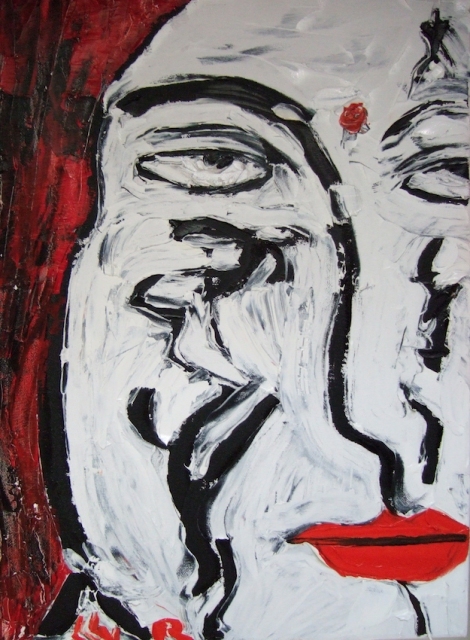
India
Story and Painting by Lehan Winifred Ramsay
The strange thing about failure is that you can work so hard to achieve it. I’ have painted and painted and painted, there has rarely been a time that I was not exhibiting my work, in a shop or a window. And yet I can honestly say that my career in painting has been remarkable in its lack of affect.
And then, I’ am doing it all wrong, and I know myself to be doing it all wrong. I do small paintings. I know that it is large paintings that capture people”””’s attention and I know that it is large paintings that you see in galleries and on the walls of homes. But I on’ly do small paintings. Partly I only do small paintings because I don’t know what I would do with a stack of big paintings, when they failed to sell just as my small paintings do. (Please forgive my lack of single apostrophes, this font doesn’t seem to have any) But, you know, you can’t make great big paintings without practice, and so it seems that at some point it is necessary to accumulate a stack of unsellable large paintings. That’s just the way things are.
I put my paintings in the window of the empty shop downtown and a number of people, after six months of silence, commented on them. That was good. They didn’t buy them, though. Since I have the impression that buying is the inevitable path one must take to critical success, I find that a little sad. I don’t really know what I need to do to make a change to this static situation.
I’ve put some on ebay, in my ebay store. This is because I have heard people say: you wouldn’t believe what people buy. I would like to believe what people buy, I would like them to buy my paintings. Nothing has happened yet, I suppose it may not ever happen.
Perhaps all this desire to have my paintings sell is simply good for one thing: keeping me painting. It fulfils some need for creative occupation, it satisfies my eye, it smells good, doesn’t cost so much money. So why not.
A thing that disturbs me is to look back at earlier paintings and see how much better done they are. Much more care for edging and lines and attention to (more) realistic renderings. Actually I can’t seem to be capable of going back to those paintings. Lines become faster and looser and rougher, a dog is barely a dog. Fascinating, disturbing and curious. I do love to look at my paintings, close up, at the paint textures and the pencil lines.
I saw these screens, in the discount shop. Room screens that fold into three, made of canvas. So you can paint a painting onto them. They are fantastic. But where would I put them, for years and years, until it was time to toss them into the pile for the second hand shop? Its very wasteful to fill unnecessary space.
Here. This one is called “India”, for no reason except the page I was turning at the time.
24 Saturday Dec 2011
Posted in Algernon
Tags
 By Algernon
I’ve returned to using public transport as a means of getting to work after years of driving. I’ve been interested watching how people stand and react waiting to catch various modes of transport. I drive Algernonia the elder to school for her early periods a few days per week the then catch a ferry. On other days I walk down to the corner and catch an express bus to the city.
Sydney’s public transport is much maligned. Decades of inaction by both sides of politics. Failure to build proper heavy rail to new housing estates like Rouse Hill twenty years ago instead building an inadequate M2 from nowhere to nowhere, then writing punitive damages into the contract should one be built. The utter stupidity of stopping the Parramatta to Chatswood rail link at Epping and thus consigning Macquarie Park to be in a form of traffic gridlock from 6:00am till 7:00pm on weekdays. On top of that there is only talk about additional rail being build under the city to cope with additional demand.
I’m fortunate however, working near Wynyard station that I can alight from my bus at the first bus stop in York Street, the short trip down to Town Hall can take as long as the trip to the city. Going home it’s the last bus stop with the bus then taking the freeway and Lane Cove tunnel before its first stop. I generally end up with a seat both ways, same on the ferry. Work colleagues who live in the Hills district tell me of having to stand for two or more hours a day.
There are some interesting characters on both forms and how they act, whilst waiting.
Firstly the ferry, they’re a fairly talkative bunch which catch the ferry, with plenty of banter before the ferry arrives. Once on the ferry the banter stops. One group of around seven in particular seems to do the same thing every day. One of the group, will take their position at the front of the queue, there rest will arrive and then congregate together. It’s not like they’re pushing in. Once the ferry arrives they go to the outdoor part at the back of the ferry, they don’t necessarily take up a seat and continue their conversation all the way to King Street where we all get off. Their conversation is nearly always positive. Most of the rest seem quite orderly and tend not to push in with the exception of one girl though nobody gets too excited. Most have their noses stuck in front of their electronic devices. The thing I like about the ferry is that it runs on time. Only twice inbound during the year did it run late and that was mechanical. Outbound also twice and one of those reasons was mechanical. They told us to catch a particular ferry and change at Cockatoo Island where a ferry was waiting. Pity it was pouring with rain at the time.

The bus has its characters too. Inbound is rarely late as our stop is the fourth on an express route. Homebound though is a lottery.
It’s a smaller crowd catching the bus in. One in particular we’ll call Beryl. Nice as at the stop chats with everyone and has interest in all those that catch the bus. Once there is sight of the bus though, Beryl becomes the bus Nazi. Woe and behold if the bus runs late, if the air conditioning is too cold, that is when the bus has air conditioning or someone dares to sit in her seat. Or a particularly mad woman bus driver is driving the bus. Beryl would be in her late fifties I’d guess. Even if she’s the last person to arrive she’ll almost insist on being the first person on. We just oblige knowing where she is aiming for.
Homebound well that’s a different story. Rare if ever on time and plenty more Beryls trying to catch it. She’ll push and barge here way to somewhere near the front of the queue along with all the others trying to barge their way to the front. One Chinese bloke has these silver things stick out of his ears. I think he feels they make him look invisible. The best way to deal with him I’ve found is to stand your ground. If he wants to get in front of you he has to walk in front of a bus. Another has his wife hog a seat for him. He’s not adverse to hitting and pushing people as he once did to me. I had to point out to him that you couldn’t go around hitting and pushing people at bus stops on a crowded bus.
I’ve run into someone I worked with who catches the same bus home he had looked familiar. He asked me if I was Algernon I couldn’t remember his. It had been about 15 years since we had last worked together. We compare notes about Beryl; she hasn’t been any different according to him.
Now wet weather makes the buses do odd things. Maybe it’s because people in Sydney forget how to drive when it rains, like they’ve never seen it. Does odd things to the punters too. One person stood in front of an oncoming bus with his umbrella to stop the damn thing, didn’t help. Beryl of cause goes completely ballistic as it might be 40 minutes late. Seems to forget that the traffic wasn’t moving at all on Clarence Street and the Bridge resembled a car park. She urges me to write to our state local member, he’ll fix things she says. In fact any time the bus is late she fires of a letter to him. Blowed if I know how he stops the rain from falling or what he does about the traffic.
After 20 years of travelling to and from work by car, I’m finding I’m less stressed by taking public transport. Except perhaps when it rains.
24 Saturday Dec 2011
Posted in Julian London
Tags
Pigadilly Circus
By Julian London
Christopher Hitchens smoked and drank
For some: bewildered; his words were dank.
Whether speaking or writing,
His words were exciting-
Always sensible, succinct and frank.
24 Saturday Dec 2011
Posted in Lehan Winifred Ramsay

Karesansui
By Lehan Winifred Ramsay
There will be no quotes on this page. Quotes are getting out of hand. Even recipe books contain quotes these days. Unfortunately it is just the beginning; Twitter is teaching people how to believe themselves to be full of wisdom and witicism. And training them to make their output entirely of quotes. Ridding consultants and other book writers of the need to troll through actual books and pull them out.
I don’t believe that half the quotes are really by the people who they’re said to be from. If I was to make a great quote, it would die a quick death. If I were to tell you all that it was really Henry Ford, perhaps it would do a few more rounds.
I have been reading some books on management, and it seems to me that a lot of people think that to be a good manager you have to go around giving out pithy little quotes that hit the ground running like a whiff of common sense. I say that probably gets people to stay watching your you-tube clip, may well bring in a thousand people to your TedTalk signing up for your daily blog-out. But otherwise, I can’t really see that it makes you a better manager.
It does though make you more popular, and a lot of people seem to think that good management equals popularity. And these days that is often the case. More and more rules are there to rid the workplace of dissent, initiative, chaos and creativity, and the result is, predictably, that we get good safe results that everyone is happy with because they cause no extra work and result in no unknowns.
Do you really think that Henry Ford had a best friend? I do not. Nor do I think that Einstein liked cats. Not only that, but I do not care if I am wrong. Which makes me a bad manager. I do not like Twitter, either.
24 Saturday Dec 2011
Posted in Sandshoe
Tags

The boys making a hundred.
By Sandshoe
Yellow flowers fallen off the overhanging branches of the cassia tree crumpled and stained the grassed public footpath. Parrots chattered among twists of juvenile cassia pods and grass seeds. A barbed-wire fence gloried a bed of marigolds.
A bunya pine littered needles and bark. An iron gate rusted and weathered to a mottled dark iron-red.
Salmon-pink, yellow, orange, orange-red and dusk-red single gerberas bloomed in narrow garden beds on each side of the front path. Mould flourished on the cement in pancake and starburst shapes. Tree roots cracked the cement open and the tree was cut down with an axe. Bird guano spackled the tree stump.
Hippeastrum displayed their red- and white-streaked blooms in garden beds on each side of the front steps. Crotons grew flame-like in summer. Caladium splashed purple-pink and dark green and olive dandled at pink, chard green and purple-red coleus. The thin lobes of the spider lily flowers drifted one way and another in the patch of spider lily at the eastern corner of the front garden bed. At the end of a day the lobes furled and the tips of the lobe touched. In the morning the lobes abandoned their cluster and drifted again.
The bungalow faced north. Red-brown leaves papered a row of straggling shrubs on its western side. Dirt prevailed where lower leaves and tassel-like flowers brushed at the ground and a remnant of yard lawn. A sometime pumpkin vine grew among weeds on the border of a neighbouring spare allotment, a bush lemon and an unproductive orange as a companion planting. Two pawpaw trees yielded their common fruit there in spite of a tatter of torn leaves and stripped branches.
A poinciana tree in the far front corner of the spare allotment threw its blossoms into the air against its massive trunk, the blues of tropical skies and their rain clouds, dank nights, a scrabble of weeds, molasses grass along a railway line and its barbed wire fence, the council verges, roads, bitumen, sand and gravel. The flowers washed in a downpour into a storm water drain on the opposite side of the adjacent side street.
Christmas Bush on the eastern side of the property bore brackets of pink blossoms. An adjacent cultivation of allamanda on the otherwise bare barbed-wire fence promised its yellow flowers for childish necklaces. An ungated opening in the fence revealed empty bolt holes in grey weathered posts. Vehicular access gates lent opened into the back yard.
In the back corner–against the back fence–a garage constructed of sheets of corrugated iron nailed and bolted onto heavy wooden frames lacked only a cross on its peaked roof to resemble a church. A mango tree tree next to it shed its flowers and did not fruit. Another mango loomed giantlike in the back yard and was laden in season.
A bungalow on high stilts on the other side of a laneway exposed its under things. No other mango tree in the vicinity was so prominent, exposed as the mango in the corner of that backyard apposite to the corrugated iron garage. The neighbouring backyard was flat and open behind the bungalow at the forefront of its block. Frank.
Wire clotheslines strung between extreme wind- and rain-weathered grey posts in the backyards of the properties propped on wooden support props.
I have described the setting of the home I grew up in, it long gone from a prime location at one end of a service laneway that runs through town congruent to the back of main street commercial properties and a spill of private homes. Tour bus drivers turned off at our end onto a football-field dimension verge so tourists could gawk in safety and comfort; our spread of a low set timber bungalow painted pale pastel green in paradise, its squared verandah posts supporting a pyramid roof, its façade a series of framed lattice screens supported by railings and subordinate barricades of vertical wooden rungs, its framed panel central front door made distinctive by a proud carved wood cornice operating as a drip cap above an oval grey-smoke glass inset in an oval frame. It must have been photographed by a thousand Box Brownies.
My childhood is the colour of rich, sweet mango flesh. Jumping, running, twirling in my imagination until I fall over in a tangle of grass and limbs, I see the green rush and the tilting ground rock. I am in a convulsive upheaval that leaves me sprawled and helpless, feeling queasy in a delicious rotting lawn of mango flesh.
The kitchen is an abstract geometry of background light. Long. An obscure surface. Emotions attach to shapes and the forms of past experience. The scratched edges of a painted wooden table and the intervention of a corner of an orange- and green-check seersucker table cloth. The dark enclosure under a kitchen dresser. Wooden chair legs stand alone against a pattern of yellow and black-squares on a stretch of linoleum.
The kitchen was at the back of the house. Outside the window over the kitchen sink–at the western end of the kitchen –an erratic shrub rustled chocolate-red and amber-red leaves and sticky flowers like a lone ranger. It applied resinous trace on the outside paintwork around the window and the window pane. A leatherhead sat amidst the leaves and flowers in the frame of the window.
Adjacent to the kitchen sink natural light slanted through a door onto the side verandah, shaped the cast off images and changing shadows on the verandah floor of lattice work and railings, vertical rungs and leaves and branches.
Step through the door with me. Come. We can follow in our imaginations the side verandah around onto the front verandah.
The foliage visible through the lower verandah rungs and lattice work of the side verandah is rust-red and red and brown and cream in sunshine. The galvanised iron roof and beam and support timbers emanate a sound. On our right the internal verandah walls of the bungalow are protected by overlapping vertical boards painted a pale hue titled Plum. Two sets of Single French doors with top and bottom rails and glass panels open onto the side verandah.
Here, past the second set, we turn right onto the front verandah. You will see on our left ahead the back of the front door with the oval glass inset I described and opposite it–on our right–an internal front door.
Please come in. Go in. Don’t be shy. It is my home. Walk straight in ahead of me.
We are in a breezeway. The ceilings are high. Stop right where we are both inside the front door. See open to us on our right and to our right behind us, a snug and comfortable appointment of living room chairs with broad arms and furniture–a radiogram against the wall in the corner, to our right backed against a drape a lounge chair, behind us against the front wall the 3-seater couch of the lounge suite, in the corner behind us to our right a bookcase with distinctive framed cut glass panel doors and–against the wall to the right of a doorway facing us–a stylish piano with sheet music and a metronome on top of it. A print–in a black frame–of a pencil and charcoal portrait of a collie sketched on grey paper hangs above a lounge chair immediately to the right of the doorway.
On our left on a wall is a porcelain wall vase decorated with a fine glaze and a florid orange and pastel blue swirl, next on our left is a door into a master bedroom and–in a plain gilt frame–a print of a Venetian canal at sunset.
The tongue and groove timber wall cladding of the living room is painted a pale shade barely discernible as green and in the middle of the living area a congoleum square–a ‘rug’–gives a rich depth of olive greens and orange and black and grey.
Any visible floor boards are painted a deep charcoal in places showing wear.
A linoleum runner strewn with a pattern of stylised cream daisies bordered by entwined olive green loops inside black tracks is common to the living room and the susequent room. We walk into the next room. Please see––to our left––a set of 6 wing-backed dining chairs, two pushed in either side and one at each end of a glass-topped dining table–its length at a right angle to us–and against the far wall facing our entrance from the living room a sideboard with on it crystal ware, a ringer telephone, a fob watch on a display stand, a portrait of an aged gentleman with beautiful eyes, a moustache, beard and smile lines. He has on a medium weight dark suit coat over a white shirt, the collar of which is a little large in its circumference and his tie is knotted with a comfortable, broad flourish.
A stylish wooden serving trolley beside the dining room sideboard––the length of the trolley parked against the wall facing us––is referred to in the family as a dumb waiter. A bone handled cutlery service is kept in a rectangular and flat veneered box on the tray top and various items of convenience on a lower tray.
A cross hatch pattern on linoleum on the body of the dining room floor is itself barely discernible almost obscured by furniture, chosen for a subtle effect and separated from the linoleum breezeway runner by a narrow margin of charcoal painted timber floor boards.
A door in a wall to our right leads off the dining room into a second bedroom. Please for now follow the linoleum runner with me to its conclusion past the end of the service trolley and step through into the kitchen.
We are in the kitchen again although at the eastern end of it. We are looking at the back door and four steps down to a smooth cement floor slab, bare impacted ground and the edge of a lawn. An ice chest to our left is positioned against the end wall of the kitchen to allow enough dimension we can easily open the door out towards us over the suprising black and yellow squares of the linoleum. Adjacent to the back of the ice chest an ancient edge of original linoleum at a dim boxroom doorway meets the new linoleum patterned with yellow and black squares. The back door opens into the kitchen to a position adjacent to the boxroom doorway.
Not a lot of light comes through the back door because of the pitch of the external roof over the external back verandah at the bottom of the stairs. A small aperture of open glass louvres half way down the length of the kitchen–in the back wall–allows in indirect light for the reason of the pitch of the roof over the back wall and external verandah. The frame of the window over the kitchen sink–at the other end of the kitchen–and the door onto the side verandah –adjacent to the kitchen sink–are full of light.
Let us retrace our steps however and look more at the interior of this family home and its decorative detail. If we step back into the dining room for example, see to your right hand side–beyond the length of the dining room table–a set of the Single French doors with top and bottom rails and glass panels open into an enclosed sleepout and a pair of stylish green and black patterned cotton curtains frame them.
On your left hand side, see through the door leading into the room I referred to as the second bedroom. We see the first of the French doors that open onto the side verandah.
Among miscellany–on a cotton embroidered linen cloth and reflected in the mirror of a dressing table/wardrobe angled across the left opposite corner of the bedroom is a pearlescent pink and black shining plastic Cadbury’s chocolate box–a treasure chest–emptied of its chocolates. The item houses satin and organza hair bows and a bluebird brooch in an original plastic box.
The bedroom is painted a pale pink and the chenille bedspread smoothed flat on a three-quarter size single bed on the right hand side of the room–its headboard facing us–is rose. A white cotton mosquitot net overhanging it on a round of loir cane suspended from the ceiling is tied in a knot out of way of its area of extension over the mattress it will be tucked under at night to exclude mosquitoes. The pattern on a covering of charcoal- and light grey carpet on the floor is freshly opened red, yellow, blue and pink roses interspersed with grey and white half concentric and intersecting lines.
Continuing on our way to retrace our steps to the front verandah please stop with me and admire on our left in the living room a pair of closed cotton drapes–a brilliant floral design–extending the available wall space. In front of them is a lounge chair and behind them is the second set of French doors that open onto the side verandah. We notice the detail of a Chinese ginger jar with its classic swirled pastel patterning on a white background and between figures of people. The ginger jar is on the top of the bookcase to our right in the far corner. Alongside it is a silver framed photograph of a group of people who appear to be dressed in the business clothing of the cities. A tattered pawpaw leaf in the photograph –behind the group–appears like a standard on the other side of a fence, a flag on relative high on a windless day.
We hesitate because we see the tip of an ivory horn mounted in a slot on a wooden base board––embellished with two pieces of ivory as wings––ornaments an occasional table.
We had to pick up the ivory bird and one of the wings slides out of the slot in the horn its tab has never properly fitted into so, like everybody before us in history, we take it in turns to––with difficulty––unhook the second wing from the body of the bird, examine the parts and reassemble them to make a bird. The wings are curious to the touch and the curve in each is different and seductive. The ivory is almost translucent.
A grey tone studio photograph on the radiogram is a half-profile portrait of a handsome 40-something man in collar-and-tie.
Glance to our right through the door leading off the living room into the small master bedroom. The walls are a bare cream. A double bed is made with a pure white cotton sheet stretched securely across its dimension and tucked in. A bolster is cased in a pure white cotton cover. A white cotton mosquito net is fitted on an attached wooden frame on the head of the bed and obscured behind its folds a significant sash window extends low against the back of a plain curved bedhead. The outlook of the sash window is onto the eastern end of the front verandah.
Were I permitted to lead you in to show you the architecture of the bungalow, you cannot walk straight across my parents’ bedroom to––the same––Single French doors with top and bottom rails and glass panels we can see open into another room. We have to walk around the end of the double bed and carefully by turning sideways past the corner of a dressing table.
The dressing table is positioned across the far right hand corner of the room. The veneer of the dressing table is precisely attached and its handles are delicate plastic items bound with brass lashing. A plastic plaque coated in a high-gloss clear resin with Rudyard Kipling’s poem ‘If’ printed on it sits in a sunken centre of the dressing table and alongside it a small box of sentiment finished in a light veneer. Alongside again but elevated––above a door closed on a storage cupboard –on the left hand side of the dressing table is a handsome black and white photograph in a plain silver frame of a man and a woman and four children arranged in a seated and crouched group around a seated baby; alongside on the other side, above a door closed on a storage cupboard on the right hand side is a grey-tone photographic studio portrait––in a plain silver frame––of an aged woman in a plain straw dress hat. The woman has a thin face, shining eyes. A collar and a small portion of the bust area of her shoulders reveal the fabric of her costume is pale––perhaps grey. She is dressed in a formal day frock.
Embroidered table linen with crocheted edges and crocheted table squares protect the walnut veneer of the table top from being scratched. Boxes stacked on the floor under the sunken centre of the dressing table advantage the vertical column of available space. Plastic red roses in a large crystal vase lying on the floor behind the shoe boxes are twisted together by their green stems. The floor covering we can see is an accomodating carpet square swirled with a pattern of orange and green abstract flowers on an amber background.
The room through the French doors––next––may have been a nursery. Linen is kept in it, a miscellany of boxes and a plump cream china rabbit with a broken ear. The inside of the rabbit is hollow. The inner surfaces of the rabbit’s ears are painted a roseate colour that is worn or the application is splattered and imperfect. Facing us an orange and green leadlight fronted dark stained linen press––possibly made of tropical timber––is the distinctive piece of furniture in that simple room that houses as well a burnished pine two door tallboy cupboard backed against the wall to the left of the doorway.
The walls are painted–barely cream. A worn and nondescript length of ageing linoleum runner partially covers the distance from one corner to a next and the boards of the floor are painted blue and worn. On the floor is a stack of National Geographic magazines angled forward next to the right hand corner––as we are facing it––of the linen press between two casement windows against the external wall.
The room is well illuminated by natural light. The casement windows have no curtains. They outlook onto the Christmas bush, side lawn, fence, allamanda, ungated pedestrian opening, laneway, the western side wall of the neighbouring bungalow and the row under it of tin caps on elevated stumps blackened with creosote.
Imagine. See to your right from where you were standing looking out one of the casement windows another door and it leads into the room I defined as an enclosed sleepout, alternatively accessible from the dining room through French doors.
The enclosed sleepout is pale green. Its furniture is robust and simple, two single plain beds with white cotton mosquito nets dangling over them off rounds of loir cane, a chest of drawers in a dressing table with an upper––mezzanine––table and mirror in an dominant carved heading and a lowboy cupboard.
Two casement windows open onto the same outlook as the linen room and one at its far end–a constituent of the back wall of the house–onto a length of rain water pipe slung between a downpipe and a circular corrugated iron tank off the back corner of the house.
The casement windows enabled a potential buffer of airiness between the extreme elements of a North Queensland summer, particularly its sunrise and the part of the internal wall––common to the sleepout––that was the blind wall opposite the box room door. The wall shared by the box room and the dining room––that the dining room sideboard was backed against and the wooden service trolley was parked alongside––was blind. Only a discrete window in the boxroom’s southern wall–a constituent of the back wall of the house–allowed a miser’s entrance of natural light in there.
Shelves in the boxroom held some pantry items. The usual reference to the room was pantry and so it was a pantry, yet I withheld the use of the term until the layout of the house was described to avoid confusion.
I digress. We have imagined ourselves into the enclosed sleep-out and now we understand the inter-relationship of the rooms might exit through the doors into the dining room and––taking care not to catch our clothing on the dining room chairs as we find our way past them and the dining table––find our way easily now back through the living room next onto the front verandah.
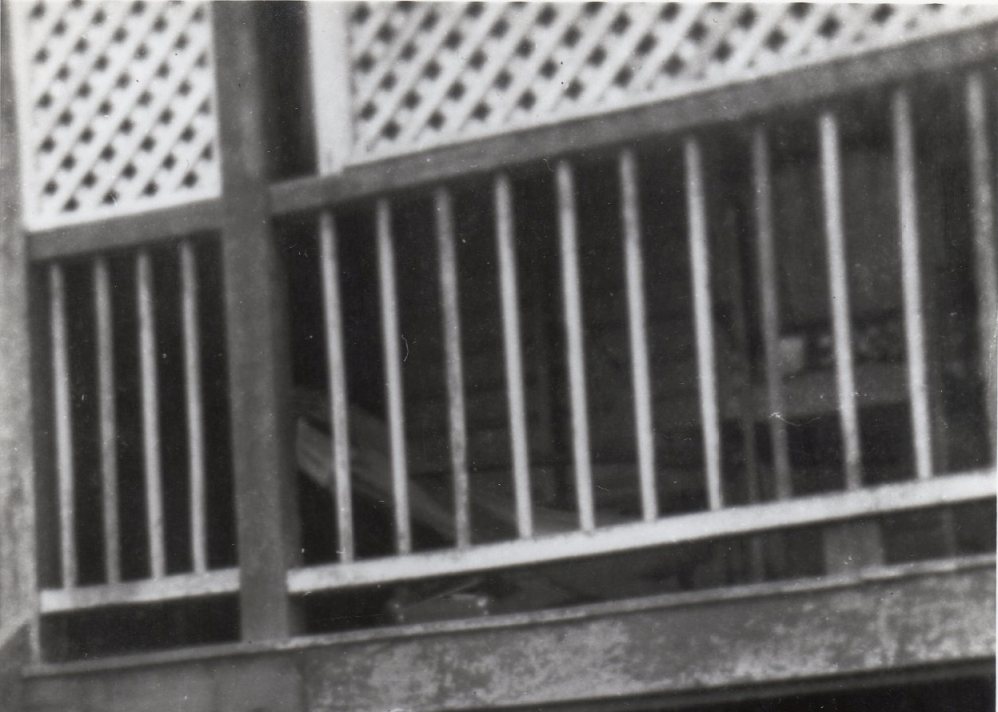
A partial view of the lattice screening and the vertical rungs
A wall of lattice to the right of the internal front door––looking to the eastern end of the verandah––extends from the front verandah’s façade of lattice work and subordinate railing and rungs to join a a door in a frame adjoining the internal front verandah wall––making a bedroom at the end of the verandah and sometime cubby house when emptied of its furniture. A white cotton mosquito net hangs over a frame attached to a single bed to our left. The bed is positioned against the façade of the bungalow. A blind made of lashed strips of bamboo cane has been suspended against the façade for privacy.
The headboard of the bed faces the internal lattice wall and leaves scant space between the end of the bed and the lattice.
A large cupboard in the room leaves scant space between it and the bed––or the door or the wall opposite the door––backed against the part of the internal front verandah wall that is blind and common to the room on its other side where the china rabbit lives.
Behind the cupboard pinned to a board is a reconnaisance map showing topographical detail, an unloaded rifle sits in the space beside the cupboard and external wall and a khaki army greatcoat hangs beside the doorway on a hook attached to the internal lattice wall. A leather case with in it a pair of binoculars hangs from a hook attached to the internal wall adjacent to the door into the room. Beside the bed on a fruit box covered with a linen cloth––pushed firmly against the external wall––is a time piece in a close-fitting soft leather case and a khaki cloth hat. The floor is bare floor boards other than for a sturdy brown rectangular mat. A Women’s Weekly magazine lies on the mat rolled open at an instalment of a serial and a copy of Mad magazine has slipped under the bed visible below the edge of a grey army blanket that is the bed cover.
Canvas on a deckchair in the front verandah corner made by the internal lattice wall and the front verandah façade fades over bare timber boards. A cross swivel extension on long pins on each of the arms of the chair has worn a scraped semi-cirlce of paint. An upright gramophone cupboard with a winder handle protruding out of its side is a dowager adjacent to the sash window of the master bedroom. Its veneer is dull and flecked by wear and design.
On the other side of the internal front door are two cane chairs and a low round wooden table that has a lower level shelf between outer curved pillars. The surface is painted pink and has a superficial black coating. I smear the material to show it makes a black smudge that transfers to the skin of my finger and indicate to strands of curled ash.
The sugar mill no longer exudes in the same malicious way the evening’s burn-off of mill bagasse out of its chimney in the crushing season.
The side verandah is furnished with a single bed against the wall under an overhead light bulb. Like all the lighting, the bulb is protected by a conical shade and the arrangement is without ornament.
An ironing board is set up on the side verandah–a temporary arrangement–at the internal corner of the front verandah to advantage a verandah breeze and access to a power point.
Cotton sheets–boiled and blue-bagged, washed, wrung and slung over the wire clothesline to dry on such a pleasant day as I am imagining have been taken off the line, folded and persuaded into rolls along with personal clothing including small items of linen and towels bundled in pillow cases. The washing–as it was still referred to–doused with water sprinkled and flicked over the articles and bundles is orderly in bundles on the ironing board. It is left to stand ready for ironing–a status referred to as ‘damped down’.
The laundry is set up under the boxroom window if you would like to imagine it–on a open cement porch–a set of stone tubs, a blue and yellow baked enamelled ringer washing machine and an electric copper accessible immediate to the four back steps. The bathroom is to our right–at the far western end of the porch –past the landing.
The landing was the redundant floor of the stove recess built as an original box extension onto the back of such a bungalow to lessen the heat a home in a tropical climate would otherwise be subjected to from a working wood stove fully encapsulated in a kitchen. The entrance of the recess had been walled, the small set of louvres inset in the wall and the recess wall on its eastern side and the back of the recess removed when the wood stove was replaced with a free standing electric stove positioned against the opposite internal kitchen wall. A small wooden table opposite the kitchen stove sits against the wall under the small set of louvres as a preparation table for cooking.
The remaining side wall of the recess was the upper portion of the wall of the attached bathroom originally serviced at the back of the house with hot water run out of an attached jacket on the wood stove, whereas the shower ran only cold water. Such was contemporaneity and its inconvenience in this respect a ‘bird bath’was usual.
A bather stood in an iron claw-foot bath tub to have the bath–facing a shallow baked enamel bowl on a pine board straddled across the end of the bath tub. Water boiled in a saucepan on the stove and mixed with cold tap water in the bowl was poured over the body with a small jug to make a discrete lather with soap and out of the bowl over the body to finish with ‘a rinse’.
The tub was positioned lengthwise along the wall to the right of the door into the bathroom––closest to the external wall opposite the doorway––and the shower rose over that end. A toilet was installed in the far left hand corner from the doorway–against the back wall–at a right angle to the tub. Inset in the wall opposite the doorway the lower half of the glass of a large sash window was painted to prevent a view into the bathroom from the side corner of the house. A rectangular cement septic tank dank with traces of fertile mould on its pocked surface was obvious partially above ground at the junction of the back wall and the eastern side wall.
The prolific character of moulds on the surface of the cement tank was encouraged by the surround of the shrubs on the eastern wall outside the kitchen window retarding air flow and the productivity of the mango tree in the backyard that shed mangoes. Flying fox dropped mangoes that were half eaten and the fruit cascaded down the grooves of the iron roof onto the tank.
Members of the family and visitors threw mangoes from the laneway side of the backyard towards a waste heap of mangoes rotting on the other. The smell of the surrounding area returns to my mind as a pleasant stench.
A study of the bungalow allows for an increased apreciation of simplicity in architecture and its visual strength. The four central rooms––living room, dining room and two bedrooms––are not large like the grand rooms of some mansion-dimension Queensland bungalows. The interest lies in the useful dimension of the front and side verandahs–naming the room off the master bedroom and the enclosed sleep-out off the dining room as components of an enclosed verandah and the boxroom/pantry and the kitchen as the enclosed back verandah
The social experience of housing determines the expectations that govern the rest of a child’s life. I have often reflected I grew up on a verandah. So much more to considering housing and writing a description of a domestic home of familiarity is not an easy writing sampler. I hope you have enjoyed the tour enough to finish with me. Thank you.
23 Friday Dec 2011
Posted in Emmjay, Pig Psalms
Tags
 It is said in the “Glass Canoe” (David Ireland’s 1980s Miles Franklin Award Winner) that beer is the “great golden god that has no voice and must speak through us”.
Three cheers for our host, Merv, from piglets one and all
We know that you are big and brave and muscular and tall
We know you will protect us when the Euro takes the fall
And super funds go guts up and leave us old with bugger-all.
When we’ve been speaking for the great gold God
And had too much to say,
Staring up from the tiles in the Mondrian loo,
Your majesty holds great sway.
But we all know not to fear you for you’re not the malevolent kind
Of leader some folk worship (that we pity but don’t mind)
We’re glad to stand beside our host
And drink to all, our Christmas toast
And raise with hope our future clear
For something far far better next year.
So kipping down, our stockings red
Are hanging on the end of the bed
And mine, I’m wondering, but hoping of course
How it could contain a thoroughbred horse
Or even if (and it’s a big if)
Perchance arrives a Zephyr diff.
19 Monday Dec 2011
Posted in Lehan Winifred Ramsay
By Lehan Ramsay
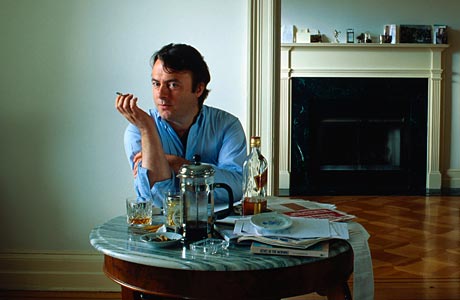
I figured that Christopher Hitchens felt a similar way about smoking and drinking that I did. That for all the threats about death and hideous illness, it wasn’t going to happen to those cool enough to stare death in the face. I figured that he was extremely embarrassed when he found out about his cancer. Here was the most embarrassing of demises for a chain-smoking boozer. And it wasn’t cool at all. So from the first announcement to the last, Christopher was stoic. I felt embarrassed for him, too.
I did find his speaking dazzling. But he annoyed me a lot. Sometimes, to be honest, I felt like answering one of his smug compact little word paintings with “nya nya nya nya nya”. He was a man who was at his best when you least knew him, I felt sorry for his family, not that he was likely to have talked to them, but who would have had to listen to his phone calls.
Still, in turning around the usual way of thinking and confounding his audience with something new, he was formidable. I hope they put a lot of cigarettes and alcohol into his coffin with him, he did good work on this earth, making people think.
17 Saturday Dec 2011
Posted in Algernon, Bands at the Pig's Arms, Entertainment Upstairs
Tags
1974, 1975, Abba, America, bachman turner overdrive, Barry White, David Bowie, David Essex, Division 4, Elton John, Eric Clapton, Fawlty Towers, Gloria Gaynor, Golden Earring, Janis Ian, music, Paul McCartney and Wings, queen, Rod Stewart, Roxy Music, Skyhooks, Steve Harley and Cockney Rebel, Stevie Wright, The Eagles, The Steve Miller Band, The Sweet, youtube

Cast of Fawlty Towers
Playlist by Algernon
As with the others these featured as Top 100 songs somewhere. Division 4 was a police “drama” which finished production in 1975. Interestingly the final episode was shown in Sydney in September 1975 and in Melbourne where it was produced in February of 1976! As for Fawlty Towers I could have put any amount of clips here and I’d still be rolling around on the floor.
http://www.youtube.com/watch?v=In1VeSjsBT8
Evie (parts 1, 2 & 3) – Stevie Wright
http://www.youtube.com/watch?v=qswKeWhjaUc
The Ballroom Blitz – The Sweet
http://www.youtube.com/watch?v=FdsedY0foGc
Sorrow –David Bowie
http://www.youtube.com/watch?v=JeRa3RtBiIU
Radar Love – Golden Earring
http://www.youtube.com/watch?v=EgkBx8csEws
Goodbye Yellow Brick Road – Elton John
http://www.youtube.com/watch?v=aK6jgzV32bg
Rock On – David Essex
http://www.youtube.com/watch?v=tRgcwT9X2J8
I shot the sheriff – Eric Clapton
http://www.youtube.com/watch?v=x0I6mhZ5wMw
Can’t get enough of you Love baby – Barry White
http://www.youtube.com/watch?v=pPOKJikcYMk
The Joker – The Steve Miller Band
http://www.youtube.com/watch?v=besiULlSlFY
Jet – Paul McCartney and Wings
http://www.youtube.com/watch?v=pOAvY5Pct1Q
Once upon a time – Division 4 (1975)
http://www.youtube.com/watch?v=khgpg-9TjVM
Talkative Moose – Fawlty Towers
http://www.youtube.com/watch?v=e5wHvzKDugA
The Builders – Fawlty Towers
http://www.youtube.com/watch?v=jRJ1y6GBQqE
Basil the Rat – Fawlty Towers
http://www.youtube.com/watch?v=o7l8rlnMpCI
Horror Movie – Skyhooks
http://www.youtube.com/watch?v=1Ti2P_z5IPw
Killer Queen – Queen
http://www.youtube.com/watch?v=RmmWJBwxvz0
One of these nights – The Eagles
http://www.youtube.com/watch?v=7miRCLeFSJo
Ain’t seen nothing yet – Bachman Turner Overdrive
http://www.youtube.com/watch?v=XIycEe59Auc
Sister golden hair – America
http://www.youtube.com/watch?v=7bYOZdM2tpg
Golden Years – David Bowie
http://www.youtube.com/watch?v=LRRLTxIxNtM
Love is the drug – Roxy Music
http://www.youtube.com/watch?v=Fxoke4yuWlI
Come up and see me (Make me smile) – Steve Harley and Cockney Rebel
http://www.youtube.com/watch?v=lhFnOAwr96o
At 17 – Janis Ian
http://www.youtube.com/watch?v=ExwMYBXbfCQ
Never could say goodbye – Gloria Gaynor
Keywords: Stevie Wright, The Sweet, David Bowie, Golden Earring, Elton John, David Essex, Eric Clapton, The Steve Miller Band, Division 4, Fawlty Towers, Skyhooks, Queen, The Eagles, Bachman Turner Overdrive, America, David Bowie, Roxy Music, Steve Harley and Cockney Rebel, Janis Ian, Gloria Gaynor, Barry White, Paul McCartney and Wings

