• The Pig’s Arms
  • About
  • The Dump

Window Dresser's Arms, Pig & Whistle

~ The Home Pub of the Famous Pink Drinks and Trotter's Ale

Window Dresser's Arms, Pig & Whistle

Author Archives: Therese Trouserzoff

Building Block Monster

11 Friday Mar 2011

Posted by Therese Trouserzoff in Lehan Winifred Ramsay

≈ 13 Comments

Tags

Monster blocks

Building Block Monster

Painting and Story by Lehan Winifred Ramsay

Small autonomous monster blocks will move in the same direction until a small pebble on the ground, a twig, a rough patch, sets them off course. For a long time they will appear to be in formation. Eventually they will veer wildly. The ant sits for what feels like a long, long time, watching them, occasionally nudging one or the other until it moves back into it’s path. But the small monster blocks are reliable only at accomplishing their small tasks. Working together is beyond them, and after consultation with the Ant Elders, the ant has formed a new plan. The small monster blocks will have to nudge and nestle themselves up and over each other block until they form one block. The Building Block Monster. Not yet a social being, but an automated device capable of more complex behaviour.  Capable of social behaviour and limited problem solving. Each block able to mimic the commands of the ant, one block correcting other blocks. One central control containing hierarchical ordering. The Building Block Monster is a RoBlock.

Pig’s Psalm 12 – the Director of Music

09 Wednesday Mar 2011

Posted by Therese Trouserzoff in Emmjay, Pig Psalms

≈ 29 Comments

Tags

humour, Pig's Psalm

It is to you, our Waz,  whizz of musicological magic

That we look for inspiration

And a howling reminder of the great tunefulness of the youtube-o-sphere

Thy range is inexhaustible.

Thy tastes hyper-eclectic, tinged with soppiness

But

Counterbalanced with edgy Zappa-like overtones.

And a tendency to lope off into the sunset with a jaunty, sandy-furred carefree gait.

Blessed be you, our Waz for the music is in you and you are in the music.

Amen (Chorus)

The Small Monster Blocks

03 Thursday Mar 2011

Posted by Therese Trouserzoff in Lehan Winifred Ramsay

≈ 6 Comments

Tags

Blocks, Monster, Painting

Small Monster Building Blocks

Painting and Story by Lehan Winifred Ramsay

The ant with his whole world carried on his back struggles at life. The world is heavy, the only way to make it easier is to make blocks. Each of these blocks contains a task that needs to be done. Publicity is a block, keeping the house clean is a block, preparing classes is a block, the maintenance of pets is a block. Once each of these blocks is constructed and set in motion, it will carry on automatically, not halted by anything but the largest obstacle. In this way the ant has learned the use of tools, extending his six legs with autonomous blocks. Small monster blocks.

A Cloud Across His Face

27 Sunday Feb 2011

Posted by Therese Trouserzoff in Lehan Winifred Ramsay

≈ 11 Comments

Tags

Ant, Painting


A Cloud Covers His Face (2)

Painting and Story by Lehan Winifred Ramsay

Every ant we see is carrying a small world on his back. You didn’t know? It’s easy enough to tell once you do. Every so often they slow down a little and stretch out their aching back. That’s all. One tiny gesture. Go outside and find one, and and watch for a while.

We don’t see the ants that don’t carry a world. They haven’t fallen yet. Still up in the clouds. Golden hued. Not yet afraid of heights.

VIVIENNE’s Thoughts and Recipes for Autumn

27 Sunday Feb 2011

Posted by Therese Trouserzoff in The Dining Room, Vivienne

≈ 39 Comments

Tags

honey duck, lamb kebabs, pork spare ribs, Recipes


I feel that Autumn is a time for being re-inspired in the kitchen.  If it has been too hot and humid for a long time, cooking (for me anyway) often becomes a bit of a chore in as much as I really would like a magic wand.  Sometimes I find myself making a potato salad (with cream and mayo and spring onions), throwing together a tossed salad and then cutting up a bought chicken or just cooking a decent piece of steak.  Sometimes I ask my husband ‘what would you like to cook tonight darling?”

Right now the hot and humid days have finally gone and energy is coming back.  Here are some of my favourites for weekend family eating.

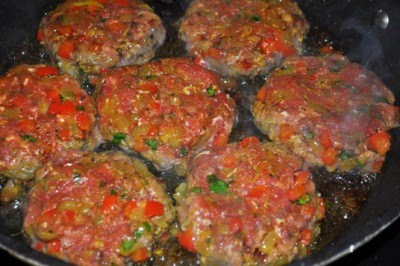
Shami Kebabs (lamb meatballs)

For this I suggest you ask your butcher to bone out a leg of lamb, skin it and put it through the coarse mincer (not fine).   About 600g will make plenty as a snack for 4. (The remainder goes in the freezer.)

Put 3 slices of white bread (crust removed) in a bowl and add milk to soak until it is mush.  Pour off any milk and squeeze till bread no longer drips.   Mix the meat and bread together and add the following:

  • 1 medium onion, very finely chopped
  • 3 cloves of crushed garlic
  • 1 inch chunk of fresh ginger, grated
  • 2 teaspoons of garam masala
  • 1 teaspoon of chilli powder
  • 1 teaspoon salt
  • ½ teaspoon black pepper
  • 1-2 tablespoons of fresh chopped mint
  • 1 egg
  • 1 tablespoon of plain flour

Mix very well.   Form into small balls about the size of a walnut (definitely no more than 3cms diameter).   Traditionally about three of these would be threaded onto a metal or bamboo skewer and then deep fried.  However, I think it is easier (and possibly safer) to just shallow fry individual balls in peanut oil, fairly quickly.   It doesn’t take long.  Drain on absorbent paper and keep warm until you have finished doing a number of batches (you can’t do them all at once).

Great eaten hot, warm or cold – as a snack or part of a bigger spread.  Mango chutney goes well as does a minty yoghurt.

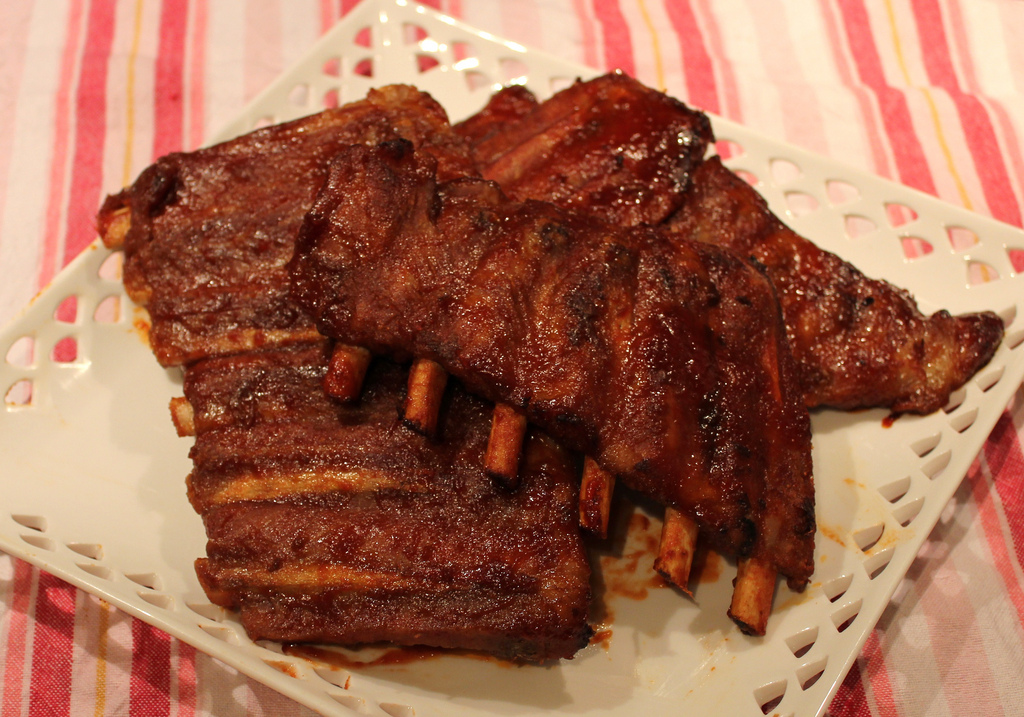
American style Pork Ribs

The trick to this dish is finding the right spare ribs.  I really do mean RIBS – they don’t have a lot of meat on them so you need to be fairly discerning in picking out the best.  My butcher doesn’t have them but I usually find them at the Safeway meat section.  Ridiculously expensive at $5-7 for just one slab of them.  To feed four people I need five or six packets.

Place ribs in a large baking dish and pop into medium hot oven to cook about ¾ through.  Add nothing, just the ribs.  The purpose is actually to cook out any fat.  Take pieces out and cut into sections of 4 or 5 ribs each.  Clean out the baking dish and arrange rib pieces side by side.   Mix the following together in a bowl:

  • About 150 ml of golden syrup
  • ½  teaspoon of cayenne pepper
  • ½  teaspoon of salt and a little pepper
  • 2 cloves of crushed garlic (more if you like)
  • 2 tablespoons of tomato paste
  • 1 ½ tablespoons of dijon mustard

Coat the top side of the ribs with this mixture and cook in oven till it becomes sticky.  Turn ribs over and coat the other side and cook again till sticky.

The mixture can be increased proportionately to fit the quantity of ribs you are cooking.  The above amount probably is just enough for 4 sets of ribs.

Serve with a little boiled rice and salad or whatever takes your fancy.


Duck de Chirico

Duck with Muscat-Honey Sauce

Buy a good duck such as Luv-a-Duck (size 20-22) which is sufficient for four people.

Place in baking dish, sprinkle with salt and then into medium hot oven.  Cook for about three hours, turning occasionally, sprinkling more salt and pricking here and there to release fat.  About 2/3rds of the way through reduce oven temperature a little.  You want the duck well cooked but not ruined.  This is a sort of confit style.

While duck is cooking boil at least one potato per person until at least half done.  Peel and cut into large cubes.  About 30 minutes before you are ready to eat, heat a large pan and add butter and the potatoes plus salt (Murray River flakes if you have them).  Turn about every now and then till crisping up.     Also prepare whatever other vegetable you might like or preferably make a really good mixed greens salad with cherry tomatoes, slices of pear, shaved real parmesan etc.

Now for this part you need to take care – remove duck to large plate and then drain off the fat in the pan into a jar for use later.   You should wind up with at least half a cup of total duck juices.   Put these juices into a small saucepan on the stove top.  Add equal quantities of Muscat (about $10 for a bottle of Chambers regular muscat) and honey (about the same quantity as the juices you have saved).

Cook and stir till it starts to foam.  Remove from heat and let settle so you can test taste.  It should be about right – sweet and yum.

Cut duck up into quarters or carve if you prefer.  Carefully share out the sauce for each serving.    Make your plate look nice and have an appropriate good wine to accompany (my favourite sparkling Shiraz-Durif goes down particularly well).

—ooo—

Euronews/NoComment

23 Wednesday Feb 2011

Posted by Therese Trouserzoff in Politics in the Pig's Arms, The Public Bar

≈ 16 Comments

I posted a comment over at the Crikey video of the day, praising the work of ordinary folks who filmed the Christchurch disaster live from their mobile phones and posted faster on Youtube than any of the mainstream media.

More than that, there was no offensive bullshit halfwit news reportage a la ABC 24 hours.  There were the images – use your own mind to assess what you see.  No explanation needed.  Not helpful for some talking head to say how awful it all was.

“Lambkins” added a useful tip – that Euronews has a comparable segment called “no comment”.

So I had a peep – for example – surprised to hear what’s happening in Egypt as far as the important ancient site tourism.  I was wondering if I might ever get to see the pyramids and Valley of the Kings – and catch up with both the Emmlets who have been there independently….

“At euronews we believe in the intelligence of our viewers and we think that the mission of a news channel is to deliver facts without any opinion or bias, so that the viewers can make their own opinion on world events.

We also think that sometimes images need no explanation or commentary, which is why we created No Comment and now No Comment TV: to show the world from a different angle…”

And so we have   Euronews no comment

Check it out

The Hanged Man

23 Wednesday Feb 2011

Posted by Therese Trouserzoff in Lehan Winifred Ramsay

≈ 16 Comments

Tags

Ant

The Hanged Man

Painting and Story by Lehan Winifred Ramsay

Here’s what I learned, in my ant struggles. It is not enough to give up. You need to be mercilessly diligent in your efforts to not give up. Sure, it may seem like an eternal hassle to get that phone company to do something about your problem. And it will be: that’s not the point. The point is that as long as there is something that can be done, there will be something that you can do. No more frustration at the impossibility of everything. You need to turn each dumb-arse impasse of service into a breathtaking new canyon of possibilities with a far horizon. Yes, we’re talking doco-more. A Soft Bank of them to land on. The Aye! Phone.

Start at the bottom, with the first point of contact, and continue with it until it takes you up a step. Understand that that step has been introduced merely to give you a place to step down to. Step down if you must. Then start again. This time you might find another step. Take that. Understand that it’s merely a way to provide you with a chute by which to slide down to the bottom. Slide down if you must. Each time you meet the impasse, try to get a sense of what’s ahead. Before you go down again I mean. Next time, aim for the other side.

What you discover after a time, if you don’t get frustrated, if you choose not to see a wall, is that there are probably going to be ways, and some people some times are going to get along a bit. Your goal cannot be the fulfilment and resolution of the original problem. Most likely you are not going to manage that. Is that important? You need a new goal: understanding and entering the system. It’s a different kind of win. But much more entertaining. By all means Hang. But do a bit of hacking while you’re about it.

Alternative Energy Sources: With Will There’s A Way

23 Wednesday Feb 2011

Posted by Therese Trouserzoff in Warrigal Mirriyuula

≈ 9 Comments

Tags

alternative energy sources, solar power, wind power

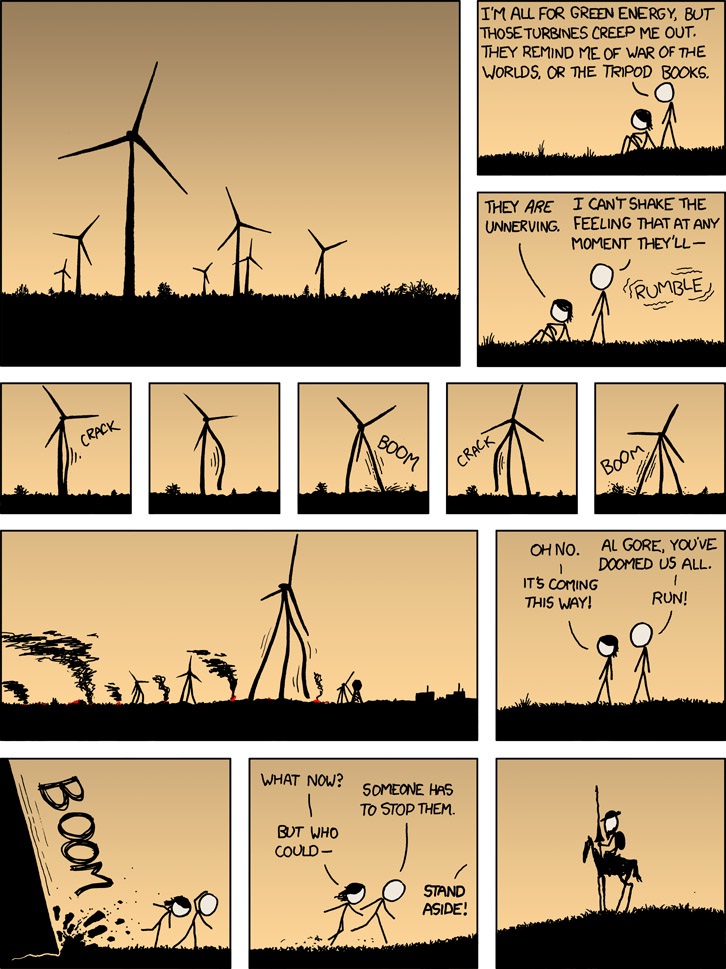
© XKCD (I borrowed this cartoon from: http://xkcd.com/556/)

Story Edited by Warrigal

It’s been a matter of some perplexity to me that governments and industry the world over have failed to pick the low hanging alternative energy fruit. While solar rebates and subsidies for domestic solar cell installation have enjoyed mixed success here in Australia and similar schemes operate globally, there seems to be a general blindness to the full potential of these existing technologies.

So if I said that a recent paper from no less august an institution than Stanford sets out a clear path to an alternative green energy future that would save perhaps as many as 3 million lives a year and simultaneously halt global warming, reduce air and water pollution and develop secure, reliable energy sources; nearly all with existing technology, and at costs comparable with what we spend on energy today you’d have to be pretty interested wouldn’t you. Further we can achieve all that according to this study by converting the world to sustainable and renewable energy sources and completely obviate the need for burning fossil fuels.

The new study co-authored by Stanford researcher Mark Z. Jacobson and Mark A. Delucchi sets out a scheme for achieving exactly that.

“Based on our findings, there are no technological or economic barriers to converting the entire world to clean, renewable energy sources,” said Jacobson, a professor of civil and environmental engineering. “It is a question of whether we have the societal and political will.”

Jacobson and Delucchi, of the University of California-Davis, have written a two-part paper in the publication Energy Policy, in which they assess the costs, technology and material requirements of converting the planet, using the plan they developed.

The world they envision would run largely on electricity. Their plan calls for using wind, water and solar energy to generate power, with wind and solar power contributing 90 percent of the needed energy.

Geothermal and hydroelectric sources would each contribute about 4 percent in their plan (70 percent of the hydroelectric is already in place), with the remaining 2 percent from wave and tidal power.

Vehicles, ships and trains would be powered by electricity and hydrogen fuel cells. Aircraft would run on liquid hydrogen. Homes would be cooled and warmed with electric heaters — no more natural gas or coal — and water would be preheated by the sun.

Commercial processes would be powered by electricity and hydrogen. In all cases, the hydrogen would be produced from electricity. Thus, wind, water and sun would power the world.

The researchers approached the conversion with the goal that by 2030, all new energy generation would come from wind, water and solar, and by 2050, all pre-existing energy production would be converted as well.

“We wanted to quantify what is necessary in order to replace all the current energy infrastructure — for all purposes — with a really clean and sustainable energy infrastructure within 20 to 40 years,” said Jacobson.

One of the benefits of the plan is that it results in a 30 percent reduction in world energy demand since it involves converting combustion processes to electrical or hydrogen fuel cell processes. Electricity is much more efficient than combustion.

That reduction in the amount of power needed, along with the millions of lives saved by the reduction in air pollution from elimination of fossil fuels, would help keep the costs of the conversion down.

“When you actually account for all the costs to society — including medical costs — of the current fuel structure, the costs of our plan are relatively similar to what we have today,” Jacobson said.

One of the biggest hurdles with wind and solar energy is that both can be highly variable, which has raised doubts about whether either source is reliable enough to provide “base load” energy, the minimum amount of energy that must be available to customers at any given hour of the day.

Jacobson said that the variability can be overcome.

“The most important thing is to combine renewable energy sources into a bundle,” he said. “If you combine them as one commodity and use hydroelectric to fill in gaps, it is a lot easier to match demand.”

Wind and solar are complementary, Jacobson said, as wind often peaks at night and sunlight peaks during the day. Using hydroelectric power to fill in the gaps, as it does in our current infrastructure, allows demand to be precisely met by supply in most cases. Other renewable sources such as geothermal and tidal power can also be used to supplement the power from wind and solar sources.

“One of the most promising methods of insuring that supply matches demand is using long-distance transmission to connect widely dispersed sites,” said Delucchi. Even if conditions are poor for wind or solar energy generation in one area on a given day, a few hundred miles away the winds could be blowing steadily and the sun shining.

“With a system that is 100 percent wind, water and solar, you can’t use normal methods for matching supply and demand. You have to have what people call a supergrid, with long-distance transmission and really good management,” he said.

Another method of meeting demand could entail building a bigger renewable-energy infrastructure to match peak hourly demand and use the off-hours excess electricity to produce hydrogen for the industrial and transportation sectors.

Using pricing to control peak demands, a tool that is used today, would also help.

Jacobson and Delucchi assessed whether their plan might run into problems with the amounts of material needed to build all the turbines, solar collectors and other devices.

They found that even materials such as platinum and the rare earth metals, the most obvious potential supply bottlenecks, are available in sufficient amounts. And recycling could effectively extend the supply.

“For solar cells there are different materials, but there are so many choices that if one becomes short, you can switch,” Jacobson said. “Major materials for wind energy are concrete and steel and there is no shortage of those.”

Jacobson and Delucchi calculated the number of wind turbines needed to implement their plan, as well as the number of solar plants, rooftop photovoltaic cells, geothermal, hydroelectric, tidal and wave-energy installations.

They found that to power 100 percent of the world for all purposes from wind, water and solar resources, the footprint needed is about 0.4 percent of the world’s land (mostly solar footprint) and the spacing between installations is another 0.6 percent of the world’s land (mostly wind-turbine spacing), Jacobson said.

One of the criticisms of wind power is that wind farms require large amounts of land, due to the spacing required between the windmills to prevent interference of turbulence from one turbine on another.

“Most of the land between wind turbines is available for other uses, such as pasture or farming,” Jacobson said. “The actual footprint required by wind turbines to power half the world’s energy is less than the area of Manhattan.” If half the wind farms were located offshore, a single Manhattan would suffice.

Jacobson said that about 1 percent of the wind turbines required are already in place, and a lesser percentage for solar power.

“This really involves a large scale transformation,” he said. “It would require an effort comparable to the Apollo moon project or constructing the interstate highway system.”

“But it is possible, without even having to go to new technologies,” Jacobson said. “We really need to just decide collectively that this is the direction we want to head as a society.”


Jacobson is the director of Stanford’s Atmosphere/Energy Program and a senior fellow at Stanford’s Woods Institute for the Environment and the Precourt Institute for Energy.

Story Source:

The above story is reprinted (with editorial adaptations) from ScienceDaily.

Source materials provided by Stanford University. The original article was written by Louis Bergeron.

Journal References:

1. Mark Z. Jacobson, Mark A. Delucchi. Providing all global energy with wind, water, and solar power, Part I: Technologies, energy resources, quantities and areas of infrastructure, and materials. Energy Policy, 2010; DOI: 10.1016/j.enpol.2010.11.040

2. Mark A. Delucchi, Mark Z. Jacobson. Providing all global energy with wind, water, and solar power, Part II: Reliability, system and transmission costs, and policies. Energy Policy, 2010; DOI: 10.1016/j.enpol.2010.11.045

 

Where’s there’s Hope, there’s Cagney

23 Wednesday Feb 2011

Posted by Therese Trouserzoff in Entertainment Upstairs

≈ 15 Comments

Contributed (drawn from the Spam-o-sphere) by an old mate – Rod

REAL STARS… 

James Cagney and Bob Hope at a Friar’s Club Meeting back when actors were real performers, Bob Hope was 52 and James Cagney was 56. For the young folks, here is something you probably have never seen before and, unfortunately, you may never see again. For us older folks, this is the best of the best, and we had it for many years! This is a side of these two entertainers you hardly ever saw but it shows you their enormous talent. Bob Hope, the best of the comedians, and Jimmy Cagney mostly cast as the bad guy, gangster in the movies. Enjoy!

HopeandCagney

HopeandCagney

Pig Psalm 12- A Noise Annoys

21 Monday Feb 2011

Posted by Therese Trouserzoff in Uncategorized

≈ 32 Comments

Our VoR

It is unto you in times like these

We seek the neighbours to appease.

Down to the Council, with strong voices

They do complain of the Pig’s Arms noises.

It was only Gez and perhaps his missus

In the carpark revved up the Lambrettistas

Obtuse the Angles came to play and pissed around last Saturday

All bluff and bluster it’s been said

Until our cocky was found stone dead.

It lowers the tone of our precincts

And presages the arrival of gangs of Finks

So Vinh, Miss Ordinaire of Rouge

Make haste and with your presence felt

Show the flag and wield the belt

And quieten down this part of town

And hold at bay

The noise-inspector’s frown.

← Older posts
Newer posts →

Patrons Posts

  • Nothing Should Re: Tardis October 16, 2026
  • Apollo Mission 1 October 5, 2026
  • Good Luck With That – Space Travel and How Boring It Really Is October 2, 2026
  • Further O’Way September 21, 2026
  • The Middle Ages September 15, 2026
  • The Early Days September 14, 2026
  • One More Mile August 31, 2026
  • God versus Satan August 24, 2026
  • Man on the Street August 21, 2026

We've been hit...

  • 874,293 times

Blogroll

  • atomou the Greek philosopher and the ancient Greek stage
  • Crikey
  • Gerard & Helvi Oosterman
  • Hello World Walk along with Me
  • Hungs World
  • Lehan Winifred Ramsay
  • Neville Cole
  • Politics 101
  • Sandshoe
  • the political sword

We've been hit...

  • 874,293 times

Patrons Posts

  • Nothing Should Re: Tardis October 16, 2026
  • Apollo Mission 1 October 5, 2026
  • Good Luck With That – Space Travel and How Boring It Really Is October 2, 2026
  • Further O’Way September 21, 2026
  • The Middle Ages September 15, 2026
  • The Early Days September 14, 2026
  • One More Mile August 31, 2026
  • God versus Satan August 24, 2026
  • Man on the Street August 21, 2026

Enter your email address to subscribe to this blog and receive notifications of new posts by email.

Join 370 other subscribers

Rooms athe Pigs Arms

The Old Stuff

  • RSS - Posts
  • RSS - Comments

Enter your email address to subscribe to this blog and receive notifications of new posts by email.

Join 370 other subscribers

Archives

Website Powered by WordPress.com.

  • Subscribe Subscribed
    Window Dresser's Arms, Pig & Whistle
    Join 276 other subscribers

    Have a WordPress.com account? Log in now.

  • Window Dresser's Arms, Pig & Whistle
    View site in Reader
    Manage subscriptionsSign upLog in
    Report this content
    Collapse this bar
Loading Comments...