A Place For Us—A melancholy musical episodic intro to the Father O’Way Chronicles
Becoming a priest turned out to be considerably easier than I had expected.
Staying one was easier still.
This came as something of a relief because, as previously discussed, I had never been burdened by ambition. Ambition requires effort, planning and, in extreme cases, getting up before nine.
St Generic Brand suited me perfectly.
I had a house. I had food. There were people who knew how to cook the food. I had somewhere to sleep and, once a week, I had to stand in front of a group of people and say generally pleasant things about being nice to one another.
God hardly entered into it.
[Author: He’s still an atheist.]
[Sandy: I know.]
[Author: Just checking.]
The church was run by Bishop Veri Bent, universally known as the Bish, although not usually while he was within earshot unless you wanted to spend the following week helping Billy unblock the drains.
Veri was an unusual churchman.
He believed the best way to help poor people was to help poor people.
This radical theology had prevented him from rising much further in the Church.
Every Monday morning at eleven we held the St Generic Brand staff meeting under a large marquee behind the church. Eleven suited Veri because it gave him sufficient time to wake up, read the paper, drink several coffees, apply a nicotine patch, have a bath, eat breakfast and contemplate whether attending his own meeting was absolutely necessary.
Billy, on the other hand, had been awake since dawn.
There was something wrong with Billy.
At one end of the table sat Bishop Veri Bent.
At the other sat Sister Horribleness.
The rest of us sat wherever survival seemed most likely.
Sister Horribleness was a woman of formidable faith, formidable dimensions and formidable hearing. She could detect a whispered obscenity through two brick walls and a lawnmower.
I once suspected she could hear thoughts.
I stopped having them around her.
On this particular Monday I made the mistake of muttering something while she was speaking.
Her head turned slowly.
“Did you have something to say, Father O’Way?”
“No, Sister.”
“You appeared to be speaking.”
“I was praying.”
“You don’t pray.”
Bugger.
She knew me too well.
“Would you care to address the chair?”
I looked at my chair.
The chair offered nothing.
It was wooden, unsympathetic and, judging by previous meetings, probably outranked me.
“No, Sister. Thank you, Sister.”
There. I had stood my ground.
Firmly.
Silently.
While retreating.
It is a skill.
People sometimes mistake cowardice for weakness. This is unfair. Cowardice has kept me alive through situations that bravery would have made considerably worse.
Veri cleared his throat.
“All right, troops. Jobs for the week.”
This was the part of St Generic Brand I actually liked.
We didn’t spend much time saving souls. Souls, as Veri once explained, were difficult to locate and impossible to invoice.
People were easier.
Someone needed food, we found food.
Someone needed somewhere to sleep, we found somewhere to sleep.
Someone was lonely, we visited them.
Someone needed a wheelchair ramp, Billy built one, usually stronger than the building it was attached to.
Proselytising was discouraged.
“You can give a bloke a sandwich,” Veri used to say, “without making him listen to a bloody sermon first.”
For a bishop, he had his moments.
That week Billy had been asked to organise access ramps for a centre helping children with disabilities.
I was given a refugee family who needed somewhere to live.
The money came from the congregation.
No television appeal.
No giant cheque.
No photograph of Veri handing the cheque over while looking concerned.
People put money in. People needed help. The money went out.
It was almost as though religion could work if you removed most of the religion.
[Author: Careful, Sandy.]
[Sandy: What?]
[Author: You’re becoming sincere.]
[Sandy: Sorry.]
Services were held every Sunday, except for two particularly sacred occasions during the year when St Generic Brand closed completely.
One was around New Year.
The other was Good Easter Day.
I never understood why it was called Good Easter Day, but Veri insisted this was because the staff had worked hard all year and deserved a day off.
There may have been a theological explanation as well.
Nobody asked for it.
The rest of the staff were mostly women.
This was another unexpected advantage of my calling.
[Author: Sandy.]
[Sandy: I’m just establishing the cast.]
[Author: You were about to establish something.]
[Sandy: I resent the implication.]
There were eight Citizen sisters: Juanita, Jacinta, Melinda, Rosita, Edwina, Sophia, Cassandra and Belinda.
There was also Glenda, although Glenda had escaped the family business and opened an establishment next door called Glenda’s House of Pain.
I never asked exactly what happened inside.
Billy did.
Billy wouldn’t tell me.
He would only stare into the distance and whisper, “Mate.”
The Citizen sisters did most of the things that caused St Generic Brand to function while the male clergy took credit for having a successful organisation.
I say this with some authority because I was one of the male clergy.
Then there was Belinda.
Belinda Citizen.
I had seen her around the place but had not yet actually spoken to her.
This arrangement suited me.
From a distance I was intelligent, articulate and occasionally charming.
At close range, particularly in the presence of an attractive woman, I had the conversational ability of damp carpet.
Belinda was beautiful.
There. I’ve said it.
[Author: You said it twelve times in the original.]
[Sandy: I was younger.]
[Author: You wrote it years later.]
[Sandy: Get out of my brackets.]
She wasn’t beautiful in the way magazines insist women are beautiful. She wasn’t standing under perfect lighting while someone held a reflector under her chin.
She was just… Belinda.
Dark, intelligent eyes. A smile that seemed to arrive a fraction before she did. The sort of face that made you want to think of something clever to say approximately ten seconds after the opportunity had passed.
I watched her walking across the courtyard.
Not staring.
Observing.
Pastorally.
She came towards me.
This was unexpected.
I considered escape.
Too late.
“Hi, Sandy.”
She knew my name.
This was serious.
“Hello.”
Excellent start.
“My name’s Belinda.”
“I know.”
Too enthusiastic.
“I mean, I’ve heard. Your name. Not heard your name speaking. People have said it. Your sisters. Not all at once.”
She smiled.
I considered taking a vow of silence.
“I believe you’ve met most of the family.”
“Yes.”
“Except Glenda?”
I glanced towards the building next door.
A sign in the window read:
GLENDA’S HOUSE OF PAIN BY APPOINTMENT WALK-INS MAY REGRET IT
“I haven’t had the pleasure.”
Belinda laughed.
“You might not call it pleasure.”
I liked her immediately.
This was inconvenient.
“Well,” she said, “I’d better get back to work. Nice meeting you, Sandy.”
“Meet to glad you.”
There was a pause.
A very small pause.
But long enough for several civilisations to rise and collapse inside my head.
Then Belinda laughed.
Not at me.
Well, probably at me.
But kindly.
I laughed too.
And just like that, something extraordinary happened.
Nothing.
No choir sang.
No sunlight burst through the clouds.
God did not speak, which was fortunate because I still didn’t believe in Him and the paperwork would have been horrendous.
Belinda simply walked away.
I watched her go.
For pastoral reasons.
[Author: Get on with it.]
[Sandy: I was getting on with it.]
[Author: Very slowly.]
[Sandy: These things take time.]
I didn’t know where it was going.
Not then.
All I knew was that I had somehow become Father Sandy O’Way of St Generic Brand: atheist priest, reluctant social worker, professional coward and, apparently, a man capable of saying “Meet to glad you” to the most beautiful woman he had ever seen.
The priesthood had given me a home, three meals a day and very reasonable working hours.
It was now about to complicate my life considerably.
A Place For Us—A melancholy musical episodic intro to the Father O’Way Chronicles
My name is Sandy.
Well, sort of.
My real name is Alexander Leonard Lyndhurst O’Way, which gives me the initials ALLOW and goes some way towards explaining my lifelong distrust of acronyms.
Not all of it, mind you.
The rest would require several hundred pages, three government inquiries and possibly a diagram.
I was born at the Inner Cyberia Hospital, usually abbreviated to ICH. Children later inserted a T and called it ITCH, on the reasonable grounds that nobody ever went into the place without coming home scratching something.
Inner Cyberia, for those unfamiliar with the geography, lies between Middle Cyberia and Outer Cyberia.
Obviously.
I arrived during change of shift.
This was my first mistake.
Nurses, administrators, doctors and probably air-traffic controllers dislike anything happening during handover because everyone is simultaneously responsible for everything and therefore nobody is responsible for anything.
Somewhere in this delicate administrative interval I was given to the wrong family.
The Wong family.
This distinction would become important.
Walter and Mavis Wong had also been expecting a child and, as far as anyone could determine afterwards, Inner Cyberia Hospital simply issued one baby to each family and called the matter completed.
The Wongs took me home.
The O’Ways took somebody else.
Nobody noticed immediately because babies are hopeless at identification.
I spent the first part of my life as a Wong.
Walter Wong was a watchmaker and a man of ideas, many of which were considered dangerous because they had not already occurred to somebody important.
Across the front of his shop, in letters large enough to be read from Middle Cyberia, were the words:
WALTER WONG’S WATCHES
Below this, in even larger letters:
WWW
Walter was extremely proud of that.
“One day, Nick, this will all be yours.”
Nick was me.
Why I was Nick has been lost to history.
Walter had also developed an interest in computers, although computers in those days were approximately the size of Tasmania and required their own weather system.
One evening over dinner he announced that one day computers would communicate with each other through telephone lines.
People stopped eating.
Walter continued.
The information, he explained, could be broken into little packets, sent separately and reconstructed at the other end.
There was silence.
An uncle eventually put down his chopsticks.
“Walter,” he said gently, “have you considered getting some rest?”
Walter had not.
The following week several serious men visited him and suggested that perhaps he was working too hard.
History later vindicated Walter, although by then somebody else had pinched WWW.
He remained bitter about it.
My life with the Wongs revolved around Walter’s watches, Mavis’s kitchen and food that I would later remember with considerable affection: fish, rice, vegetables, soups and things that tasted of ginger, garlic and ingredients nobody at the O’Way house had ever met.
Then the Pleece arrived.
The Pleece are similar to police except their spelling was determined during an industrial dispute.
A constable stood at the Wong family door with a clipboard.
“Mavis Wong?”
“Yes?”
“There has been an error at Inner Cyberia Hospital. You appear to have brought home the wrong child.”
Mavis frowned.
“The Wong child?”
“No. The wrong child.”
“Yes. Wong.”
“No. Wrong.”
“That what I say.”
“No, Mrs Wong. W-R-O-N-G.”
“W-O-N-G.”
The constable looked at his clipboard.
The clipboard offered no assistance.
A sergeant was called.
Then an inspector.
The inspector eventually determined that the Wongs had the O’Way baby and the O’Ways had the Wong baby, which meant that both families had the wrong baby although only one of them had the Wong baby.
The paperwork became formidable.
[A note for the reader: occasionally the author and I disagree about how this story should be told. Those conversations appear in square brackets. I would prefer they didn’t. — Sandy]
[Author: Sandy, are we going to need a diagram here? Sandy: Probably. Author: We don’t have a diagram. Sandy: Then tell them to concentrate.]
Eventually I was delivered to John and Olive O’Way.
John was a Traffic Control Officer with the Main Roads Department.
A lollipop man.
Olive was a farmer’s daughter.
They were poor, kind and utterly bewildered by the small child who had suddenly arrived with opinions about rice.
Dinner changed.
Fish and rice became lamb and potatoes.
The first plate of roast lamb placed in front of me was regarded by the O’Ways as normal food and by me as evidence that something catastrophic had occurred.
There were peas.
The peas had been boiled long enough to remove any possibility of resistance.
Potatoes came in several forms, although all of them ultimately involved potatoes.
It took time.
Culture does.
The adults regarded the baby exchange as a mistake that had now been corrected.
For the children it was more complicated.
I had already belonged somewhere else.
Fortunately, something rather good came out of the whole mess.
The Wongs and the O’Ways became friends.
Walter and John would sit for hours arguing about politics, technology, roadworks and whether a watch that gained three minutes a week was still technically a watch.
Mavis and Olive exchanged recipes.
So fish and rice returned.
Lamb and potatoes travelled in the opposite direction.
For a while I had two families.
Then Walter was offered a job in Outer Cyberia.
It involved attempting to put an egg back together after it had fallen from a wall.
He said the government money was excellent.
The Wongs moved away.
Outer Cyberia is a long way from Inner Cyberia.
Not merely a long way.
A long way, followed by another long way, and then a bit more long way for administrative purposes.
I missed them.
Children are supposed to adapt.
Adults say this because adults are usually the ones causing whatever children are adapting to.
School began soon afterwards.
Mum broke the news.
“You start Monday.”
“Oh.”
“You’ll like it.”
This turned out to be false.
“What happens Tuesday?”
“You go back.”
That seemed vindictive.
School interfered badly with my education.
I wanted to build things.
Circuit boards fascinated me. Radios fascinated me. Machines fascinated me. I wanted to build a robot in Dad’s shed.
Instead I was required to sit in rows while adults explained things I either already knew or had no intention of ever needing.
Then Billy Bishop arrived.
William Bishop officially.
Billy immediately.
We became mates because neither of us required much convincing that the best use of a summer afternoon was cricket.
We played cricket.
Football.
Soccer.
Anything involving a ball, a patch of ground and the possibility of somebody’s window being broken.
Billy was better at fighting than I was.
This was useful because I had already discovered an important principle which would guide me throughout adult life:
Confrontation should be avoided wherever possible.
Preferably by somebody else confronting it.
I was good at running.
Billy was good at convincing the person chasing us that further pursuit might result in dental expenses.
Between us we formed an efficient social unit.
Around 1966 something strange happened.
I remember a Mintie wrapper.
At least I think I do.
A station wagon went past. Somebody let a wrapper fly from the window and I picked it up.
What followed is less reliable.
There may have been a public meeting.
There may have been a protest.
There may have been signs demanding biodegradable Mintie wrappers.
I have a vague memory of thousands of people, riot police and possibly a tank, which seems excessive for confectionery packaging even by Inner Cyberian standards.
Then there was a cloud.
And a man.
A peculiar man wearing an English flat cap.
“Listen up,” he said.
I remember the name Gordon.
Gordon O’Donnell.
G.O.D.
Another bloody acronym.
His clothes were ordinary, his flat cap was ordinary, and he looked like a man who might have difficulty finding enough change for the bus.
Years later I discovered Gordon could have bought the bus company.
And the bank that financed it.
And, technically, the money.
He told us impossible things.
Computers would become small enough to carry.
They would communicate with each other.
A man would walk on the moon.
Someone would eventually discover the answer to life, the universe and everything but have considerable difficulty establishing what the question was.
Then Gordon said he was going to make us forget the entire incident.
After that my memory stops.
Which rather supports his case.
For years afterwards I occasionally dreamed about a man in a flat cap.
I never thought much about it.
There are some things the human mind sensibly files under Not My Problem.
I have always had a very large folder.
Billy and I survived school until the Orange Incident.
We had decided to steal some oranges from a local orchard.
I wish to emphasise that these were oranges.
Not diamonds.
Not plutonium.
Oranges.
Inner Cyberia, however, has always taken citrus crime seriously.
We climbed the fence and filled our shirts.
The owner appeared carrying what I later learned was an Anti-Orange-Stealing Device.
An AK-47.
He demonstrated its operation.
We ran.
There is an old expression about being caught between a rock and a hard place.
When somebody is firing an AK-47 in your direction, both the rock and the hard place become attractive housing options.
The Pleece arrived.
For once I was delighted to see them.
They prevented the orchardist from improving his aim and arrested Billy and me instead.
Stealing oranges, we discovered, was a serious offence.
Tax evasion merely required a better accountant.
Orange theft meant reform school.
We were sentenced to the Sow End High School for Boys with Criminal Records.
SEHSBCR.
I tried making an acronym from it and suffered a nosebleed.
Sow End contained some frightening people.
There were boys who could solve a Rubik’s Cube in seconds.
Boys who could use calculators without reading the instructions.
One could recite pi to twenty-five decimal places.
Billy knew karate.
I knew where somebody had left a four-by-two.
Eventually a peaceful understanding developed.
School at Sow End was mostly endurance.
Billy and I stayed together.
At first Mum visited.
Then visits became letters.
Then the letters became less frequent.
Eventually I received one that appeared to have been generated by a machine.
Dear {Insert Name Here},
We have had to let your room. Unfortunately you will not be able to return home after completing school. We all miss you {Insert Name Here}.
Mum
I read it twice.
Then a third time in case my name had appeared while I wasn’t looking.
It hadn’t.
Billy sat beside me.
“What are you going to do?”
“Cross them off the Christmas card list.”
“You don’t send Christmas cards.”
“Good. Saves time.”
It hurt.
I’m not going to pretend it didn’t.
But humour is useful when there isn’t much else available.
In our final year at Sow End, Father Veritas Bent came to speak to us.
Veri Bent.
Of course he was.
He represented the Church of St Generic Brand.
Attendance was compulsory.
The alternative was afternoon work detail, so naturally the auditorium was packed with deeply committed young theologians.
Father Veri explained that St Generic Brand was unusual.
All were welcome.
People could believe in God.
Or not.
They could belong to different religions.
Or none.
There was one important rule.
No proselytising.
“What’s proselytising?” Billy whispered.
“No idea.”
“Sounds painful.”
Father Veri continued.
The church’s work was simple.
Feed people.
Help people.
Provide shelter where possible.
Try not to be a bastard.
I looked at Billy.
Billy looked at me.
Neither of us believed in God.
That had never been particularly complicated.
If God existed, I reasoned, my football team would have won more often.
Case closed.
After the lecture Billy was thoughtful.
“I might do that.”
“Do what?”
“Become a priest.”
I laughed.
Billy didn’t.
“Think about it. They give you somewhere to live.”
I stopped laughing.
“Go on.”
“Food.”
“Interesting.”
“Regular meals.”
“Very interesting.”
“You wear a funny outfit and listen to people’s problems.”
“Any heavy lifting?”
“Probably not.”
Billy Bishop had found religion.
Not God.
Religion.
There is a difference.
A few weeks later Billy left for St Generic Brand.
I didn’t.
When Sow End finally released me into society, society immediately demanded to know what skills I possessed.
I could play cricket.
I could solder.
I had some unfinished ideas about robots.
I could run remarkably fast when being shot at.
None of these were currently advertised.
Eventually I obtained employment in a wing-nut factory.
The work demanded peak physical fitness, high intelligence and exceptional dexterity.
Fortunately none of these were actually checked.
The process consisted of putting a wing together with a nut and pressing a button.
A wing nut emerged.
Civilisation continued.
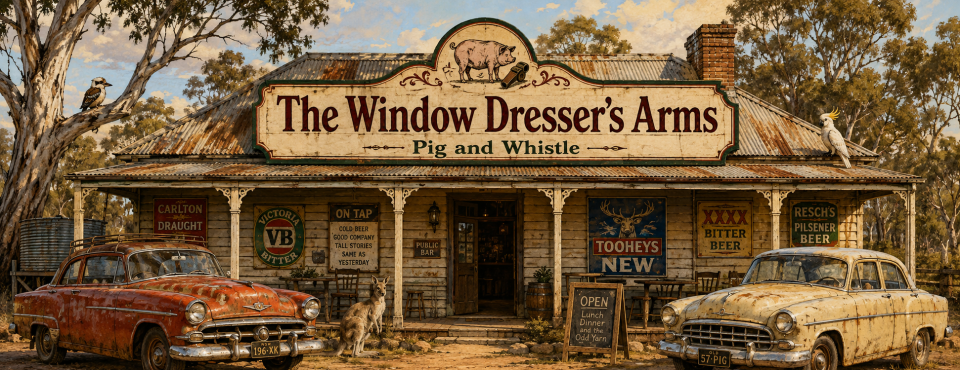
I boarded at Madame La SpaghettiBolognaise’s Commorancy, not far from the Window Dresser’s Arms Pig and Whistle, generally known as the Pig’s Arms because nobody could be bothered saying the rest.
Madame was magnificent.
You could tell the day of the week from the sauce.
Monday might be garlic.
Tuesday chilli.
Wednesday mushroom.
Sunday was roast chicken.
She took our wages and returned a small portion as spending money, an arrangement she described as teaching financial responsibility.
Looking back, I think it mostly taught Madame La SpaghettiBolognaise financial responsibility.
Still, I had a bed.
I had food.
I had work.
And I was miserable.
In the afternoons I would kick a football around the park and think about the robot I had never finished.
One afternoon a priest walked towards me.
I prepared to escape.
Then he grinned.
Billy.
He looked healthy.
More than healthy.
He looked well fed.
This made a considerable impression.
“Sandy!”
“Billy!”
We hugged.
I stood back and examined him.
The cassock looked ridiculous.
The grin did not.
“You look happy.”
“I am.”
This was suspicious.
Billy invited me to St Generic Brand the following Sunday.
“I don’t believe in God.”
“Neither do I.”
“You’re a priest.”
“Yes.”
“That seems like a significant administrative error.”
“You’ll fit right in.”
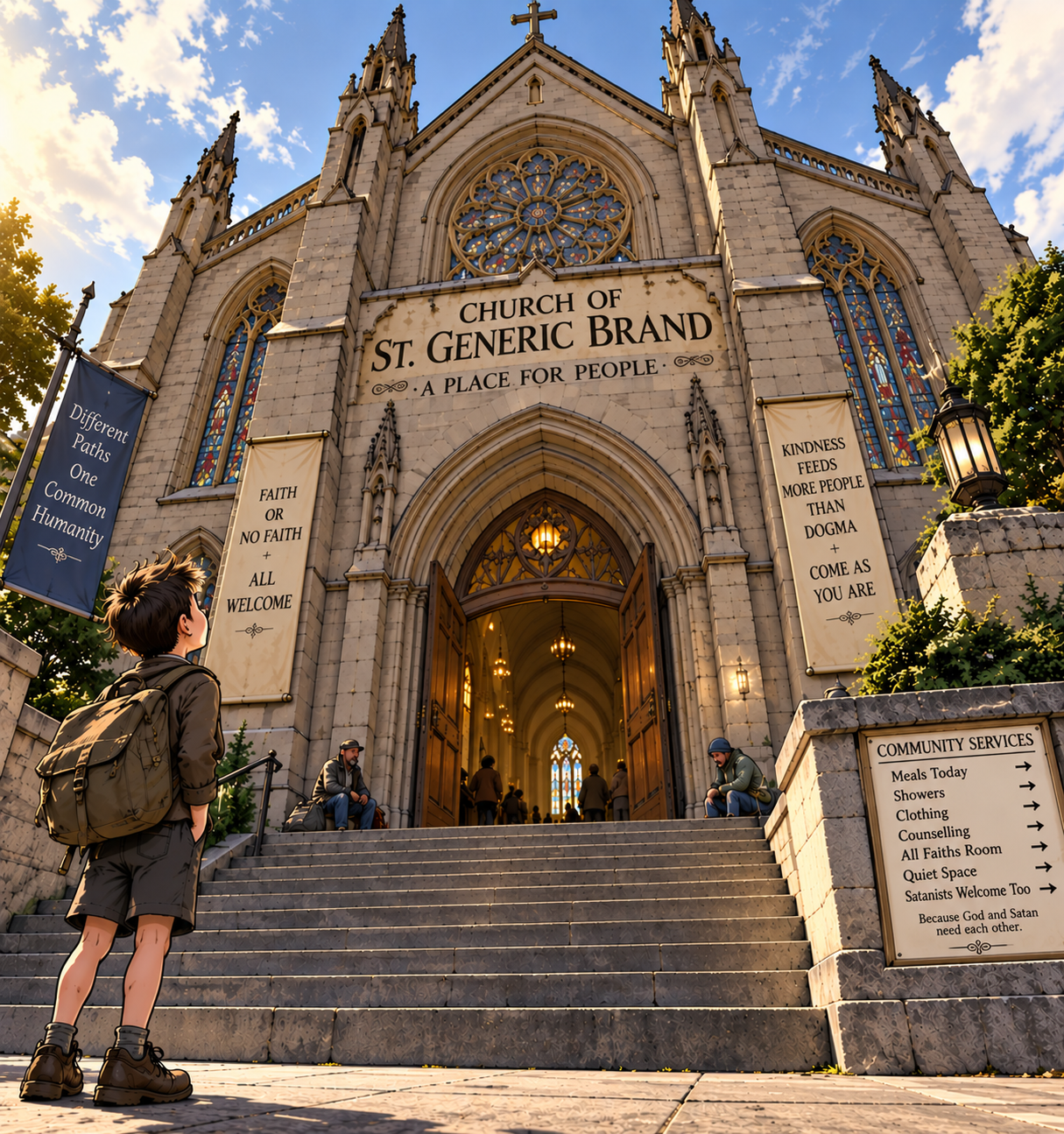
On Sunday morning I walked towards St Generic Brand expecting stained glass, threats of eternal damnation and possibly a collection plate.
The building surprised me.
It was old but beautifully restored.
People were arriving from everywhere.
Different clothes.
Different ages.
Different backgrounds.
Some entered one room.
Others another.
There were spaces set aside for different faiths and quiet spaces for people who simply wanted somewhere to sit and think.
Nobody seemed interested in converting anybody.
I found Billy at the gate.
“So what exactly do you people believe?”
Billy shrugged.
“Depends who you ask.”
“That doesn’t sound very organised.”
“That’s why it works.”
He showed me around.
Later everyone gathered beneath a large marquee.
Tables filled with food.
For one glorious moment I thought this was the priesthood’s famous catering package.
Then buses arrived from St Porcine Nursing Home.
Another vehicle had been driving the streets offering homeless people a shower, clean clothes and a meal.
They ate first.
We served them.
An old bloke wanted tea.
A woman from the nursing home wanted another slice of cake and informed me that at her age dietary advice could go to hell.
A man who had been sleeping rough asked whether there was any more roast lamb.
There was.
I gave him plenty.
For some reason I thought about fish and rice.
Then lamb and potatoes.
Mavis and Olive exchanging recipes.
Two families arguing over a baby until eventually deciding there was enough room for everybody.
Something clicked.
Not God.
Let’s not get carried away.
But something.
[Author: Sandy, this is getting dangerously sincere. Sandy: I know. Author: Want me to put in a fart joke? Sandy: Give it another paragraph.]
Billy found me stacking plates.
“You enjoyed today.”
It wasn’t a question.
“Don’t get excited.”
“You did.”
“All right. Yes.”
“Veri wants to meet you.”
Father Veritas Bent had recently been promoted.
That created a vacancy.
Apparently St Generic Brand required another kind-hearted young man.
There had obviously been a shortage of applicants.
Veri explained the position.
Accommodation.
Meals.
A small allowance.
Community work.
Listening to people.
Helping where possible.
There was even a housekeeper.
I considered the theological implications very carefully.
“How firm is the God requirement?”
Veri smiled.
“Believe whatever you like. Just don’t force it on anyone else.”
“And the job?”
“Feed people who are hungry. Help people who need help. Try to leave things a little better than you found them.”
This seemed dangerously reasonable.
“What about sermons?”
“Keep them short.”
“I think I may have a calling.”
Billy coughed.
“You have a housing problem.”
“Sometimes the Lord moves in practical ways.”
“You don’t believe in the Lord.”
“Then he’s exceeded expectations.”
And that, more or less, is how Alexander Leonard Lyndhurst O’Way — Sandy to his friends — became Father O’Way of the Church of St Generic Brand, Inner Cyberia.
I still didn’t believe in God.
I did believe in lunch.
I believed that homeless people should be fed.
I believed old people deserved another slice of cake if they bloody well wanted one.
I believed that nobody should be bullied into believing anything.
And I believed that a job providing a house, meals and a housekeeper was considerably better than making wing nuts.
It wasn’t much of a theology.
But it was a start.
Years later Billy Bishop would climb the ecclesiastical ladder and become Bishop Bishop.
I would remain where I was perfectly comfortable.
Until the Bish discovered that the Pig’s Arms needed a foreign correspondent.
And somebody remembered I owned a passport.
My first assignment was Kerobokan.
That was when things really began to go wrong.
Although somewhere, in a part of my memory I could never quite reach, a peculiar man in a flat cap was already waiting for me.
“I am so sorry to hear about your loss, Bettina”. “Ah, don’t be.” “Thank God he is gone, the miserable man”. And with that, the Bettina with the massive battle ship chin dismissed the passing of her husband of over forty years. Sometimes, people hide their grief with putting up a brave front. I don’t think she was in that category, having known both of them for over twenty years.
Sometime during the seventies both Bettina and husband Bob in their wild and impetuous youth traveled Europe in a left hand drive large bus converted to a camper wagon. You now see them everywhere, sometimes with bicycles or even a boat strapped at the back or on the roof. I saw a camper wagon recently that even towed a small car to buzz about in. And no doubt used, through the help of a GPS satellite system, to guide the happy travelers to the nearest Aldi or Woolworth emporium, to stock up on the essentials, including butter and lamb chops with continental parsley.
Bettina and husband Bob, (while in their youth) traveled overland back to Australia where they lived in a large house near the water. It must have been quite an adventure when Afghanistan and Burma were hardly on the well trodden traveler’s route. You would often see Bob and wife with their large grey converted left hand drive vehicle driving around the place with Bob never missing a friendly wave.
He used to regale their travel adventures to us but his Bettina would butt in ‘ oh, nonsense Bob, it wasn’t like that’ and than impose her version of it. He just used to smile and let her do the talking. He did love her, or at least allowed her the freedom to dominate him in conversations.
While on their return journey, they had filled their bus up with Afghan tapestries and carpets which they sold to anyone keen on a bargain. It were the days of so many young couples with children setting up camp in the inner city of Sydney. A true beginning of city living instead of the mind boggling boring but well promoted ‘dream’ of living in the suburbs.
As the years went by, as they seem to so relentlessly, Bob became profoundly deaf and conversations became stilted and awry. A great pity. He was always the friendly giving man and his wife the shouting over the top with such a large chin to accept (in a round-a-bout way). In any case, a long standing marriage were both no doubt had found their levels of comfort and acceptance of each other. True love?
I sometimes thought of Bob waking up and turning towards his Bettina and see the familiar large chin jutting above the sheets. He loved her, that’s for sure, and accepted her as lovingly as any caring husband would. Millions of couple all over the world do this. Hundreds of millions more likely.
And then, Bob died suddenly. Towards the last few years he had a long white beard and often stood silently next to his beloved Bettina. He was now as deaf as a bucket of sand and could not converse as before even though he would sometimes still break out and, while still smiling, mention bits about Afghanistan. Bettina now mostly had the full attention of the audience.
“Thank God he is gone” is what she said. (after forty years)
We usually start off in life from a bed or if not a bed, something soft. Not many mothers would give birth to a baby on top of rocks or on a push bike. When the birth pain arrives and the waters break, a comfortable soft and safe place is what most would prefer. This is where you all started. That tabernacle of life. Of course, about nine months earlier there would have been some kind of mating going on, hopefully consensual and perhaps even loving. The glorious pleasure of two becoming one, limbs entwined with a joining that seems to be what most of us will also seek, once we have left the birthing bed, and grown up as well. Perhaps also a few of us might well be a result of illicit love affairs conducted with passion on the finery of satin sheets with Lilies of the Valley carefully embroidered. Perhaps blue irises on down pillows featured beneath the thighs of a voluptuous woman giving into complete rapture to her ardent lover…?
Perhaps, doing the rounds amongst those Vinnie’s fashion items from the past, we re-discover those sweet scents, those delicate fragrances of bygone years of the many souls of evaporated lovers. It’s all so long ago now. How did we fare since leaving the bed of our birth mothers, having to make our own? Do we still carry around and live off the love of rose petals strewn around so abundantly and carefree at our beginning?
Can anyone understand people buying new beds, beds to which no memories or cares are attached? I made our own bed from Oregon pine more than fifty years ago. It is still as good now as it was then and travelled with us between continents and cities many times. Our bed as would many of those belonging to others withstood the storms of tempestuous oceans as well as the joys of soothing, weaving grassy meadows strewn with buttercups.
It seems such an awful telling sign of those discarded beds that are now featuring at many a shopping centre car-park. People must, perhaps at the dead of the night, get up and lash the hated mattress on to the top of their Holden Ute, dump their beds. There are clear signs at those charity collection bins not to leave bedding. Yet, it seems the temptation to get rid of beds overcomes the warnings, and the soiled and stained remnants of bedding and dead loves are left there. At any given time there must be those, so utterly disappointed in what those beds produced, they feel the urgent need to jettison those hated items of joyless nights and loathsome sad embraces. They drive, looking for the graveyards of hopeless loves and hateful congress but end up in the grey concrete of Westfield’s car-park or the Vinnie’s bin in front of Woolies.
Is it not so true that we deserve the beds that we lie in?