Tags
Art, books, Gordon O’Donnell, humour, photography, Space travel, travel, writing
Oh well, never mind.
Written by Verity, edited by Mark.
GOOD LUCK WITH THAT
Space Travel and How Boring It Really Is
Episode Two — The Shortest Distance Between Two Points Is a Nuisance
The first thing you should understand about travelling through space is that there is absolutely nowhere to stop for a tea. The second is that, should you encounter somewhere offering tea, you would be well advised to keep going.
I had been aboard Rudolph for seventy-three hours, during which time I had travelled approximately four hundred billion kilometres, eaten twelve meals, visited the lavatory nine times and discovered that the ship possessed a small room containing nothing but a chair. The chair was bolted to the floor. Above it hung a sign.
DO NOT SIT HERE.
Naturally, I sat. Nothing happened.
I waited. Still nothing.
Eventually Nick appeared in the doorway, his translucent blue figure flickering, with what I had come to recognise as electronic disappointment.
“You’re sitting in the emergency existential stabilisation chair.”
“What’s it supposed to do?” I say. Well, you know, maybe not for sure.
“Prevent the occupant from becoming detached from reality during dimensional displacement.”
“And?”
“You haven’t been dimensionally displaced.”
“Then why am I sitting here?”
“I was rather hoping you could tell me.”
He disappeared.
I remained seated for another twenty minutes, largely because I was determined to get something out of the experience.
Eventually I returned to the bridge.
Rudolph was a magnificent vessel. The Reindeer Company of Meup had spared absolutely no expense in designing him, principally because the university was paying.
From the outside he resembled a long, elegant silver needle, sixty-three metres from his sharply pointed red nose to the cluster of propulsion vanes at his stern. His hull consisted of overlapping hexagonal plates of molecularly aligned neutronium composite, each thinner than paper and considerably less forgiving. Beneath the plates ran millions of microscopic channels carrying coolant, electrical impulses and a substance the engineers had referred to as liquid probability.
Nobody had explained the last one.
The ship’s interior was ninety-one metres long.
This troubled me.
Nick assured me it was perfectly normal.
“Dimensional engineering”, he explained. “We simply folded the interior through an additional spatial axis.”
“Where’s the extra twenty-eight metres?”
“Inside.”
“Inside what?”
“The ship.”
I decided not to pursue the matter.
The bridge occupied the forward section, directly behind Rudolph’s enormous glowing nose. It was a circular chamber surrounded by sweeping observation panels, with a central command chair, two secondary consoles and a floating navigational display that resembled a miniature galaxy suspended in blue light. The floor was polished black, the walls a softly glowing silver, and the ceiling contained enough instrumentation to operate a small planetary government.
Most of it was unnecessary.
Rudolph could fly himself.
Indeed, he preferred to.
Whenever I touched the controls, a discreet message appeared.
ARE YOU QUITE SURE?
Occasionally it added:
WE HAVE INSURANCE, BUT THERE ARE LIMITS.
Behind the bridge stretched a narrow corridor whose walls curved almost imperceptibly with the ship’s artificial gravity field.
The gravity was generated by a rotating mass of compressed exotic particles somewhere beneath the deck.
When operating normally, the system produced a gentle downward force indistinguishable from that of Meup.
When operating abnormally, it produced what Nick described as “interesting opportunities for personal reflection”.
The accommodation section contained six cabins, a library, a galley, a medical bay and an entirely unnecessary sauna.
There was also the cricket bay.
This was the single most impressive achievement in the history of interdimensional spacecraft design.
A complete indoor cricket ground occupied a space theoretically larger than Rudolph himself. Its grass was genuine, maintained by an autonomous horticultural system, while artificial sunlight illuminated the pitch through a ceiling depicting a perfect Meupian summer afternoon.
The scoreboard could accommodate scores up to nine figures.
This was considered prudent.
The bowling machine could bowl anything from a gentle off-break to a delivery travelling at forty thousand kilometres per hour.
I had tried the latter setting once.
The ball passed through three practice nets, demolished the electronic umpire and embedded itself in a structural bulkhead.
Nick deducted six runs for property damage.
Beyond the cricket bay lay the engineering section.
Here Rudolph became something altogether more serious. The main propulsion chamber rose through three decks, its central column surrounded by enormous superconducting rings that rotated silently in opposing directions.
Inside the column flowed a luminous blue stream of subatomic particles. This was the wind drive.
Ordinary spacecraft push themselves forward by throwing something backwards.
Rudolph did something rather cleverer.
He persuaded the particles already travelling through space that they were going in the wrong direction.
Having established this misunderstanding, he allowed them to correct it.
The resulting acceleration was extraordinary.
The dimensional transit core operated differently.
It did not make Rudolph travel faster than light.
Instead, it shortened the distance between where we were and where we wanted to be.
Nick described the process as persuading two distant points in space to become temporarily adjacent.
I described it as cheating.
“All advanced technology is cheating,” Nick replied. “The trick is to cheat consistently.”
On the fourth day, the stars began to change.
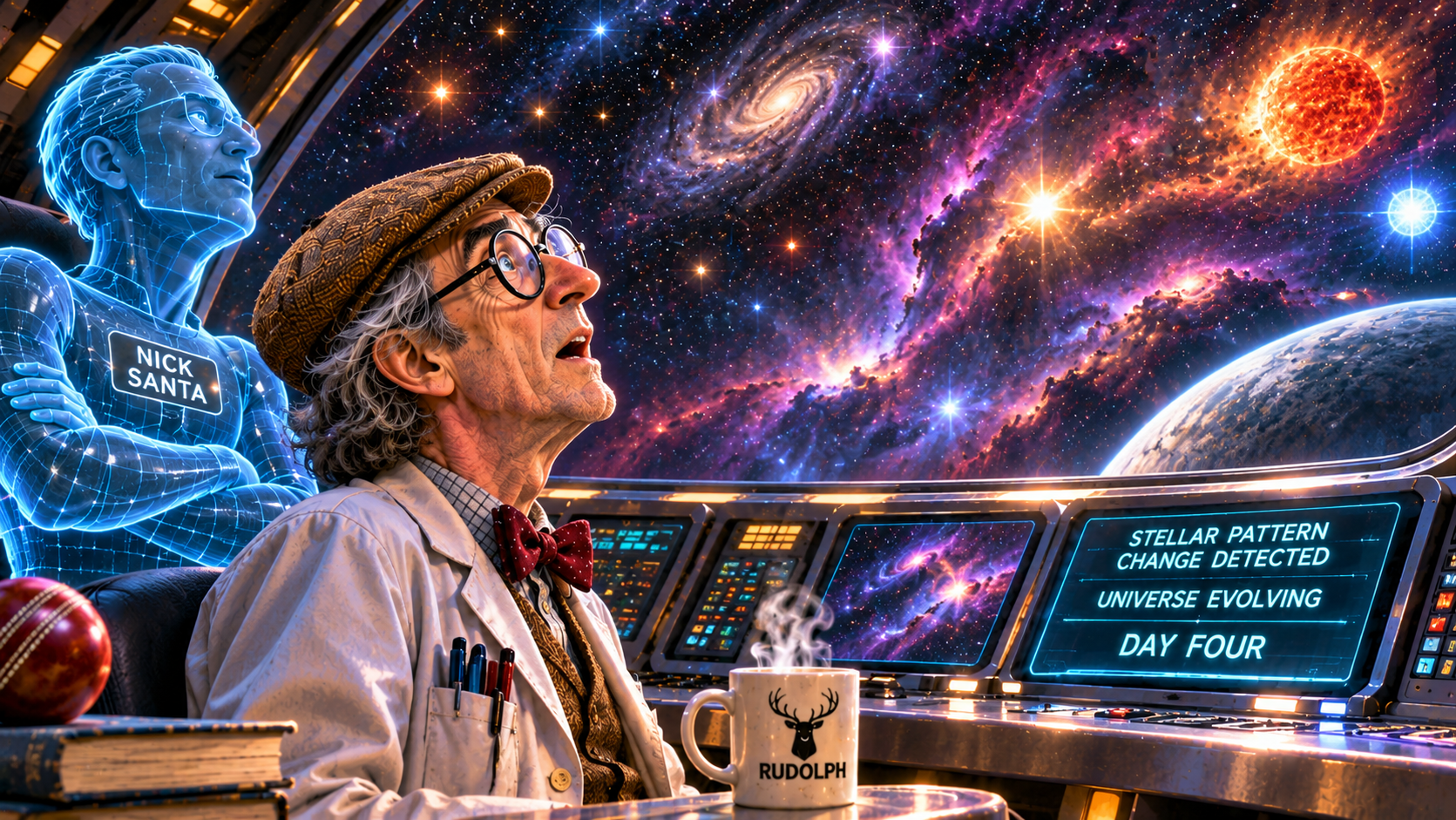
Until then, our journey had consisted largely of darkness interrupted by small, indifferent points of light.
Now an enormous cloud appeared ahead.
At first it resembled a faint red stain on the blackness. As Rudolph approached, it expanded into a vast luminous structure extending across thousands of light-years.
Great curtains of crimson gas folded over one another. Immense pillars of dust rose through the glowing haze, their edges illuminated by brilliant blue-white stars.
Within the cloud, new suns were forming.
Gravity gathered hydrogen into enormous spinning knots. Pressure increased. Temperatures climbed. At the centres of these collapsing clouds, nuclear fusion ignited, turning darkness into light.
Some stars were barely born. Others had already begun their long, extravagant lives, pouring radiation into the surrounding gas. The entire nebula shimmered with the slow violence of creation.
I stood before the observation window, utterly transfixed.
“Beautiful,” I whispered.
“Mostly hydrogen,” said Nick.
“You really know how to ruin a moment.”
“There’s also helium.”
The cloud filled the forward observation panels.
Vast blue stars shone through translucent sheets of glowing matter. Dark lanes twisted between them, concealing pockets of gas so dense that even Rudolph’s sensors struggled to penetrate them.
Far below, a newly formed star was illuminating a tremendous circular disc of dust.
Planets were beginning to assemble within it.
Worlds of molten rock.
Worlds of frozen gas.
Worlds that might, given sufficient time, develop oceans, continents and creatures capable of arguing about parking.
I found myself smiling.
We had created this.
Three irresponsible students, a shoebox and something from the laboratory refrigerator.
And here it was.
A universe building itself.
“Rather impressive, isn’t it?” I said.
“Yes,” replied Nick. “Although Professor Salad would probably have insisted on a safety railing.”
A warning tone sounded.
The navigational display turned amber.
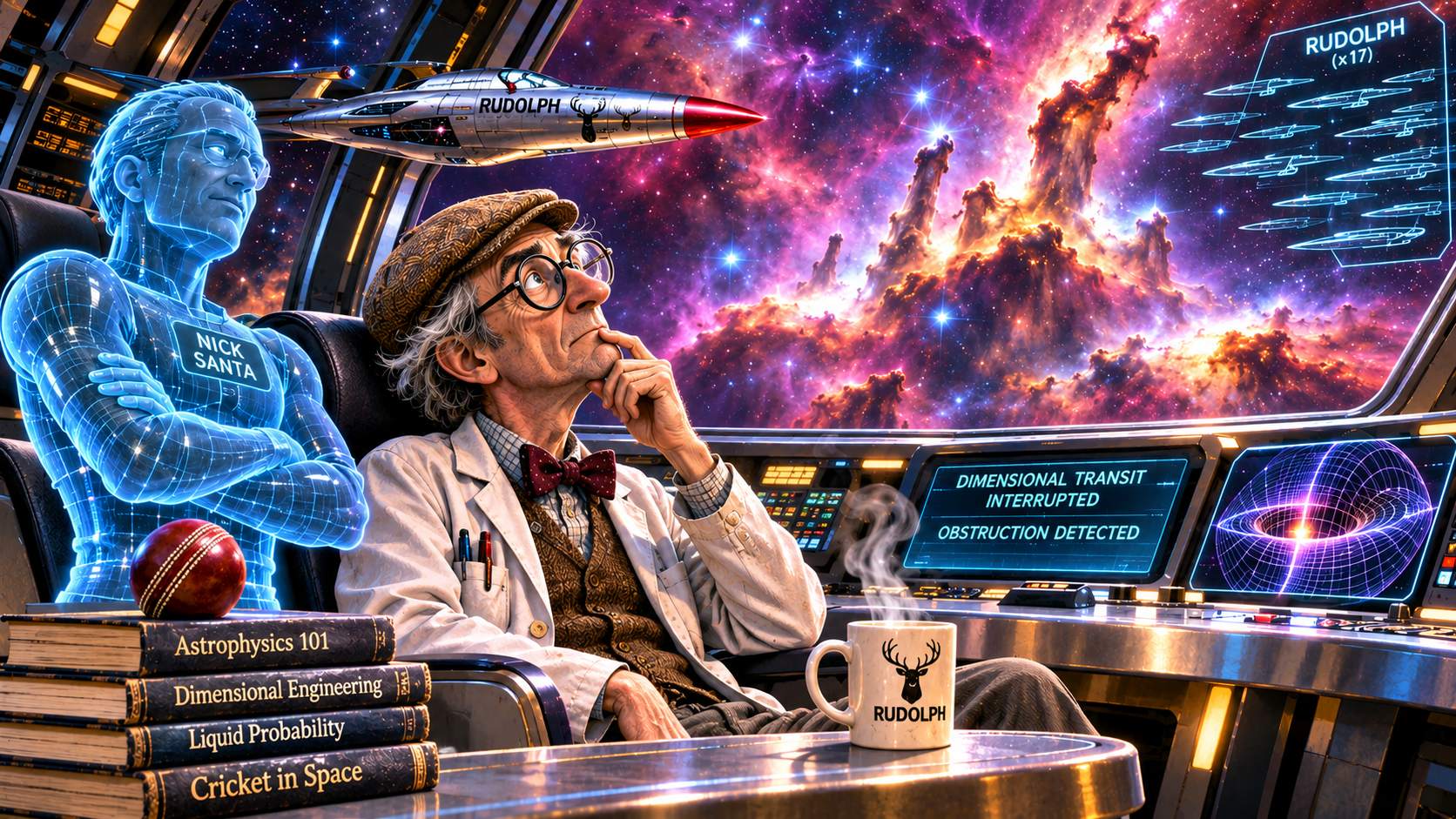
DIMENSIONAL TRANSIT INTERRUPTED.
“What’s wrong?” I asked.
“An obstruction” said Nick.
“Space is mostly empty. How can there be an obstruction?”
“That is precisely what makes this one so interesting.”
The display expanded.
Ahead of us, hidden within the brilliant cloud, lay an enormous region of distorted space.
It had no visible surface.
No measurable mass.
No conventional dimensions.
Yet light bent around it, producing a strange circular darkness surrounded by a brilliant halo of displaced stars.
Rudolph reduced speed.
The great propulsion rings slowed.
Somewhere deep within the ship, a mechanical relay clicked with an unnecessarily ominous sound.
“What is it?” I asked.
Nick studied the readings.
“A structural irregularity in spacetime.”
“A black hole?”
“No.”
“A wormhole?”
“No.”
“Something dangerous?”
“Almost certainly.”
“Wonderful.”
He projected a series of equations into the air.
I recognised them immediately.
Not because they were particularly elegant.
Quite the opposite.
One contained a mathematical substitution that made no sense whatsoever.
Another involved dividing by a quantity that could occasionally become zero.
And the third—
Oh dear.
I remembered the third.
It had been written by Gees Ass during our university assessment.
I had questioned it at the time.
He had explained that the equation was perfectly sound provided nobody examined it too closely.
“Nick,” I said slowly, “I think we made that.”
“Indeed.”
“How?”
“You appear to have incorporated a contradiction into the original spacetime framework.”
“Can we go around it?”
“Certainly.”
“How long?”
“Approximately eleven thousand years.”
“Can we go through it?”
“Possibly.”
“What happens if we can’t?”
Nick considered this.
“We may become distributed across several incompatible versions of ourselves.”
“That sounds unpleasant.”
“On the positive side, you would never have to make another decision.”
I looked at the black circle ahead.
Its boundary shimmered with impossible colours.
Light stretched around it in narrow luminous arcs, while distant stars appeared simultaneously above, below and behind one another.
For a moment I could see Rudolph’s own red nose reflected in the distortion.
Then I saw it again.
And again.
Three Rudolphs.
All approaching the same point from different directions.
“Nick?”
“Yes?”
“Why are there three of us?”
“Technically, there are seventeen. I’m only displaying the reassuring ones.”
The ship began to vibrate.
A low resonant hum rose through the deck as the dimensional transit core reached full power.
Blue light spilled from the engineering displays.
The artificial gravity weakened, returned, then briefly developed an opinion of its own.
A loose pencil floated upwards.
It paused beside my ear.
Then it fell sideways.
Nick appeared beside the command chair.
“Preparing transit.”
“Is this wise?”
“No.”
“Then why are we doing it?”
“Because you have expressed a preference for arriving on Earth before the heat death of the universe.”
I tightened my harness.
Outside, the great nebula stretched into ribbons of light.
The stars curved.
The darkness folded.
For one extraordinary instant I could see the entire ship from outside, its silver hull suspended within a twisting tunnel of brilliant blue energy.
Then the tunnel collapsed.
There was a tremendous flash.
A sound like an orchestra falling downstairs.
And silence.
Rudolph emerged into ordinary space.
The stars returned to their proper places.
Gravity resumed its duties.
The pencil dropped onto the floor.
I released my harness.
“Well,” I said, “that wasn’t so bad.”
Nick said nothing.
This was unusual.
“What?”
“We have received a transmission.”
“From where?”
“Unknown.”
“Who sent it?”
“Unknown.”
“What does it say?”
Nick hesitated.
The navigational display flickered.
A line of unfamiliar symbols appeared, rearranged themselves and became perfectly readable Meupian script.
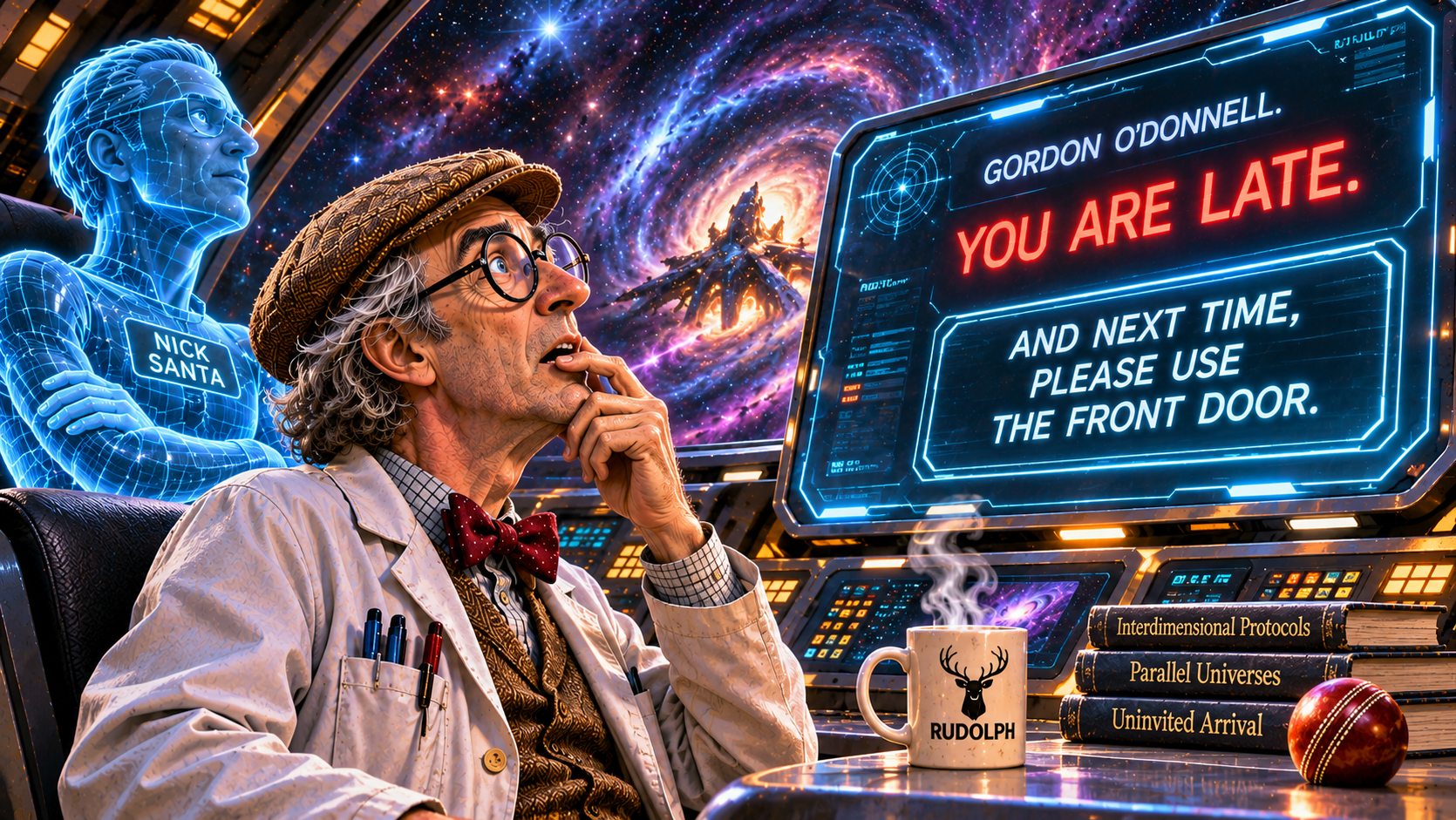
GORDON O’DONNELL.
YOU ARE LATE.
I stared at the message.
“Nick?”
“Yes?”
“Who knows we’re here?”
“I have absolutely no idea.”
The message vanished.
A second appeared.
AND NEXT TIME, PLEASE USE THE FRONT DOOR.
For the first time since leaving Meup, I found myself wishing space travel were boring again.