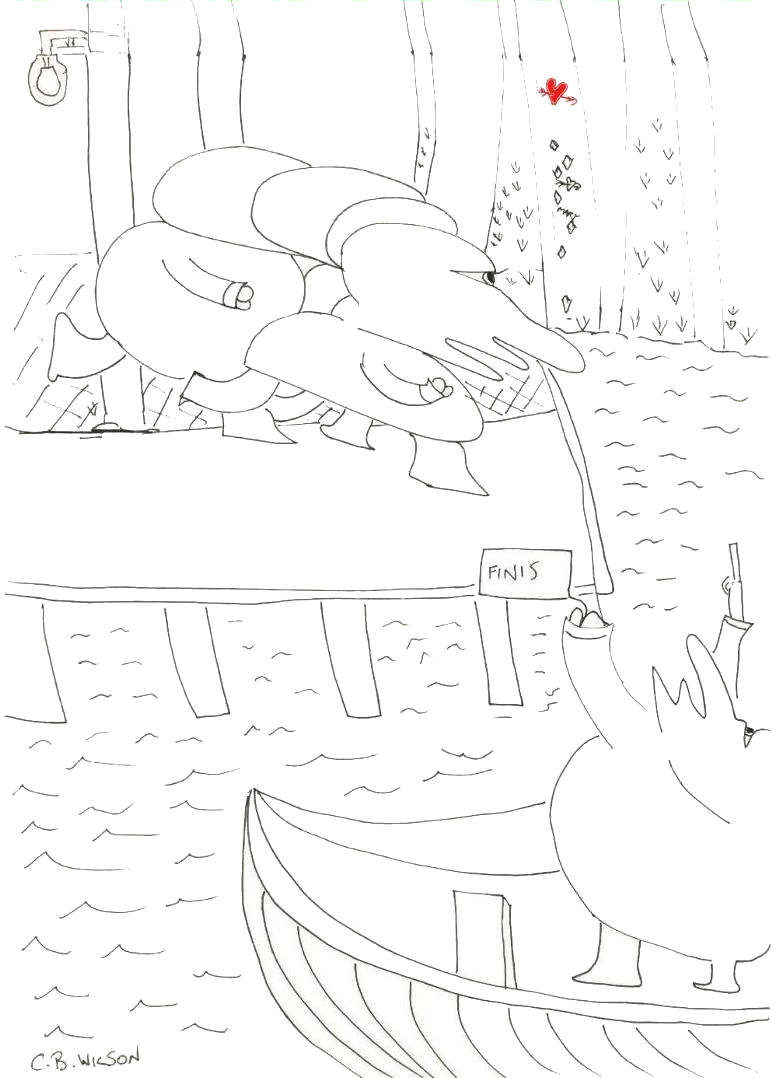
Same thing, different wall hanging (NZ,1988...fine line pen, pencil, computagraphic).
Graphic by Sandshoe

26 Sunday Feb 2012
Posted in Sandshoe
Same thing, different wall hanging (NZ,1988...fine line pen, pencil, computagraphic).
Graphic by Sandshoe
26 Sunday Feb 2012
Posted in Emmjay, Politics in the Pig's Arms

I'm voting for you. You're Dead Meat.
The Pig’s Arms Boozecasting Corporation (PABC) psephologist and race-caller, Antony Puce – ever the man for an each way bet has been staying up all night sucking on his insider sauces. Here’s his latest update on the Rudd / Gillard debacle / fisco / coup / sledging competition.
[[
I was mulling over the complex shitfight known as Australian politics last night. Burning the midnight absinthe and Merv rolled up in the passenger seat of a chauffeured Turramurra starlifter. He was sitting next to Giles – the best attired occupant of said vehicle.
On the back seat were a sartorially startling couple on their way back from the St Ives Golf Club Ball and Liberal Party fundraiser. Merv had amazingly coaxed them this side of the big swamp (otherwise known as Sydney Harbour). It was lucky Giles knew the way, because I’m certain they had never been out of the leafy northern suburbs since birth, except to streak to Kingsford Smith International airport – by way of transiting to Paris at the pointy end of an Airbus 380. Possibly one of THEIR airbus 380s.
Rumour has it that the harbour tunnel was built so that they didn’t have to actually look at any of the dwellers on the south side on the way to overseas.
But Fern and Godfrey were not both halves of your average mega-wealthy couple. As they took up comfortable seats in the Pig’s Arms ladies lounge, and quaffed the first of several bottles of Kurg (Merv would later have words with Manne over the little slip up with the label hastily stuck over the bottle that strongly reminded me of Porphyry Pearl), Godfrey let fly with some deeply inside information of the as he said “laughingly called” Labor shenanigans. Quaff Quaff.
He said that according to Michael Crocker (at least I thought he said “Crocker”), Kevin Rudd has no expectations of winning the PMship. It’s just a justification for reluctantly accepting his fate – the OK Corral Monday 10:00 – and opening the way for Rudd to have his shot at the main game – Secretary General of the UN, by way of first being the member for the backbench nearest to the unisex toilet and nappy-changing room.
Godfrey said that Crocker stepped it out for him – Julia wins the PM again – Rudd pledges full support for Julia – Crean sprays coffee out his nose, trying not to die laughing in front of the cameras.
Godfrey said that that last trip to Washington was to stitch up Hillary’s support for the Rudder to take over from Bunky Moon next year – just before the election.
Julia is supposed to lose in a Ruddslide. Abbott cannot win, so he will need to run across the road in a triathlon and be mowed down by a paper truck owned by Fairfux who by then, will in turn be wholly-owned by Gina Rawhide. Alternative theories suggest a return to that old conservative tactic – the Harold Holt man oeuvre board.
The replacement for Abbot will be problematic. Turnbuckle is too wet for the miners, Jumpin’ Joe is just not bright enough, but is at least malleable – provided Christopher Pyne-o-clean does the thinking for him. So the Turnbuckle / Pyne-o-clean team gets up.
The independents will be massacred and buried in unmarked shallow ballot boxes.
The Labor party will have an across the board spill. Anthony Albuqueque – who has shown great courage and personal integrity by voting for Rudd – as a protest against Rudd getting shafted in a “not the Labor Party” way, without admitting that he also recognises that the massive disaffection with Rudd is based on the reality that Rudd was, is and always will be a micro-managing tosser who happened to run against the most hated Liberal since Bob Menzies played in the Bethlehem under sixes.
Julia refused to accept Albo’s resignation for fessing up that he’s not going to vote for her – possibly because without Albo, Labor does not have an attack dog in the front row – but more probably because he has the respect of many in caucus because he gives not a shit about anything else except punching out Tories.
On that basis, Julia has confirmed that she’s not tough enough to be PM – remembering that Australians prefer a PM that reminds them of their dad after he’s had a skinful and feels like fighting coppers.
So Albo will be our man – but not for ….. say …… ten years of total misery by which time…. prolonged mining in WA will cause Australia to overbalance and half slide off the East Coast continental shelf, pranging into New Zealand.
There will be a massive voter backlash due to proximity discomfort from Dame Kiri. And Albo will be the man of the hour. Clive Palmist, Twiggy Foreign and Gina Rhino will start mining the Pacific Ocean, Antarctica and Bill Grate’s bank account – figuring that it’s easier to just mine money and cut out all that dirt and noise – that requires (gasp) labour.
Rudd as UN chief will preside over the subjugation of the Arab states by the Chinese – brought about by a mistranslation of the mandarin for “we’ll have all of it” as “we laugh at awful tit”,
People will remember with fondness / deep anger Australia’s experiment with a hung parliament and a government led by our first shiela PM, but being Australians we will cop it sweet and stand by our man.
Our Man Albo.
I finished copying down Godfrey’s diatribe, Emailed it off to the editor (Voice – who will take out ALL the dashes and a goodly-proportion of the apostrophes) and toddled into the Ladies lounge for a share of what was left of the Porphyry Kurg.
]] (sic*)
*Editor’s note: The proof-reader is currently on emergency leave of absinthe.
25 Saturday Feb 2012
Posted in Algernon

Hot Contender for Most Horrendous Cover of All Time.
Playlist and Truly Awful Cover discovered by Algernon
Thought I’d look at a few more cover versions. The covers aren’t necessarily the most famous covers of these songs but interesting interpretations just the same.
http://www.youtube.com/watch?v=Q8Tiz6INF7I
Hit the road Jack – Ray Charles
http://www.youtube.com/watch?v=Hta0HrMyRHA&feature=related
Hit the road Jack – the Lennon Sisters
http://www.youtube.com/watch?v=MHIAZUxlr8g
Eloise – Paul Ryan
http://www.youtube.com/watch?v=b31L4P7G5j8
Eloise – The Damned
http://www.youtube.com/watch?v=mIsnIt1p978
It’s my party – Lesley Gore
http://www.youtube.com/watch?v=ri8OCDUbFig
It’s my party – Amy Winehouse
http://www.youtube.com/watch?v=a-ponMaR-2E
Dedicated to the one I love – The “5” Royales
http://www.youtube.com/watch?v=V8h6lPMk9kw
Dedicated to the one I love – The Mamas and the Papas
http://www.youtube.com/watch?v=5T3FXFnoTzE
Don’t let me be misunderstood – Nina Simone
http://www.youtube.com/watch?v=d2FT4FprxDg
Don’t let me be misunderstood – The Animals
http://www.youtube.com/watch?v=bnZdlhUDEJo
Hazy shade of winter – Simon & Garfunkel
http://www.youtube.com/watch?v=NFRx4PkXeVM
Hazy Shade of winter – The Bangles
http://www.youtube.com/watch?v=QTfwcLdP5Xk
Wichita Linesman – Glen Campbell
http://www.youtube.com/watch?v=bqz3lgnroVc
Wichita Linesman – Dennis Brown
http://www.youtube.com/watch?v=3a7cHPy04s8
Satisfaction – The Rolling Stones
http://www.youtube.com/watch?v=jadvt7CbH1o
Satisfaction – Devo
http://www.youtube.com/watch?v=7t-2GeZFDdc
Mr Bojangles – Jerry Jeff Walker
http://www.youtube.com/watch?v=86wME5d_yZM&feature=fvst
Mr Bojangles – Nina Simone
http://www.youtube.com/watch?v=WWvwP72FuVg
Heard it through the grapevine – Gladys knight and the pips
http://www.youtube.com/watch?v=1kU3m7oWpBg
Heard it through the grapevine – Creedence Clearwater revival
http://www.youtube.com/watch?v=3Y9mopy0ly8&feature=fvst
Quinn the Eskimo – Bob Dylan
http://www.youtube.com/watch?v=liIQLIx2Onw
Mighty Quinn – Manfred Mann
http://www.youtube.com/watch?v=A7F2X3rSSCU
Lucy in the sky with diamonds – The Beatles
http://www.youtube.com/watch?v=_SZ6J6fjw9w
Lucy in the sky with diamonds – Elton John
http://www.youtube.com/watch?v=HeLdF7ONGts
You were always on my mind – Elvis Presley
http://www.youtube.com/watch?v=n2aMaMkDwTA
You were always on my mind – Pet shop Boys
23 Thursday Feb 2012
Posted in Emmjay
Tags
 Story by the PABC (Pig’s Arms Boozecasting Company) psephologist and race caller Antony Puce.
It was two in the afternoon when Antony Puce slouched into the Pig’s Arms and drew up a stool at the bar. Merv could see that he had had a big night and it was no big deal guessing what was on his mind.
Merv tossed the ice into the shaker, added his magic pink liquors, capped the vessel and shook it like he meant it. “Hold the little paper umbrella” said Puce. And Merv decanted the Pink into a cocktail glass fit for …. a bit of a cock.
“The main game?” said Merv, well-knowing that a leadership spill against a PM is likely to happen only once in a lifetime. “Of course.” said Puce.
He adjusted his Anthony Squires bag of fruit pants to restore the blood flow to his wedding tackle, raised the Pink and downed it in a single smooth fluid flourish. Without needing prompting, Merv reloaded the shaker, shook and charged a fresh glass, forgetting to leave out the paper umbrella. Puce picked out the offending poolside miniature and flicked it in the general direction of away – as a smoker might discard a butt from a car window in bushfire season – and with the same amount of care.
“It’s like this:” Puce said and Merv adopted his old kung fu stance – the sleeping horse and readied himself for a distillation of Puce’s take on the spill.
This is a big spill. It makes Exxon Valdiz look like catshit on the carpet. I mean, when Gees minders gelded Rudd, they broke the unwritten code.
” What’s that ?” asked Merv. “Dunno” said Puce. “It’s not written down”. But Puce had a feeling in his waters and his water feelings rarely let him down. I’d say that it doesn’t matter how big a deadshit the PM is, his or her party must back him or her until the electorate throw the bastard out. The electorate decides when to change the lead horse. The parties only pick the jockey. So when The Gee team gelded Rudd, they were taking a big punt that came within a gnat’s whisker of not succeeding. Still might not in the last furlong.
But to roll the dice on another scratching and a bloody resurrection is beyond wild irresponsibility with the crown jewels. It’s fuckin’ suicidal, said Puce, who by now was feeling his oats and the warming effect of a Pink and a half was unmistakeable.
I’ve been down to the track. I’d say it was hard. The owners and trainers are taking up their positions in the Members’ Stand. I’d say they could not care less who wins this one – or the minor placings. These magnates are building their war chests and preparing for a big killing in the 2013 season. The bookies in the ring are sending every fuckin’ mixed message they can think of to keep the punters unsteady on their feet. Now just because Rudd’s handlers have scratched him today, does not mean he’s been put out to grass on the backbenches, much less sent off to the knackery. He’s a definite starter for Monday’s steeple and despite indifferent form overseas, he can’t be ruled out – at least for a place.
“But the big filly has to have the shortest odds, surely, Puco” said Merv.
Maybe, but there’s a lot of activity amongst the handlers and there’s a strong chance that a dark horse might surprise everyone. “Wot, like Christopher Pyne-o-clean ?”, joked Merv.
No.
Pink. And make it snappy !
I’m sure there’s been a lot of preparation over at the Smith stable and there’s talk that the Palomino from Grayndler – or should I say Albermino, are capable runners. But across the scales, I’d say they were stayers running just out of the placings. Lightly handicapped for a good reason.
“I think it’s probably a mistake to put either horse in the jumps.” said Puce. “Too many falls. Too many serious injuries.”
“And too many deaths”, added Merv. “Ida thought that a pony that’s lost his nuts in a previous fall would be smart enough to not draw attention to that. After all, it’s not much of a stud that touts a gelding as it’s big name draw card, is it ?”
The hangers-on and listeners-in in the bar murmured that they were keeping up and were keen to have some insight into the result in advance – so they could lay on their bets at decent odds before the form had been thoroughly analysed to death.
“Listen, this is how I reckon it’ll play out” said Puco. The handlers and owners gelded the Rudder because they were shit sick of him misbehaving in the stalls and not working with the stable hands. He’d become a show pony in a show of one pony. Look at his form. No results in three years. Didn’t take the team with him.
Now, Big Red likes a rails run, but I have to say that the filly has a few results racked up on pretty difficult tracks. Not a great record, no outstanding wins greater than a half head, and a tendency to be distracted by dark horses on the wrong side of the track, but none-the-less she does have a few wins.
“What fuckin’ wins would those be ?” said a crusty from Queensland. “Well, she got up with carbon in a late finish, the economy didn’t fall apart like most of the rest of the world, she got a tiny tax on the trainers and owners and she’s safe with kiddies.
“Last in dressage” piped up some wag from South Australia.
“Yeah, true, but she looks a lot more appealing than some fuckin’ Dalek in red speedos.
“I reckon it’s come down to that” said Puco. “It’s a country with crappy bush tracks, shitty hay and hopeless handlers. No way are we gunna get world-class performance from the nags here “ said Puco – and the punters took their time finishing their Trotter’s Ales. No hurry into the TAB, the odds just weren’t attractive enough.
23 Thursday Feb 2012
Posted in Neville Cole
Tags

Apache Greyhound Park
Story and Photographs by Neville Cole (aint it great to have him back ?)
Martin strode through the open door of the Apache Greyhound Park wearing his lucky African tee shirt (the one given to him by Freeman Mbowe, the Tanzanian Presidental hopeful who bore a striking resemblance to Eddie Murphy), his lucky vintage Hawaiian shirt decorated with 60s era Chryslers that he’d found in a Goodwill in Pacific Beach, his lucky charcoal checked shorts, and his lucky red Chuck Taylor’s. Underneath all this lucky apparel he was wearing his lucky Monster Garage boxers. In fact, the only things he had on that weren’t particularly lucky were his socks; but truth be told he didn’t yet own any lucky socks so for all intents and purposes everything about Martin that morning was lucky. He even stopped at a 7/11 – two of his lucky numbers, not coincidentally – to buy a pack of Lucky cigarettes; although 7/11 didn’t carry Lucky brand cigarettes anymore so he picked up Marlboro Lights instead.
Apache Greyhound Park was pretty busy for a Sunday morning. Even though only a handful of East Coast tracks had started racing most of the locals were already in position. The Mexicans, the Rednecks, the assorted Old Farts and the hard core Doggers were all buried in their racing forms. Martin wondered if the crowd was gathering early for the upcoming Super Bowl celebration or if the New Seasons Christian Fellowship – which meets in the back conference room of the Apache Greyhound Park – had suddenly doubled in faithful; but he didn’t have time to worry about all that, he was on a mission. Today Martin Meeks would finally break the $200 barrier. Martin hadn’t been a betting man for long but he was without a doubt pretty damn lucky. More often than not he almost broke even. One any given day he’d hit an exacta or two. He’d even managed a couple of trifectas and once a superfecta. The only problem was he’d never won more than $187 in any single bet. Today that would change. At least Martin was hoping it would change. He was supposed to host a Super Bowl party in four hours and he barely had enough money in the bank to buy beer.
Martin was worried about all that. He lived by his wits and relied almost completely the whims of fate to guide his path. Every decision Martin ever made was based on one part superstition and two parts intuition – shaken but not stirred. It was a life cocktail that rarely let him down for long. By now it shouldn’t be surprising to anyone that Martin shunned traditional gambling methods. He prided himself on having no idea how to read a racing form. In gambling as in life he preferred to ignore data. In fact, the act of compiling hard evidence in Martin’s world was akin to cheating.

The main reason Martin frequented the Apache Greyhound track was its lucky location; practically within the shadow of the Superstition Mountains. The spectacular façade of Geronimo’s last hideout was always looming just a few miles away. Surely a vortex of good fortune must be close by, Martin reckoned. After all, these mountains are the final resting place of Jacob Waltz and hidden within those peaks, somewhere down a long lost cavern, all of the Lost Dutchman’s riches sit waiting to be discovered.
Martin didn’t trust reason and logic but was devoted to routines. His day at the track always began at the ATM machine. He considered the $2.50 bank fee the machine charged him an offering to the gods of high commerce and trusted it would eventually pay dividends. Just as you always tip the cashier after a win Martin believed in tipping the ATM before the win. Call it karma. Martin’s routine began with a $100 deduction from his checking account; even if, as in this case, he only intended to spend $40 of it. After sliding three twenties into his wallet, Martin fed the remaining two twenties into the cash-betting machine by the bar instead of going to the cashier and immediately printed himself a voucher. Then, voucher in hand, he made his way to the TV wall in the back room. That would place him close to the back North wall. All of his best bets were made at back North wall.
It was a good sign that, even on this busy morning, one seat was still available in the front row. Martin liked to think that the front row was lucky but in the back of his mind he knew he only preferred the front row because his eyesight was failing him and if he sat anywhere else he would have to get up at the end of each race and walk up to the screens to see who won. He was not about to copy Stroke Grannies lead and bring binoculars to the OTB. He’d rather get up and walk than sit in the second row staring at a TV set through binoculars. Of course, Stroke Granny used a walker so she didn’t really have an option. Actually, for her, binoculars were a pretty clever idea. For one thing, they came in pretty handy when there was a photo finish. On more than one occasion the back room crowd turned to Stroke Granny at the end of a race to see which horse’s nose got across the line first. Not that you had to turn to Stroke Granny for anything as she tended to yell out the numbers of the first four horses in each race as a matter of course. Stroke Granny was the self-appointed back room race caller.
Martin scanned the TVs for the next race. Even though he had set his mind on a personal record win; he was well aware that he had been shutout the last three times he came to the park. It was the longest losing streak of his short career. “Maybe what I really need is one small win to break the ice,” Martin told himself.
The very next race of the day was the third at Golden Gate. Golden Gate was one of Martin’s favorites. He was already familiar with a number of the jockeys: Russell Baze, Francisco Duran, Aaron Gryder, Frank Alvarado, Kerwin John, and the longshot specialist Alejandro Gomez. The only problem was the third today was one of those races that Martin usually avoided: a six horse race with two scratches. Four horse left with the 6/1 Excelling as the only horse that could even be considered close to a long shot; but Martin decided to make an easy bet then let his winning’s ride on a shot at breaking the $200 barrier and pretty much the only way to make any money on a four horse race was to go for a trifecta.
Martin put his voucher into the third machine from the left and stared at the entries displayed on his iPhone. His initial goal was to divine the horse most likely to win. His initial selections were based solely on names and numbers. He looked at the names first and one or two special horses would usually present themselves. These became his favorites. With a couple of favorite in mind Martin compared the Equibase odds to the current odds and contemplated the shifts that had taken place over the past 24 hours.
Equibase had #3 Dance Chief 5/1, #4 Excelling 6/1, #5 Unexpected Gift 9/2 and #6 Stormy Surge 2/1. With the two overnight scratches the odds for all the horses had dropped except for Excelling which had held at 6/1. Martin figured a $2 keyed trifacta on a four horse race was about as close to a sure thing as he be bothered betting. He ended up with three keyed trifectas: the favorite 6 over 4 and 5, the long shot 4 over 5 and 6, and 3 over 5 and 6. As long as #5 Unexpected Gift didn’t win he had reasonable shot at breaking even.
Bets made, Martin retired to the patio for a pre-race smoke. This was another of his recent obsessions and one he was already ready to quit. For 47 years, Martin easily resisted an addiction to cigarettes; but ever since he started frequenting casinos and OTBs, a pre-race smoke had become part of his routine. He would change that routine very soon, but not today.
As usual, the only guy on the patio was Sweat Pants Guy. Sweat Pants Guy was a hard core Dogger. Martin didn’t believe that people who played the dogs were actually ever called Doggers; but that’s what he liked to call them. It just made sense.
Similarly, Sweat Pants Guy was called Sweat Pants Guy because he always wore an old pair of black sweat pants pulled up high over his beer belly. He also always wore a tucked-in white tee shirt featuring some kind of wilderness scene – a wolf in the snow, a fish jumping out of a stream, or band of horses running across the desert – but Tucked-In Tee Shirt guy didn’t have much pizzazz. Then again, Sweat Pant Guy did always have an old beat up baseball cap perched on top of his noggin; but geez, Beat Up Baseball Cap Guy could describe 99% percent of the residents of Apache Junction.
Martin preferred to register people by their outward appearance rather than having to ask for and memorize a bunch of useless names. In fact, when people told Martin their names he ignored and promptly forgot them until he figured it would be totally embarrassing to admit that he didn’t know who they were. Fortunately for Martin most people seemed quite satisfied to be acknowledged with a smile and a “Hey, how you doing?” Of course, there becomes a point when people would start to worry Martin had Alzheimer’s if he still couldn’t remember their names. That’s when he would be forced to eavesdrop on the unnamed person’s conversations to see if the other people ever referred to the unnamed person by name. In rare circumstances when this clever ruse didn’t work, Martin would resign himself to engaging someone “in the know” and quietly whispering something like: “This is really embarrassing but what is that guy (or girls) name again?” Then he would admit in a half-joking way that he was “really terrible with names” and that he “really needed to get better at remembering names” but still half the time he would forget the name again in a matter of hours unless that new person had somehow managed to become a true friend.
Not surprisingly, Martin had few true friends. Sweat Pants Guy was a long, long way from being a true friend. Martin couldn’t see Sweat Pants Guy ever being anything but Sweat Pants Guy: the blind slob who bet on practically every dog race across the country every single day of his life.
Sweat Pants Guy bet often but not much. Rarely did he put down more than a dollar or two on any race; relying on exotics – pick 3s, pick 6s and superfectas – to boost his winnings. Sweat Pants Guy also never sat down. He paced and smoked between races and during races positioned himself two or three feet from the screen alternately yelling encouragement and obscenities. Sweat Pants Guy was the Bill Parcells of the OTB; he never called a dog by name referring to them only by number.
Martin was highly entertained by Sweat Pants Guy but the two rarely shared more than a word or two of conversation. Maybe it was because Martin played the ponies and Sweat Pants Guy was a Dogger. But really, what is there to talk about with a near total stranger? Certainly not what they planned to bet! That was Martin’s biggest superstition. He never shared his bets with anyone until the after the race. Martin thought placing a bet was like voting: an inalienable right every adult was free to exercise without any obligation of disclosure.
Martin was seated at the table closest to screen as the horses burst from the gates at Golden Gate. Taking the lead right away was Unexpected Gift followed by Excelling, Stormy Surge and Dance Chief already trailing by a few lengths. This wasn’t perfect by any means but the long shot in second gave Martin hope. Martin isn’t a big yeller. He sat quietly puffing through the first couple of furlongs. Then, at the last turn things started to fall in place. “Go 6!” Martin urged as Stormy Surge made (dare I say it?) a Stormy Surge past Unexpected Gift down the straight. It was looking like Martin’s first win in two weeks. The camera followed 6 and 5 to the line then there was a brief pause. Several seconds passed until 4 appeared on screen closely matched by 3. “Goddamnit!” Martin bellowed, “Where did 3 come from?” Of course, it was for naught, as right at the line Dance Chief edged out the long shot and Martin’s shoe-in trifecta was history. The losing streak was still alive.
“What’d you have?” asked Sweat Pants Guy.
“6 over 5, 4” Martin answered.
“Aw, shit…” replied Sweat Pants Guy.
Martin wandered off to stare at the abandoned dog track that was at one time the pride of Apache Junction. Martin imagined for a moment Apache Greyhound Park in its 70s heyday. The manicured red dirt track, colorful flower boxes lining the club entrance, a sparkling new grandstand, and flocks and flocks of snowbirds decked out in orange and yellow polyester dresses and lime green leisure suits. Those were heady days indeed; the likes of which will never be seen in these parts again.
Martin shook his head. He had two, maybe three, chances to get his personal record and what does he do? Waste $12 on three useless trifectas. But, like some strangers name, the pep talk didn’t register for long and with just a few minutes to post at Gulfstream, Martin rushed in a $4 boxed 5/1 exacta and a $10 win/place bet on the long shot #2. Before he even walked away from the machine, he couldn’t remember the names of the horses he picked. He was picking odds again, instead of following his routine. He clearly hadn’t let the names speak to him and made his picks based only on which choices might get him that personal best. He had to cover his bases. The only way out was to pull another twenty from his wallet and pick another race before the one at Gulfstream started. In the fifth at Fairgrounds the name Hobson’s Choice was the one that stood out. Martin compared the odds, 24 hours ago Hobson’s Choice was a 20\1 long shot, now she was 12\1. Martin always liked late money so brimming with confidence Martin punched in $20 on 2 to win.
There was still 3 minutes to post at Gulfstream so Martin stepped out again for another smoke. He tried to puff as quickly as he could but by the time he got back to the TV wall the horses were already crossing the line. He saw 5 out front and, could it be? Was that a 1 to place? Martin stepped forward but before the question even had time to fully form in his mind the unofficial results 5/4/1 were posted. “Shit!” Martin blurted. “I always pick 4. Why did I not pick 4?” Then as if to answer himself he added “It’s my fault, I should have been here at post time.” Then he told himself: “I have to quit smoking, it’s ruining my luck.” By the time he sat down again it was post time at Fairgrounds.
The one thing about sitting by the back wall of TVs at Apache Greyhound Park on a Sunday morning is you have to listen to the rock and roll gospel blasting out from The Church of New Seasons.
“Jesus Christ!” said Old Pony Tail. “How long are they going to play that crap? It’s been going on for hours already. I’m 71 years old I don’t have to listen to that churchy bullshit anymore.” Old Pony Tail turned to Martin and grinned: “The one good thing about being 71 years old is that you don’t have to put up with churchy bullshit if you don’t want to.”
“You don’t look 71. I would have guessed you were in your early 60s” Martin replied quite honestly.
“I’ll be 72 in a few weeks and I feel like 80,” Old Pony Tail laughed.
“Is it better to feel older than you look or look older than you feel?” Martin asked almost rhetorically.
“Well shit,” Old Pony Tail said quickly. “That’s easy. I’d rather look as old as dirt and still feel good any old day.”
“People think I’m fifty-eight…” Martin noted.
“How old are you?” said Old Pony Tail leaning in for a closer gander.
“Forty-eight but I feel like I’m thirty.”
“Well, consider yourself lucky,” said Old Pony Tail staring back at the TV.
Martin looked up just in time to see Hobson’s Choice just beat out the favorite at the line.
“Finally,” he said.
“Did you have money on 2?” asked old pony tail guy.
“Twenty bucks,” said Martin breaking into a grin as the official results appeared on screen.
“Nice win, buddy!” Old Pony Tail said raising his hand to Martin for a high five.
“It’s about time” said Martin as he slapped Old Pony Tail some skin. “Now I can splurge on a few Super Bowl party supplies.” With that Martin headed straight to the cashier to pick up his winnings. The last thing he heard was old pony tail guy sharing one final word of advice:
“Hey buddy. Pick up one of those shrimp rings at the supermarket! They’re a great party starter.”
“What happened?” screamed Stroke Granny after Martin left the building. “Did he win, or something?”
“He had 20 bucks on 2 at 12\1!”
“Lucky bastard…” Stroke Granny muttered as she scanned the wall of TVs with her binoculars.
“Tell me about it,” said Old Pony Tail guy…and he didn’t even offer to buy me a beer!
“You know, something,” said Stroke Granny. “Something I learned a long time ago. When you get lucky, you got to spread your good fortune around a bit. That shit will come back to bite you in the ass. Karma is one nasty bitch!”
It wouldn’t be long before Martin would learn that Stroke Granny knew a thing or two about karma.
22 Wednesday Feb 2012
Posted in Emmjay
Tags
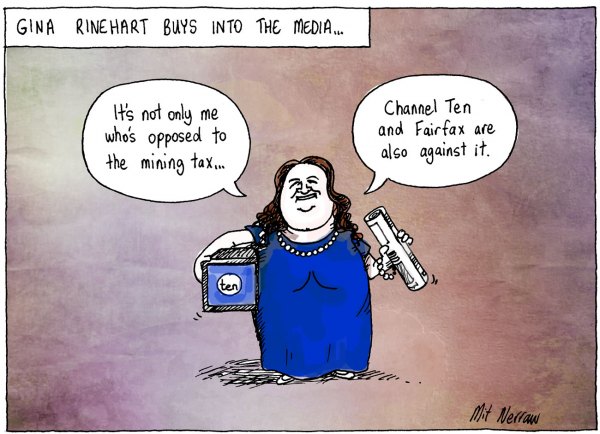
Cartoon borrowed from Mitt Nerraw - http://mitnerraw.wordpress.com/category/mit-nerraws-cartoon-blog/
The Editor
Sydney Morning Herald
Dear Sir or Madam or Gina.
I’m sorry to not address you by name. I know it’s impolite, but I tried to find out your name from the website: it’s apparently a secret – or the editorship changes so frequently that the web master isn’t prepared to commit to posting it by random selection from a database of Australian journos.
Anyway, after you’ve read this subscription cancellation, perhaps you might like to hand it on to the circulation people who doubtlessly are experienced in handling these things.
I apologise for being so pissweak that I can no longer cope with the once great paper’s slide into massive negativity. In short, I have to stop reading the paper for my own mental well-being. After considerable thought I have decided that I really do not benefit from you telling me all the shit that is happening in the world – from the micro (e.g. death of a child from neglect despite the child being well-known to DoCS), the meso – NSW Police unable to deal effectively with the daily afternoon drive by shooting to the macro – the killings in – pick a location – say Syria today.
And the illusion you are creating of massive economic oblivion – unspecified but shit-scary, eh ? Riots in Greece. 500 QANTAS workers getting the shaft, a thousand bank staff to help maintain record profits – so we can be serviced from some tin shed call centre in a third world country where string and barb-wire repairs are considered luxuries and super glue is unheard-of. Keep that profit up, advertisers !
The puzzling thing, despite people at my work walking around oozing fear of retrenchment (thanks to you and the other media), looming unemployment is given the lie by the fact that employment statistics are stable. I’m not suggesting that you are lying to us, Gina. But hey, prove to me that you’re not being just a tad selective with the truth. I heard two dudes on the train yesterday talking enthusiastically about how the “new grads” were about to start at their organisation and that they were excellent candidates.
Maybe this kind of news eludes your posse of seekers of truth. Must have this time, I guess.
I know that you think the Rudd Gillard shenanigan / farce / farrago / imbroglio is a kind of light relief, which might be qualitatively true except that the alternative is some kind of Dalek in swimming trunks. It’s not funny, Gina. It’s sad beyond belief.
And depressing.
So depressing.
So, in the balance, how much worse off will I be by not paying any more for you to bring me down when every day I open the front door only to be confronted by screaming headlines about some parliamentarian who fucks prostitutes, cheery fad diet tips from vacuous stars and pouting photographs of Marieke Hardy ?
Clearly, when you chew on it for a while, cancelling your subscription is as healthy as laying off salt, fat, sugar, alcohol, tobacco and as good as a weekend on a Zen retreat.
I suggest you try it too.
Good luck going forward.
Emmjay.
22 Wednesday Feb 2012
Posted in Lehan Winifred Ramsay
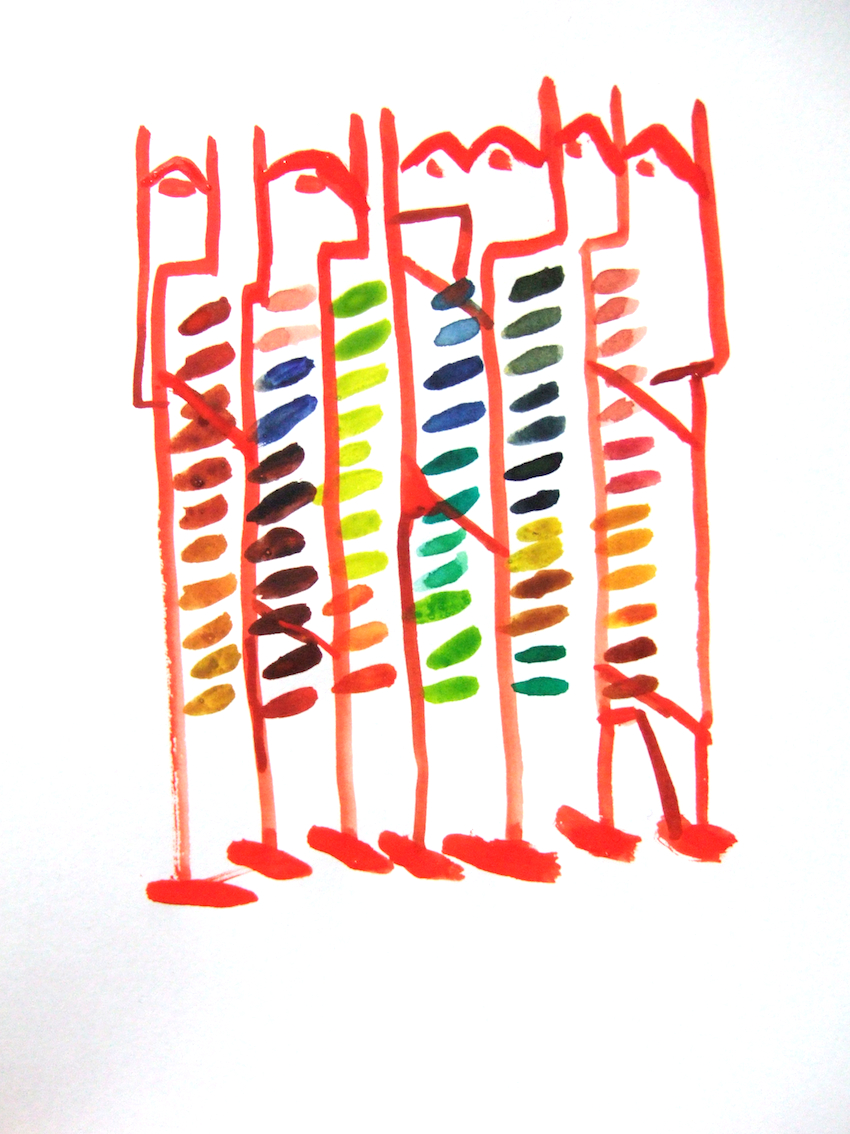
Genomino
Story and painting by the Pig’s Arms Osaka Correspondent – Lehan Winifred Ramsay
Recently I read in The Washington Post an article called “Walking Wounded: 20 genes down and still good to go”. It described a research project on human genetics that is being developed by 50 scientists around the world. What caught my eye was the comparison made between this genetic code and language.
The researchers described the genetic material (the human genome) as “our species 3-billion letter instruction manual for self.” Which has an attractive resonance for me, a person with little knowledge of biology but an interest in manuals. In the study, the article said, the researchers “carefully read a book – an individual’s genome – in which some of the sentences – a single gene – have suffered a typographical catastrophe. Words have been changed, or whole phrases have been dropped. Whatever the cause, the result is a sentence that no longer makes sense.”
The researchers point out that the absence of genetic material appears to be as important as the presence of material. Perhaps then, rather than the result being “a sentence that no longer makes sense”, it would be more accurate to say “the result is a sentence that no longer makes the same sense.” A sentence that does not make the same sense still has something to tell us.
I found myself thinking a lot about this. Do these researchers really feel a strong correlation between the genome and language, or is this merely a way of making the subject easier for us to understand? I’m fascinated with the possibility that there is some connection between the genome and the development of language; that we may be involved in a long process of finding the words to describe our selves as a mirror describes our that the compulsion to develop language itself may have been for this very reason – but I can’t tell if this is what these researchers mean, and it might simply be my own flight of fancy. No doubt their mission is not to compare our genes to our words; an instruction manual can have many uses, and they have not explained what they mean to use it for. To make one…to fix one…to search for one…or to just own the manual. To input that “manual” into a computer and have a painting come out?
It is my first day back in Japan, after an absence of nine months. I had only limited reasons to speak to people yesterday, and I have been wondering what effect the absence of the language would have had on my ability. Today I had some challenging negotiations, for phones and contracts and rearranged delivery schedules. I had been expecting that I would have lost vocabulary, but there was not one time that I struggled to find a word. Or even struggled. The words were fine, but what I had to say was very rough. Listening to people explain things I noticed I was having more trouble with nuance and meaning; with “common sense”.
It was more a problem with why things were as they were. Why did I need a phone number to get a phone number, when my reason for getting one was that I did not have one? Because it was a dilemma that Japanese people were unlikely to have, with an unbroken existence in Japan, and therefore not an unreasonable request for a Japanese person. And why were those celebrities on the television commercial for the mobile phone running, only running, during the commercial, and would I have found that as baffling before I left?
When people on the phone requested information from a form, why did they ask for it in a different order to the form itself? Seeing it was their form, wouldn’t it make sense to have the information in the order it was needed? I seem to be having a cultural disorder….I know how things should work but it still takes some to put the pieces together so that they make sense. Anyway, big cities have complex repetitions; the trains, for example, are numbers of networks laid over each other, each with their own ticketing and movements, and it is at first difficult to separate one network from the others. But I am accustomed to adjusting, and my cultural dis-order will neaten itself within a few sleeps.
I am reminded of when I was five and the words in a book suddenly flipped and became reading. Has that happened to our friends the researchers, or is that what they are working on still. Why hasn’t it happened to me? Is this what I must do; sift through the words, understand how they work, identify the errors, and wait for the repetitions? For recognition to catch my eye, as it has my ear.
I want to know how reading works. This is a culture that prefers its foreign languages in reading. A culture with an extremely complex and difficult system for reading. Reading is assumption, because when we begin reading we do not understand all the words, all the sentences. But if each gene is a sentence, in language a sentence contains many genes. I could imagine researchers here taking that same 3-billion genes and coming up with a very different reading, an instruction manual with its own internal logic that disagreed with many of the assumptions of the other. Still, authorship is ownership; they would have quite a battle to make even the simplest changes. Perhaps the essence of this research is: who will be authority with the right to read our genes.
21 Tuesday Feb 2012
Posted in Gregor Stronach
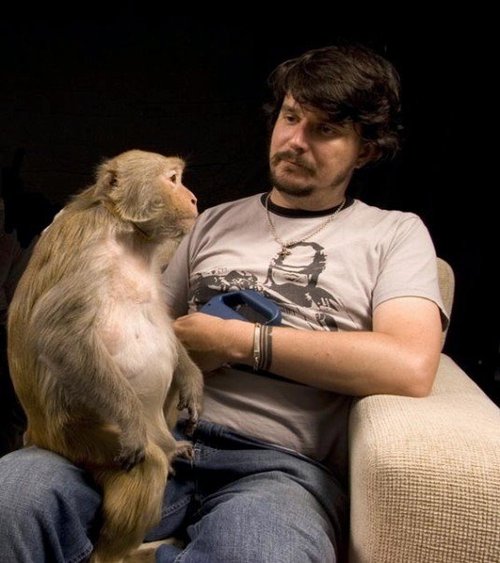
Simianlated Photo of Gregor
By Gregor Stronach
Things are slow in the world of Gregor at the moment, so I figured I’d take the time to be nice and publicly answer some of the fan mail I’ve received. This serves a number of purposes. Firstly, it allows me to appear to care about the folks that take the time to write to me. Secondly, it allows me to pamper my ego by slyly suggesting to you all that I do, indeed, receive fan mail. Last, but not least, it’s just another forum in which I can make fun of you all where you have no right of reply. Everyone’s a winner…
I get some freaky mail. It’s seriously unusual stuff, most of it, which concerns me a little. Is it me, my writing style or a combination of both that attracts the unhinged, the desperate and the lonely?
Unfortunately, most of the letters I receive come anonymously – they’re sent through the author’s bio page, a link to which appears below. It’s infinitely easier for me to make disparaging remarks about you when you include your email address, so be sure to do so if you require a rude or amusing reply.
Otherwise, you’ll end up being quoted in public, like the following people. Where possible, I’ve included the name of the article to which the sender was referring in their message. This is for my own peace of mind. Without this reference, these letters make no sense whatsoever, something I find confusing and vaguely disturbing.
(A little knowledge, R&M, Dec 7th, 2002)
Dear Gregor,
By some strange synchronicity my husband Chris Stronach, also of Australia, has been taking some recent interest in reptilian uberlords of the fourth dimension. Are you and he one and the same? You must surely be related.
I’m not related to your husband in any way, but I would suggest you get your hubby along to a shrink quick-smart. Sure, they’ll test him and probe him and make him perform embarrassing procedures, but the more he talks about the lizards, the more likely it is they’ll abduct him and eat his eyeballs. It’s for his own good.
(God’s Diaires, R&M, Jan 24th, 2003)
Dear Gregor,
I’d like an interview with God, if you please. I’m with Modern Gods magazine, and I want to talk with him about his new book.
Ahhh… I see what you’re doing there. Very clever. But, to quote someone whom I respect quite a lot, “This joke only works when one of us is telling it.” Thanks for your letter though.
(Narcisse Vol II, R&M, Jan 10th, 2003)
Dear Gregor,
Do you have any idea how close your words reflect the deffinition of a Missanthropic Megalomaniac? (Human hater with big ego..) Just so you know, Missanthropes of that sort are more dangerous then Psychpaths (no natural understanding of right and wrong) because they think they are ABOVE right and wrong,. and feel disconnected from people. You are a scary mofo.
Aside from the horrible spelling and the fact that you’ve completely missed the point of the article, that’s a wonderful letter. What was it about that piece that made you think that I was really like that? I feel a little bit like James Woods, always on the search for credibility in his acting roles… but to have someone believe that I am truly like that warms my heart – it means that someone, somewhere, is even more stupid than I am.
(A little knowledge, R&M, Dec 7th, 2002)
Dear Gregor
roaarrrr
Hisssssss
Lizzzzaaaarrrddssssss
Hisssssss?
You’ve no idea how much this one freaked me out for some reason – the first overtly sibilant email I’d ever received and truth be told it scared me silly. Mind you, it was very early in the morning, I hadn’t had my coffee yet, and the mere thought of lizards that can type is enough to give me the willies at the best of times.
(Performance Review: The Four Horsemen, R&M, Dec 26th, 2002)
Dear Gregor
You rock 🙂
Admittedly this letter did come from my sister in Milwaukee, but everyone has the right to feel loved, do they not?
(The True Spirit of Christmas, R&M, Dec 1st, 2002)
Dear Gregor,
Do you still believe in Santa Claus? What ever happened to Mike Butler? And can you tell me if the Easter Bunny is involved?
Sheesh – no, I don’t believe in Santa Claus. I stopped believing in Santa Claus months ago. Mike Butler is now serving time in a maximum security prison for his part in the conspiracy. He also stole several motor vehicles and injured himself fleeing from the police. He’ll be eligible for parole in 19 years. And yes – the Easter Bunny is involved. Very involved. Hence, I don’t have the time to go into it here.
The following letter arrived with no apparent source of inspiration. I have a feeling that one of my workmates has also discovered this wonderful site. This could have something to do with the fact that I frequently walk to their desks and stand over them, pestering them until they log in and read every word of my latest article. I’m so vain.
Dear Gregor,
I’m going to the coke machine. They’ve only got vanilla coke left, just checking if you want one. And isn’t it funny how normal coke has now suddenly become a tough man’s drink. It used to be “a girl’s drink” but now with new “poofter coke” on the market hetero hard cases can now order a tinnie of black gold without fear of anyone questioning their sexuality. Anyway let me know if you’re thirsty and I’ll come over.
It was during a conversation with this person that the concept of ‘The Official Drink of the 2002 Gay Games’ was discussed. We settled on the idea that ‘Vanilla Coke’ would be the perfect candidate, but closer inspection and a moderate amount of investigative journalism found that the official drink was, in fact, semen.
I really enjoy hearing from you all (even the complete lunatics). So send me messages, the more the merrier. I love writing for the Pig’s Arms, as it’s entertaining for you and cheap therapy for me.
I love you all.
19 Sunday Feb 2012
Tags
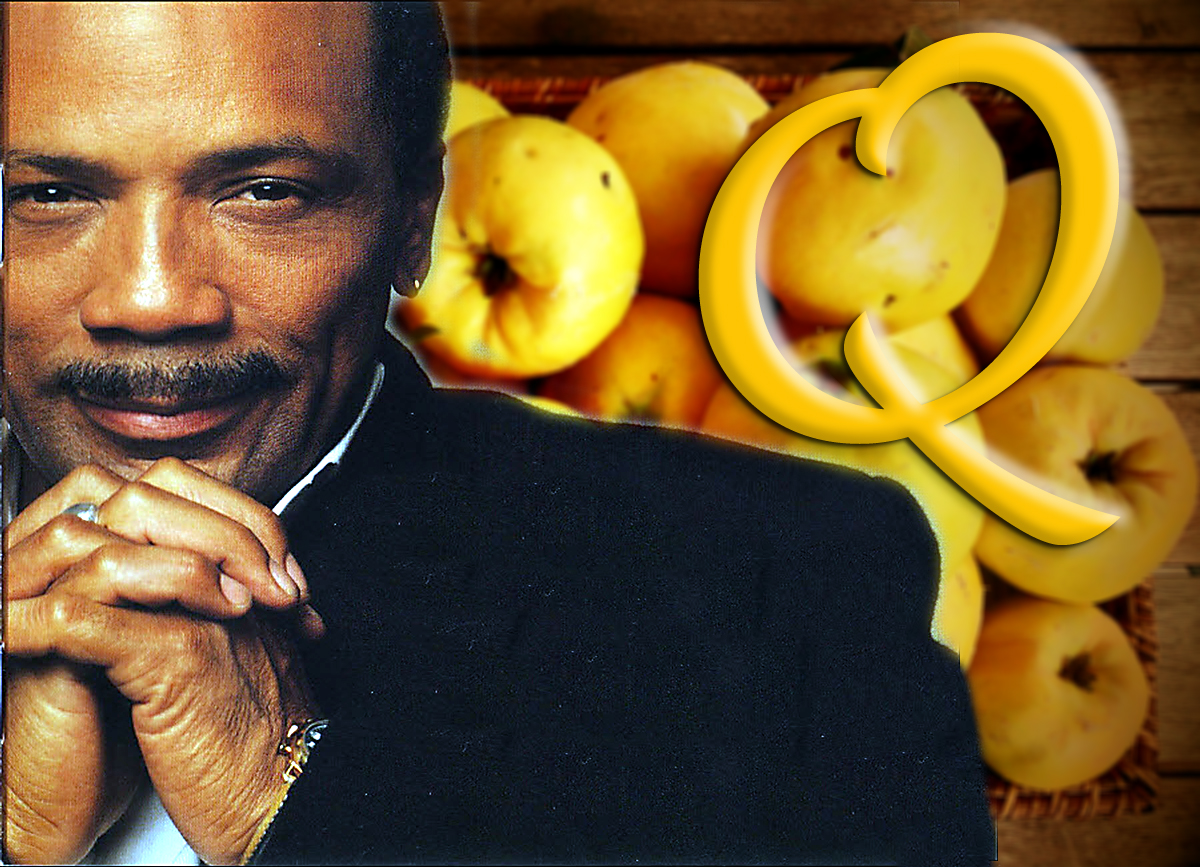
Quince Jam
Playlist and Digital Mischief by Warrigal Mirriyuula
http://www.youtube.com/watch?v=aSGyt6KJsLc
Q, Back On The Block, Septembro
http://www.youtube.com/watch?v=dzA_gdoHhtA
Body Heat, If I Ever Lose This Heaven
http://www.youtube.com/watch?v=I0Qq5wJOn7c&feature=results_video&playnext=1&list=PL7D828A162046F7A0
The Dude, Ai No Corrida
http://www.youtube.com/watch?v=CAiy5P0gYz4
Q & Patti Austin, “Betcha’ Wouldn’t Hurt Me”
http://www.youtube.com/watch?v=kl4BWx0fyjw
Q, Ray Charles & Chaka Khan – I’ll Be Good To
http://www.youtube.com/watch?v=7U87dNVH_oM
Q &. Siedah Garrett, The Places You Find Love
http://www.youtube.com/watch?v=Rc4ZDceGGDU
Stuff Like That, Q, Nicholas Ashford & Valerie Simpson with Chaka Khan
http://www.youtube.com/watch?v=pd9wMHKMj6E
Q, Summer In The City
http://www.youtube.com/watch?v=1OMphRz-sY4
Donna Summer, Love Is In Control (Finger On The Trigger) Produced by Q
http://www.youtube.com/watch?v=gF49ZzkK2nw
Back On The Block, The Secret Garden
http://www.youtube.com/watch?v=T5ALPzS0QfQ
Soul Bossa Nova, Soul Bossa Nova
http://www.youtube.com/watch?v=zoOqNVTCtzI
Q, Walking In Space
http://www.youtube.com/watch?v=CAHA5Yhudao&feature=fvst
The Gypsy – Quincy Jones and His Orchestra
http://www.youtube.com/watch?v=s1F9Vg8CCCE
Kill Bill Vol.02, Ironside
http://www.youtube.com/watch?v=QL20CV6svu0
Q, They Call Me Mister Tibbs
http://www.youtube.com/watch?v=BBY4o26fCt8
James Ingram, One Hundred Ways
http://www.youtube.com/watch?v=nxhMvrNSB84
Brandy, Q, Heavy D & The Boyz – Rock With You
http://www.youtube.com/watch?v=uXHwkUnydd0
Q & Herbie Hancock, Take Five
http://www.youtube.com/watch?v=GJA5sO8MqYw
Q, Oprah Winfrey Theme
http://www.youtube.com/watch?v=UvtaG1LKZng
Q reminisces.
17 Friday Feb 2012
Posted in Warrigal Mirriyuula
Tags
canine behaviuor, Canine intelligence, dog behaviour, dog intelligence, maltese terrier, miniature poodle
Bassett Plays it Cool
Story and Digital Mischief by Warrigal Mirriyuula
Over the past few weeks we’ve been dogsitting the nephew’s little black Moodle, a cross between a Miniature Poodle and a Maltese Terrier. They call her “Lolly”, a sweet enough name, and she is about the size of a licorice twist.
She’s still a pup at only eighteen months old but she’s a lot of fun, particularly when we play “crazy puppy”. This starts with me getting down on the floor on all fours and looking at her with an excited expression on my face. She “reads” my expression and will come to a position just in front of me, also down in the prone position, tail wagging, tongue out panting. She knows what’s coming; she knows my intention. We’re about to play “crazy puppy”, her favourite game.
At the cry “crazy puppy” she takes off at full speed, running around the perimeter of the room.
Our living area is a large open plan space incorporating the kitchen, dining area, lounge and TV area and the piano space with the stair well in the middle. It’s big for a little dog and she’ll skitter on the timber floors and drift onto the carpets. Better traction sees her reach full speed before nipping under a chair, turning on a sixpence and shooting out the way she came, going “round the outside” again.
To keep her going you just stand on the track and as she passes cry “crazy puppy” once more. She does this thing with her backside, like a half flip with twist, changes direction and shoots off again. It really is enormous fun and she loves it. She can keep going for quite some time.
She knows her toys descriptors too, and can fetch her tyre, her doll, her ball. Interestingly she also knows “stick” and when asked will go out onto the balcony and fetch back a stick, usually small and with not much girth; she’s only a tiny thing; and will bring it back in and chew it for a while. Unfortunately she doesn’t return the detritus to the balcony when she’s finished, but she does show a good deal of interest in the dustpan and brush when one of us goes to clean her mess up. She also likes reducing tissues to shredded paper and on one occasion reduced an entire toilet roll to pieces not much bigger than a few millimetres across. Fabulous commitment to the job!
Down at the park she likes to play all the regular games; fetch and tricks like roll over, shake hands and bark on demand. She shows good socialisation and plays nice with the other pups, particularly “Dougie”, a twelve month old Beagle/Spaniel cross. They tumble and run, growl and bark, like a couple of madmen on a spree. He’s all ears, paws and tongue and gets so excited he can hardly stay upright while she, being all agility and spirit, jumps him and tugs at him, all the time bearing her tiny little fangs for effect.
Having been trained and habituated to food rewards, she comes when you call, will reluctantly sit or occasionally drop. This last only when she can see the food reward; because of course while we train them, they too often train us.
It’s been a real delight having her and we were sad to see her go when the nephew and niece came round the other day to pick her up.
Though she’s only a pup and will never be bigger than a handful she still displays so many of the essential characteristics of “dogness” that we associate with the species, no matter the breed, no matter the size.
One of the areas in which she displays this essential “dogness” is that she understands my intention to communicate and can parse the “language” of that communication, whether it is a gesture, a word or even just a look. What’s more, recent studies have shown that she could probably do it better than our closest genetic relatives, the chimps and bonobos. These primates are good at understanding expression and will follow the gaze of other chimps, and experimenters, but they tend to fall down on gestures like pointing or conveying desired action by hand and arm gesture. Anybody that’s ever been to a sheep dog trial will have seen for themselves that interpreting the shepherds complex of calls, whistles and gestures is the working dog’s stock in trade.
We expect these dogs to understand us, to understand our intentions; but is there any scientific basis for our expectations?
Yes there is.
You’d think that it would have been studied sooner but recently there’s been a spate of research putting the whole matter on a more scientific basis
Brian Hare at the Max Planck Institute tested a group of dogs and chimps and found that while chimps and dogs performed roughly equally well at many tasks that involved interpretation of facial expression, gaze direction and simple “find the food” tasks, they signally failed to correctly interpret intention when it came to co-operation such as when the experimenter or even another chimp indicated the position of hidden food for them. The primates just didn’t get it but the dogs did. Put in psychological terms the dogs correctly inferred the experimenter’s mental state.
While chimps may fail to infer others’ mental states when cooperating, domestic dogs do quite well at such tasks. If you point to hidden food, dogs often grasp what you are trying to tell them. Puppies even do it without prior training, indicating that it is an innate ability, not simply one they acquire through contact with their owners.
What accounts for this piece of convergent evolution between humans and domestic dogs is nothing other than the process of domestication — the breeding of dogs to tolerate, rather than fear, human company.
According to Hare, domesticated dogs’ ability to solve social problems may have emerged once the brain systems mediating fear were altered — and the same thing may have occurred in human evolution. Chimps, he says, are constrained in solving cooperative problems by their impulse to fear more dominant individuals and behave aggressively toward more subordinate ones. Like parliamentarians, for instance.
“Taken together,” Hare writes, “the results on chimpanzee cooperation and their use of social cues support the hypothesis that evolution in human social problem solving, much like that of dog social problem solving, occurred after changes in our species’ social emotions lifted social constraints.”
Apparently, like us, all the dogs had to fear was fear itself.
Dogs pick up not only on the words we say but also on our intent to communicate with them, according to a report published online in the journal “Current Biology”
The findings might help to explain why so many people treat their dogs like their children; dogs’ receptivity to human communication is surprisingly similar to the receptivity of very young children, the researchers say.
“Increasing evidence supports the notion that humans and dogs share some social skills, with dogs’ social-cognitive functioning resembling that of a 6-month to 2-year-old child in many respects,” said József Topál of the Hungarian Academy of Sciences. “The utilization of ostensive cues is one of these features: dogs, as well as human infants, are sensitive to cues that signal communicative intent.”
Those cues include verbal addressing and eye contact, he explained. Whether or not dogs rely on similar pathways in the brain for processing those cues isn’t yet clear.
Topál’s team presented dogs with video recordings of a person turning toward one of two identical plastic pots while an eye tracker captured information on the dogs’ reactions. In one condition, the person first looked straight at the dog, addressing it in a high-pitched voice with “Hi dog!” In the second condition, the person gave only a low-pitched “Hi dog” while avoiding eye contact.
The data show that the dogs were more likely to follow along and look at the pot when the person first expressed an intention to communicate.
“Our findings reveal that dogs are receptive to human communication in a manner that was previously attributed only to human infants,” Topál said.
As is often the case in research, the results will undoubtedly confirm what many dog owners and trainers already know, the researchers say. Notably, however, it is the first study to use eye-tracking techniques to study dogs’ social skills.
“By following the eye movements of dogs, we are able to get a firsthand look at how their minds are actually working,” Topál said. “We think that the use of this new eye-tracking technology has many potential surprises in store.”
So just how smart is the pooch snoring on his mat?
Although you wouldn’t want Mongrel to balance your cheque book, it turns out he can count.
He can also understand more than 150 words and intentionally deceive other dogs and people to get treats, according to psychologist and leading canine researcher Stanley Coren, PhD, of the University of British Columbia.
He’s the author of more than a half-dozen popular books on dogs and dog behavior, has reviewed numerous studies to conclude that dogs have the ability to solve complex problems and are more like humans and other higher primates than previously thought.
“We all want insight into how our furry companions think, and we want to understand the silly, quirky and apparently irrational behaviours that Lassie or Rover demonstrate,” Coren said in an interview. “Their stunning flashes of brilliance and creativity are reminders that they may not be Einsteins but are sure closer to humans than we thought.”
According to several behavioural measures, Coren says dogs’ mental abilities are close to a human child age 2 to 2.5 years.
The intelligence of various types of dogs does differ and the dog’s breed determines some of these differences, Coren says. “There are three types of dog intelligence: instinctive (what the dog is bred to do), adaptive (how well the dog learns from its environment to solve problems) and working and obedience (the equivalent of ‘school learning’).”
Data from 208 dog obedience judges from the United States and Canada showed the differences in working and obedience intelligence of dog breeds, according to Coren. “Border collies are number one; poodles are second, followed by German shepherds. Fourth on the list is golden retrievers; fifth, dobermans; sixth, Shetland sheepdogs; and finally, Labrador retrievers,” said Coren.
As for language, the average dog can learn 165 words, including signals, and the “super dogs” (those in the top 20 percent of dog intelligence) can learn 250 words, Coren says. “The upper limit of dogs’ ability to learn language is partly based on a study of a border collie named Rico who showed knowledge of 200 spoken words and demonstrated ‘fast-track learning,’ which scientists believed to be found only in humans and language learning apes,” Coren said.
Dogs can also count up to four or five, said Coren. And they have a basic understanding of arithmetic and will notice errors in simple computations, such as 1+1=1 or 1+1=3.
Four studies he examined looked at how dogs solve spatial problems by modelling human or other dogs’ behaviour using a barrier type problem. Through observation, Coren said, dogs can learn the location of valued items (treats), better routes in the environment (the fastest way to a favourite chair), how to operate mechanisms (such as latches and simple machines) and the meaning of words and symbolic concepts (sometimes by simply listening to people speak and watching their actions).
During play, dogs are capable of deliberately trying to deceive other dogs and people in order to get rewards, said Coren. “And they are nearly as successful in deceiving humans as humans are in deceiving dogs.”
So there you are. All that and deceit too.
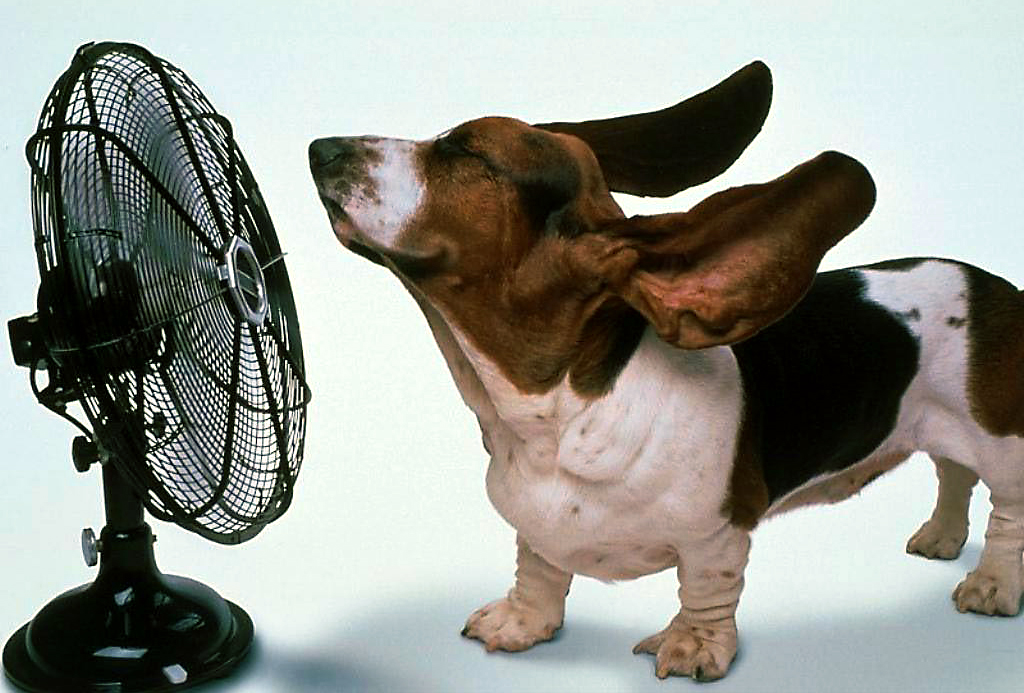
But I don’t think any of these investigators have met the dog in this clip.

