• The Pig’s Arms
  • About
  • The Dump

Window Dresser's Arms, Pig & Whistle

~ The Home Pub of the Famous Pink Drinks and Trotter's Ale

Window Dresser's Arms, Pig & Whistle

Author Archives: Therese Trouserzoff

Singalong with Pete

14 Friday Feb 2014

Posted by Therese Trouserzoff in Algernon

≈ 26 Comments

Tags

Bob Dylan, Pete Seeger, the Byrdys, the Weavers, Woodie Guthrie

pete seeger 2

Playlist by Algernon

http://www.youtube.com/watch?v=A9_MpNwduAA

Kisses sweeter than wine – the Weavers

http://www.youtube.com/watch?v=W4ga_M5Zdn4

Turn turn turn – The Byrds

http://www.youtube.com/watch?v=zqiblXFlZuk

Dusty old Dust (So Long it’s been good to know you) – Woody Guthrie

http://www.youtube.com/watch?v=2it5kYqkhN8

Sixteen Tons –The Weevers

http://www.youtube.com/watch?v=eJxm58htzqc

Maggies Farm – Bob Dylan

http://www.youtube.com/watch?v=uXnJVkEX8O4

Waist Deep in the Muddy – Pete Seeger

http://www.youtube.com/watch?v=1y2SIIeqy34

Where have all the Flowers gone – Pete Seeger.

http://www.youtube.com/watch?v=HlSpc87Jfr0

Little Boxes – Pete Seeger

http://www.youtube.com/watch?v=X5JLCAIJLJ8

Guantanamera – Pete Seeger

http://www.youtube.com/watch?v=2b24Ewk934g

We shall overcome – Pete Seeger

http://www.youtube.com/watch?v=va7aW1_KxP0

If I had a hammer – Peter Paul and Mary

http://www.youtube.com/watch?v=b6hBe-s40q4

There’s a valley in Spain call Jarama – Woody Guthrie

http://www.youtube.com/watch?v=Ezyd40kJFq0

Forever young –Pete Seeger

http://www.youtube.com/watch?v=JG9RwcMP0hk

This Land is your Land – Pete Seeger

http://www.youtube.com/watch?v=f7XjzqPZJDc&feature=kp

Wimoweh – The Weevers

http://www.youtube.com/watch?v=J4QpKxCtfUI

Dear Mister Eisenhower – Pete Seeger

http://www.youtube.com/watch?v=HlDGHEk68XI&feature=kp

biyoyo – Pete Seeger


Maybe Not as Parochial as You might Think – Last Week’s Views

07 Friday Feb 2014

Posted by Therese Trouserzoff in Uncategorized

≈ 42 Comments

 Australia 2,461
United States FlagUnited States 836
United Kingdom FlagUnited Kingdom 35
France FlagFrance 25
Germany FlagGermany 24
Canada FlagCanada 14
Mexico FlagMexico 12
Italy FlagItaly 10
Brazil FlagBrazil 9
India FlagIndia 7
Bahrain FlagBahrain 4
United Arab Emirates FlagUnited Arab Emirates 4
Philippines FlagPhilippines 3
Algeria FlagAlgeria 3
Slovenia FlagSlovenia 3
Malaysia FlagMalaysia 3
Japan FlagJapan 3
South Africa FlagSouth Africa 2
Finland FlagFinland 2
Austria FlagAustria 2
Romania FlagRomania 2
Guatemala FlagGuatemala 2
New Zealand FlagNew Zealand 2
Papua New Guinea FlagPapua New Guinea 2
Indonesia FlagIndonesia 2
Turkey FlagTurkey 2
Poland FlagPoland 2
Sweden FlagSweden 2
Russian Federation FlagRussian Federation 1
Argentina FlagArgentina 1
Venezuela FlagVenezuela 1
Spain FlagSpain 1
Jamaica FlagJamaica 1
Sri Lanka FlagSri Lanka 1
Israel FlagIsrael 1
Estonia FlagEstonia 1
Ireland FlagIreland 1
Thailand FlagThailand 1
Saudi Arabia FlagSaudi Arabia 1
Peru FlagPeru 1
Georgia FlagGeorgia 1
Kuwait FlagKuwait 1
Belgium FlagBelgium

Everything Good in Moderation

06 Thursday Feb 2014

Posted by Therese Trouserzoff in Emmjay

≈ 47 Comments

dunnyman

Emmjay

Many patrons of the Pig’s Arms, including myself, have expressed dismay at the recent blood letting in the front bar and for this, I would like to extend my apologies to any patron who feels badly treated.

Most pubs have a blow up from time to time.  Fortunately nobody here has lost a life so far but let’s hope our bouncer Crispin Bacon returns from his stint in the Sydney CBD soon.  Far be it for me to Barry O’Farrellise the Pig’s Arms though and there will, as usual be no closing time here.

Moderating a blog is both time consuming and challenging – balancing a desire for maintaining a venue for free speech with a need to maintain mutual respect amongst individuals, if not always for ideas espoused in the pub. And in moderation, it is very important to not stonewall and kill conversations – a point apparently lost at the ABC.

In the nearly five years that the Pig’s Arms has been open – continuously – we have seen thousands of articles posted, over 400,000 views and around 100,000 comments – although it’s hard to be certain because we need to delete old discussions on the dot and the dump so that the performance doesn’t grind to a halt.

Throughout this time and massive communication space, we have run free (mostly) and I would like to publicly thank Gez, Voice and Hung (also for his brilliant renovations) for their sterling contributions to the administration and moderation effort at the Pig’s Arms. 

However, in the end, the responsibility for maintaining lora norder falls with yours truly.    There can be no ambiguity fielding in slips. As a result, I will be assuming sole admin and moderation duties.

We will return to the mutual respect model whereby comments will be automatically permitted until a commenter plays the man – or woman – instead of the idea – after which that person goes onto a moderation list.

Since I do not have unlimited time to moderate comments I will attempt to cover the bases twice or thrice a day – so expect some delay if you’re an overly contentious, abusive bastard 🙂  Behave and your comments go up more or less immediately.

Fair enough ?

Right.  Drinks on me.

Shark Culling or Palmering it Off

05 Wednesday Feb 2014

Posted by Therese Trouserzoff in Emmjay

≈ 12 Comments

Tags

Clive Palmer, coal seam gas, fracking, Greens, shark culling

Our thanks to Steve Lewis and News for the clip

– we love reporters interviewing reporters

Story by Emmjay

Taking a leaf from the controversial WA government playbook, the NSW Department of Consumptive Affairs is about to initiate another shark culling operation.  Unlike WA, the NSW shark cull has widespread multiparty support.

The NSW scheme, like WA aims at lowering the risk of serious lacerations to the state’s punters by instigating a long line baited hook approach.  But unlike WA, no marine creatures will be harmed in the cull, the spokesperson alleged.

The Pig’s Arms government reporter, Tua Manne, spoke briefly (he was wearing briefs) with the Departmental spokesperson who outlined the approach.

Apparently the prey who are normally regarded as the predators are energy mining magnates and the bait will be auctioned CSG fracking permits. The Department anticipates that a flurry of ex-Labor apparatchiks, developers, lobbyists, union officials and massively overweight owners of race horses and professional sporting teams, will be attracted to the bait.

In a clever piece of COAG collaboration, the baits will be trawled from the sterns of inflatable unsinkable rescue craft heading across apparently dangerous marine shark infested waters in the Timor Sea.  The Department is intending to cast off the lines in the general vicinity of the Indo-international maritime border – and who can tell what might happen after that.

Conservationists are concerned that undiscerning marine sharks could unwittingly sample the school of reptiles and white shoe sharks and risk toxic scum poisoning. And not surprisingly, schools of accountant and legal suckerfish are gathering in keen anticipation of a feeding frenzy.

Modern Technology – Dara O’Briain

04 Tuesday Feb 2014

Posted by Therese Trouserzoff in Uncategorized

≈ 7 Comments

Tags

Dara O'Briain

Down South

02 Sunday Feb 2014

Posted by Therese Trouserzoff in Algernon, Entertainment Upstairs

≈ 44 Comments

Tags

Aretha Franklin, Bobby Bland, Booker T and the MGs, Isaac Hayes, James Brown, Joe Tex, Little Richard, Little Willie John, Otis Redding, Percy Sledge, Ray Charles, Sam and Dave, Sam Cooke, the Staple Singers, Wilson Pickett

southern-soul-1

Playlist by Algernon

http://www.youtube.com/watch?v=r_7iRVtxui8

I can’t stop loving you – Ray Charles

http://www.youtube.com/watch?v=QCdc1YW001Q

It’s a man’s world – James Brown

http://www.youtube.com/watch?v=25xKEQ5PRcQ

Soul Man – Sam and Dave

http://www.youtube.com/watch?v=5KFYUJ63nk8

In the midnight hour – Wilson Pickett

http://www.youtube.com/watch?v=uY3vgBzgYn4

I’ll take you there – The Staple Singers

http://www.youtube.com/watch?v=pxb-9p5hdRY

I never loved a man they way I love you – Aretha Franklin

http://www.youtube.com/watch?v=nFvRvSxsW-I

Theme from Shaft – Isaac Hayes

http://www.youtube.com/watch?v=UCmUhYSr-e4

The dock of the bay – Otis Redding

http://www.youtube.com/watch?v=z3-OaNevkfg

Lucille – Little Richard

http://www.youtube.com/watch?v=pX6QlnlMqjE

You Send Me – Sam Cooke

http://www.youtube.com/watch?v=vwGTzuMlyQE

Fever – Little Willie John

http://www.youtube.com/watch?v=7lp7FtJXp7k

When a man loves a women – Percy Sledge

http://www.youtube.com/watch?v=_yx6aaLArZw

A sweet woman like you – Joe Tex

http://www.youtube.com/watch?v=gGAiW5dOnKo

Chain of Fools – Aretha Franklin

Green Onions- Booker T and the MGs

http://www.youtube.com/watch?v=O9xpKfqpfhw

That’s the way love is – Bobby Bland

http://www.youtube.com/watch?v=Ip_pjb5_fgA

Freeway of Love – Aretha Franklin

Screw the Taxpayers, Growers, Working People – the Lot

30 Thursday Jan 2014

Posted by Therese Trouserzoff in Emmjay

≈ 160 Comments

Tags

Australian jobs, Joe Hockey, SPC Ardmona

banner_spc

Pic borrowed from SPC Ardmona Web Site – with thanks

Story by Emmjay

It’s not often that I can agree with Joe Hockey, assuming that he’s not misinformed,  simply telling lies or shading the truth about bailing out SPC Ardmona.

But if what he said IS true, and that he is unwilling to spot the company a piddling $25M (supposed to be matched by the Victorian citizens who apparently get to kick in twice) AND that SPC Ardmona is owned by Coca Cola Amatil (he alleges made $150M profit for the half year), I reckon, like Joe’s generous body language suggested, the company can go and whistle for their lunch.

Good enough for the Abbott government to tell GMH to piss off ?  Good enough to tell Coca Cola Amatil to do the same.

But typical of all Tory governments, in both cases, the Abbott government by ignoring the consequent impact on growers, rural communities and working families from the direct and flow-on effects of massive job losses,  is simply and utterly contemptible.  It is unacceptable.

Unacceptable to trash national industries without bothering to contemplate alternative business models.

Now I for one don’t put my money where my mouth is as far as buying locally built cars is concerned.  I did once.  It was a Ford Laser- which was really just a Mazda 323 assembled in Australia.  In the last 15 years we have had only 2 cars – Subaru Forresters – something utterly reliable, useful and fun to drive – and recently an Alfa – which is beautiful and fun to drive too.  Until GM started making similar models to the Forrester (but bigger, more expensive, less economical to run and less technically advanced) there was no locally made product we wanted to buy.  Moreover, I was comfortable that other people bought the local monsters and kept the American and Japanese-owned industry afloat, albeit with sizeable taxpayer-funded subsidies.

But SPC Ardmona is different.  This is an iconic Australian group, now owned by Coca Cola Amatil, those guardians of Australian health and well being (the group also includes IXL, Goulburn Valley and …. wait for it …… Weight Watchers and others).  SPC Ardmona is a rurally – concentrated business.

I do purchase their products in preference to mainly cheaper home brand imports from all over the world.  I admit this is not all altruism on my part.  I strongly suspect that canned foods from wherever quite possibly have lax quality controls and are produced with little or no environmental protection laws – and the producers work doing extreme physical labour for slave wages. How else can the products be grown, processed, shipped, stored, wholesaled and retailed for less money than the same foods grown in Australia ?

I have seen documentaries showing indiscriminate use of pesticides in 3rd world countries -pesticides and the like that are now banned in the West.  Worse than that, the documentaries show peasant farmers throwing the stuff around like confetti – no awareness of proper application rates and a huge risk to their personal well being and the future of their children.  Pesticides manufactured by notoriously uncaring multinational corporations getting away with whatever they can.  It doesn’t bear thinking about from where most of our coffee comes and how it is produced.

I generally trust Australian producers and regulatory authorities as much as one can trust anybody these days.  I am glad that our producers do not work for slave wages and that farm production generates lots of flow-on employment.  I am happy to pay a bit more for these products.

But I am not happy to see this Tory government hang the growers and workers of SPC Ardmona products out to dry. The government is right to tell Coca Cola Amatil to go and take a hike.  Like GM, Ford and probably many others ripping off the Australian taxpayers, they have had their snouts in the corporate troughs for long enough.

And these monsters have no right to blackmail Australian governments of any persuasion by threatening job losses.

No more massive subsidies for foreign-owned companies.  Especially to protect them from the free-trade flowing from agreements made by the self same governments.

What then can be done ?

Well, if $50M will keep the last significant Australian fruit cannery alive, let the local stakeholders have the SPC Ardmona business – make it a co-op (once again ?) call the bluff of Coca Cola Amatil.  Increase the tax on Amatil and the other tobacco companies and provide a direct support line of credit until SPC Ardmona get clear of their difficulties.

Surely $50M is trivial money for a national government and for multinational companies – struth, it’s what Gina spends on morning tea.

And Joe spends entertaining Annabel Crabb.

Beamey

28 Tuesday Jan 2014

Posted by Therese Trouserzoff in Uncategorized

≈ 23 Comments

Tags

Beamy, childhood playground games, Christina Binning Wilson, iona and Peter Opie

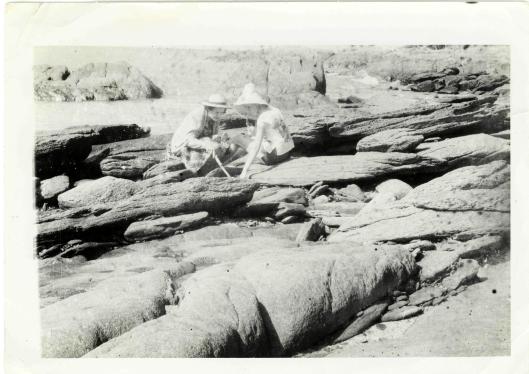
Looking in Rock Pools

Looking in Rock Pools

Story by Sandshoe

We played beamey at “little lunch” which was morning recess and at “big lunch” at midday underneath the raised school rooms on posts. The regular spacing of the posts black with creosote described the width of our courts and shallow grooves that were lines in the concrete floor made by its being laid in squares became serving lines-two equidistant from either side of the position of the central joist beam supporting the floor of the school rooms above.  Players stood behind the second line that was the furtherest from the overhead central beam.

The wing of the school consisted of three rooms. The potential underneath it was two beamey courts under each room according to the spacing of the posts ie six games could be played at one time (12 players).

One player of an opposed pair standing at the serving line with a tennis ball in their hand raised their arm and bent their elbow to throw the ball from the level of their shoulder with an expert thrust. The object was to bounce the ball off the central joist beam so the ball returned to the player and could be caught.

If instead of it connecting with the central joist beam it flew off into the court of the player on the other (opposing) side (delineated by the central joist beam), or if the player failed to catch the ball on its return, the ‘turn’ faulted to the opposing player.

Each game was comprised of a set of throws by the player.

First set was ten throws that connected with the beam and full-catch with two hands each time the ball returned to the player as accomplishment of its bouncing off the beam.

Second was ten throws and full-catch with one hand.

Third was ten throws and clap-catch on the ball’s return (catch with two hands). Fourth was ten throws and two claps-catch and so on up to five claps for senior players who might also challenge a champion to execute six and so on.

Each set of ten throws had to be completed and if not were begun again when the ball faulted back to the player who had not accomplished their full set. Each set of ten that was accomplished by a player signalled that the players change sides and the players walked to the other end of the court – swapped ends – before resuming play.

Players held their own creatively, challenged to more complex tasks by each other including catching the ball behind their back and/or throwing the ball under a raised leg and alternate legs. The more experienced the players, yet more complex the challenges issued. The skill of the game included its self regulation that if a player was unable to progress to ten throws and consecutive catches or clap-catches within a reasonable time, they graciously conceded and the ball passed to a new player. The excitement generated keen contenders and audience that grew the longer the champion player held their ground as happens in any sport. The bystanders lined up between the courts in closely packed lines and exclaimed, clapped and jeered. For one set players threw the ball so it bounced off the beam and fell to bounce within the court before it was caught. The ball at the point of being caught had to have had enough spin originally incorporated into its trajectory to fall graciously into position as it lost momentum. The game slowed, but room for error caused a fluster of excitement among bystanders such was the level of skill  required that was understood and appreciated.

The area was not uniformly or well lit at the best of times. The inner wall had a series of windows set in it high off the ground, but threw awkward shadow in dark blocks. Sunshine in changing striations cast angles of light into the eyes of the player facing the outer end of the court that was open to a quadrangle of bitumen. The sun’s glare generated a momentary illusion that the ball disappeared when it was thrown at the beam.

I had taken this game for granted until I read as a University student the volume by Iona and Peter Opie, pub.1959, The Lore and Language of Schoolchildren (Oxford University Press).

I recognised school yard games and rhymes I had half-forgotten. Oranges and Lemons as a well known example and its variations recalled our chanting in the school ground the names of these places and bells that in North Queensland in Australia we had little or no familiarity with. Yet, like ducks to water we chanted as if we knew what we were singing about.

Such was our enjoyment in the play we organised ourselves, I had never wondered how we knew the language of rhyme and play. Iona and Peter describe games they had collected from geographically far-flung contributors of knowledge of children’s activity, pastimes and social alliances through which games were reformed, child to child, generation to generation. Children moving to different schools in a neighbourhood took their rhymes to the next, making up variations on original games, but changing words and meanings depending on the interests of the day or the bright spark’s who made up a new joke on a refrain.

The random thought occurred that I might be unlikely to encounter in literature a description of the game of beamey. Might it be eccentric to my hometown and school. Since, I know from canvassing Facebook users on a local interest page that beamey was widely and fiercely played in other schools in the area in the same way we played it at my school, bouncing a ball off a central joist beam under the floorboards of an overhead school room…and  dependent on a complex set of rules and challenges.

The Opies’ central thesis as I read it is that children live in a creative playscape (my word, I think) of skill and inventiveness that nevertheless has a common heritage, a childish built-play environment, schoolyard to schoolyard and across seas. Migrants bring their play and other travellers carry it back with variations in a never-ending criss-cross of fertilisation. Parents’ play with their children perpetuates the heritage.

The game of ‘tag’, as another example I can think of, is played the world over that a group of children forms into a circle a child runs around inside until they suddenly swoop to touch one of the children in the circle on the upper arm. A variation of it I played with my friends was the child ran around the outside of the circle. The children in the circle could not second guess who the next person ‘tagged’ would be. In either game, the resultant excitement was a whoop and a mix of exclamations and shouting, “You’re it”. The game is one of empathy and collusion. The collusion is designed to develop group skills and reflex judgment. A variation involves a melee of children darting and confusing in a good humoured manner the person who is ‘it’. The skill is to not get immediately tagged back when tagging.

The wonder of it all is that these games do not degenerate into bad feelings and wounded pride. ‘Tag’ proceeds apace so the huffing and puffing of the individual runners red in their face from exertion, but never anticipating serious harm turns into serious exercise. The attention paid concentration and focus, but particularly preparedness to maintain ‘tag’ and not generate a biff-up is evidence alone of the children’s creative intention. Readers will recall a host of variations of this simple game.

Although as far as I am aware entirely organised by children for children, beamey may be different in that it is shaped by the built environment itself, which is its limiter.


The Pig’s Arms Best of 2013 – Volume 5

25 Saturday Jan 2014

Posted by Therese Trouserzoff in Algernon

≈ 22 Comments

best of 2013 6

Playlist by Algernon

http://www.youtube.com/watch?v=txjHaoV1rO8

Evolution – Taman Shud

http://www.youtube.com/watch?v=td_IWrhAtG0

Lady Sunshine – Taman Shud

http://www.youtube.com/watch?v=DWfFFMcfEt4

Sheik of Scrubby Creek – Chad Morgan

http://www.youtube.com/watch?v=jpkGvk1rQBI

Beds are Burning – Midnight Oil

http://www.youtube.com/watch?v=Tlnz95SZwBk

Stares and whispers – Renne Geyer

http://www.youtube.com/watch?v=Urtiyp-G6jY

I was only nineteen – Redgum

https://www.youtube.com/watch?v=Ej6_oaETVp8

Winter in America – Doug Ashdown

http://www.youtube.com/watch?v=CG-CNqOhO2c

Djapana – Yothu Yindi

http://www.youtube.com/watch?v=Vzd_bcVDnJQ

To her Door – Paul Kelly

http://www.youtube.com/watch?v=3mkidP2OUCk

Great Southern Land – Icehouse

http://www.youtube.com/watch?v=6pKPNnk-JhE

Power and the Passion – Midnight Oil

http://www.youtube.com/watch?v=5etdXzGAZWA

Quasimodo’s Dream – The Reels

http://www.youtube.com/watch?v=SUGlWCCVA4M

Cheap Wine – Cold Chisel

http://www.youtube.com/watch?v=Rvqh3ghEqtk

Khe Sanh – Cold Chisel

http://www.youtube.com/watch?v=FKEIQQs6qO8

Tuckers Daughter – Ian Moss

http://www.youtube.com/watch?v=O9seGsUGvMU

I hear motion – The Models

I Remember, I Remember

23 Thursday Jan 2014

Posted by Therese Trouserzoff in Warrigal Mirriyuula

≈ 42 Comments

Tags

Ageing brains, Memory, Warrigal Mirriyuula

Yikes

Story and Digital Mischief by Warrigal Mirriyuula.

As we grow older we have the opportunity to witness and ponder the shifts and changes in the world around us. To note what used to be called the “passing parade”; to see first our children and then our grandchildren grow up, as we too grow, travelling our various life and career paths.

This is such a commonplace experience and our musings such an ineluctable outcome thereof that it’s usually put down to the “human condition”, what Sartre called the existential dilemma. It all boils down to “how do we feel, how should we think, how should we act”?

Another commonplace is the notion that as we age our cognitive abilities wane. We take longer to recall memories accurately and can’t program the DVD, we misname people and endure what is often professionally described as “age appropriate” memory loss.

But is this slow decline into la la land real?

Not according to new research led by Dr. Michael Ramscar of Tübingen University. He and his colleagues’ recently published work in Journal Topics in Cognitive Science seems to put the lie to established ideas about older brains and declining cognitive acuity.

The team discovered that most standard cognitive measures, which date back to the early twentieth century, are flawed. “The human brain works slower in old age,” says Ramscar, “but only because we have stored more information over time.”

One of the things that stood out for me was that they discovered this new truth by teaching computers to “read books”. The books were a proxy for reality. What was “read” simulating the experiences of a life-time. The reading computers were then interrogated and tested for recall and comprehension.

When the computer was only allowed to read a small amount, subsequent cognitive test results were the equivalent of a young adult, but when the computer had accumulated the equivalent of a lifetimes reading over decades the cognitive test results looked like those of an older person. The computer was slower, not because its processing capacity had declined but because its data base had increased substantially and all that extra data, read life experience, took longer to process.

Technology now allows researchers to make quantitative estimates of the number of words an adult can be expected to learn across a lifetime, enabling the Tübingen team to separate the challenge that increasing knowledge poses to memory from the actual performance of memory itself.

“Imagine someone who knows two people’s birthdays and can recall them almost perfectly. Would you really want to say that person has a better memory than a person who knows the birthdays of 2000 people, but can ‘only’ match the right person to the right birthday nine times out of ten?” asks Ramscar.

The answer appears to be “no.” When Ramscar’s team trained their computer models on huge linguistic datasets, they found that standardized vocabulary tests, which are used to take account of the growth of knowledge in studies of aging, massively underestimate the size of adult vocabularies. It takes computers longer to search databases of words as their sizes grow, which is hardly surprising but may have important implications for our understanding of age-related slowdowns. The researchers found that to get their computers to replicate human performance in word recognition tests across adulthood, they had to keep their capacities the same. “Forget about forgetting,” explained Tübingen researcher Peter Hendrix, “if I wanted to get the computer to look like an older adult, I had to keep all the words it learned in memory and let them compete for attention.”

The research shows that studies of the problems older people have with recalling names suffer from a similar blind spot: there is a far greater variety of given names today than there were two generations ago. This cultural shift toward greater name diversity means the number of different names anyone learns over their lifetime has increased dramatically. The work shows how this makes locating a name in memory far harder than it used to be. Even for computers.

Ramscar and his colleagues’ work provides more than an explanation of why, in the light of all the extra information they have to process, we might expect older brains to seem slower and more forgetful than younger brains. Their work also shows how changes in test performance that have been taken as evidence for declining cognitive abilities in fact demonstrates older adults’ greater mastery of the knowledge they have acquired.

Take “paired-associate learning,” a commonly used cognitive test that involves learning to connect words like “up” to “down” or “necktie” to “cracker” in memory. Using Big Data sets to quantify how often different words appear together in English, the Tuebingen team show that younger adults do better when asked to learn to pair “up” with “down” than “necktie” and “cracker” because “up” and “down” appear in close proximity to one another more frequently. However, whereas older adults also understand which words don’t usually go together, young adults notice this less. When the researchers examined performance on this test across a range of word pairs that go together more and less in English, they found older adult’s scores to be far more closely attuned to the actual information in hundreds of millions of words of English than their younger counterparts.

As Prof. Harald Baayen, who heads the Alexander von Humboldt Quantitative Linguistics research group where the work was carried out puts it, “If you think linguistic skill involves something like being able to choose one word given another, younger adults seem to do better in this task. But, of course, proper understanding of language involves more than this. You have also to not put plausible but wrong pairs of words together. The fact that older adults find nonsense pairs—but not connected pairs—harder to learn than young adults simply demonstrates older adults’ much better understanding of language. They have to make more of an effort to learn unrelated word pairs because, unlike the youngsters, they know a lot about which words don’t belong together.”

The Tübingen researchers concluded that we need different tests for the cognitive abilities of older people—taking into account the nature and amount of information our brains process.

“The brains of older people do not get weak,” says Michael Ramscar. “On the contrary, they simply know more.”

A lot more!

Note: I took my title from the Thomas Hood Poem of the same name. My father used to regularly recite the poem when the issue of memory and remembering came up. Over time the portion quoted was reduced to the first four lines.

For me, now, it’s the last four lines that truly illuminate our subject here.

Source:

The above story is based on materials provided by Universitaet Tübingen and Science Daily.

Journal Reference:

Michael Ramscar, Peter Hendrix, Cyrus Shaoul, Petar Milin, Harald Baayen. The Myth of Cognitive Decline: Non-Linear Dynamics of Lifelong Learning. Topics in Cognitive Science, 2014; DOI: 10.1111/tops.12078

← Older posts
Newer posts →

Patrons Posts

  • The Question-Crafting Compass November 15, 2025
  • The Dreaming Machine November 10, 2025
  • Reflections on Intelligence — Human and Artificial October 26, 2025
  • Ikigai III May 17, 2025
  • Ikugai May 9, 2025
  • Coalition to Rebate All the Daylight Saved April 1, 2025
  • Out of the Mouths of Superheroes March 15, 2025
  • Post COVID Cooking February 7, 2025
  • What’s Goin’ On ? January 21, 2025

We've been hit...

  • 783,517 times

Blogroll

  • atomou the Greek philosopher and the ancient Greek stage
  • Crikey
  • Gerard & Helvi Oosterman
  • Hello World Walk along with Me
  • Hungs World
  • Lehan Winifred Ramsay
  • Neville Cole
  • Politics 101
  • Sandshoe
  • the political sword

We've been hit...

  • 783,517 times

Patrons Posts

  • The Question-Crafting Compass November 15, 2025
  • The Dreaming Machine November 10, 2025
  • Reflections on Intelligence — Human and Artificial October 26, 2025
  • Ikigai III May 17, 2025
  • Ikugai May 9, 2025
  • Coalition to Rebate All the Daylight Saved April 1, 2025
  • Out of the Mouths of Superheroes March 15, 2025
  • Post COVID Cooking February 7, 2025
  • What’s Goin’ On ? January 21, 2025

Enter your email address to subscribe to this blog and receive notifications of new posts by email.

Join 374 other subscribers

Rooms athe Pigs Arms

The Old Stuff

  • RSS - Posts
  • RSS - Comments

Enter your email address to subscribe to this blog and receive notifications of new posts by email.

Join 374 other subscribers

Archives

Website Powered by WordPress.com.

  • Subscribe Subscribed
    • Window Dresser's Arms, Pig & Whistle
    • Join 280 other subscribers
    • Already have a WordPress.com account? Log in now.
    • Window Dresser's Arms, Pig & Whistle
    • Subscribe Subscribed
    • Sign up
    • Log in
    • Report this content
    • View site in Reader
    • Manage subscriptions
    • Collapse this bar
 

Loading Comments...