Tags
family, Father O'Way, fiction, Gordon O'Donnell, humour, Life, travel, writing
If you have a gun and you see a cat, you have a moral obligation.
A Place For Us—A melancholy musical episodic intro to the Father O’Way Chronicles, think Coronation Street
FATHER O’WAY
O’Way in Space 2 — Re: Tardis
The further adventures of Father Sandy O’Way
A Little More Space Than I Bargained For
There are certain things in life that a man should never question too closely: the contents of a meat pie, the honesty of a politician, and the precise circumstances surrounding his appointment to the priesthood.
I had recently discovered a fourth.
Never ask a bloke called Gordon O’Donnell to explain the universe.
I was standing in the garden of an English country manor, watching a pair of swallows swoop across a blue sky. The morning air carried the scent of cut grass, roses and something delicious frying in a nearby kitchen. Beyond the stone garden wall, a church bell was ringing, while somewhere in the distance a dog barked at something that probably deserved it.
It was a magnificent English morning.
There was just one small problem.
England was several thousand kilometres beneath my feet.
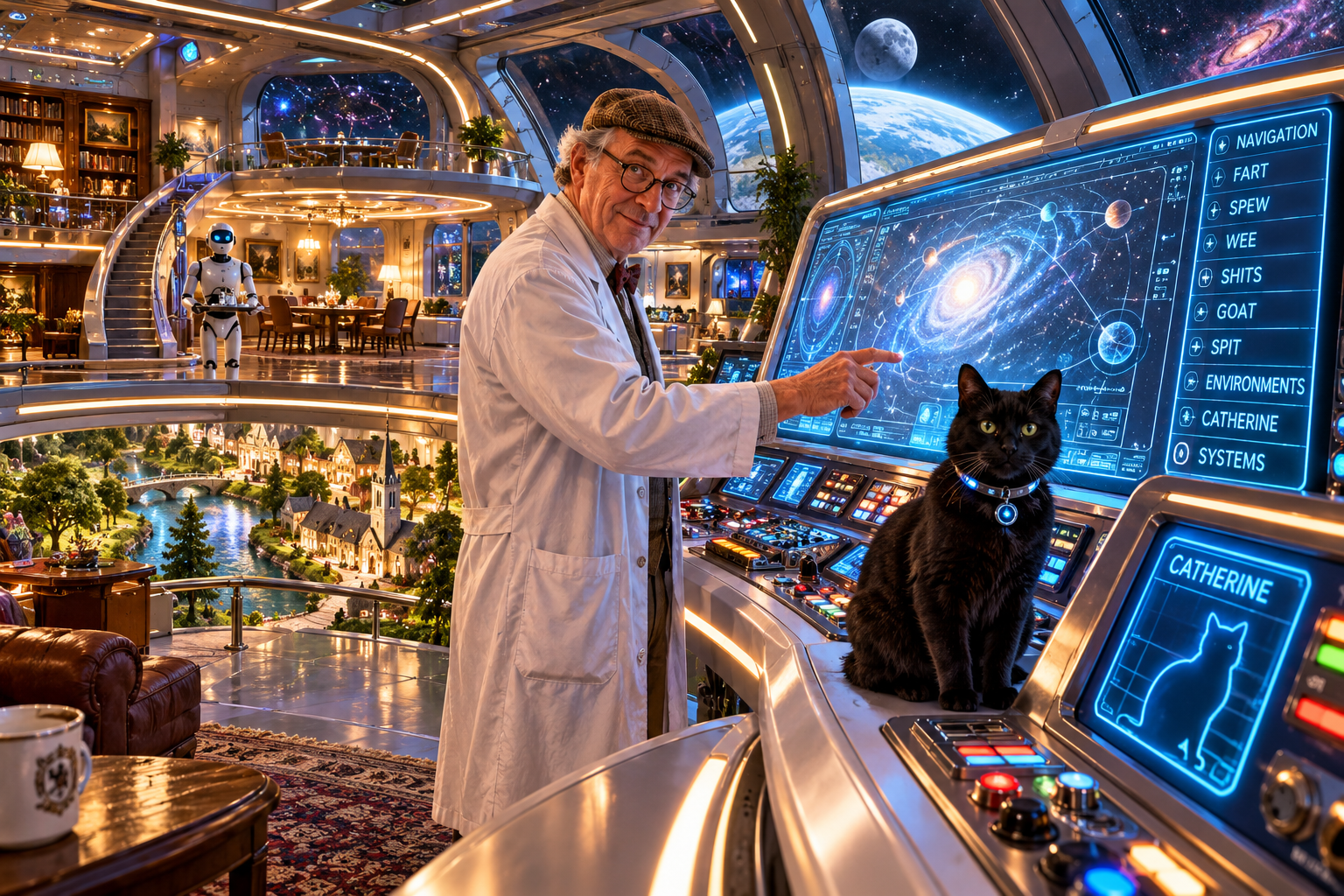
I was aboard Gordon’s spacecraft, travelling towards the Moon.
Only the previous evening Belinda and I had been standing in Inner Cyberia. Then Gordon had produced a small device, pressed a button and transported us aboard his enormous ship without the customary inconvenience of airports, tickets or border security.
He called the device a SPIT—a Small Personal Interplanetary Teleporter.
The journey had taken no time at all, although for several seconds afterwards I had the uncomfortable sensation that my elbows were following slightly behind the rest of me. Gordon assured me this was impossible, which was reassuring until I remembered that Gordon had also assured us the universe was perfectly safe.
My beautiful companion, Belinda, appeared completely untroubled by any of this. She was standing beside a flowering rosebush, examining a particularly magnificent bloom.
Belinda was an adventurous woman. Where I saw danger, she saw opportunity. Where I anticipated catastrophe, she anticipated excitement. It was one of the reasons I adored her, although it occasionally placed a considerable strain on my digestive system.
Behind us stood the manor, a sprawling Georgian residence of honey-coloured stone, tall sash windows and climbing ivy. Its front door was large enough to admit a moderately successful elephant.
Our butler, George, had disappeared into his recharging cupboard after preparing breakfast.
George was a droid. He was also considerably more polite than most people I had encountered on Earth, although his habit of standing motionless inside cupboards would take some getting used to.
Presiding over the entire arrangement was a computer named Catherine, who apparently controlled everything aboard the spacecraft: the engines, navigation, atmosphere, weather, food production and, I suspected, the temperature of my morning coffee.
I had never met Catherine.
Already I disliked her.
“Come on, Sandy,” Belinda called from the garden gate. “Let’s explore the village before lunch.”
A comfortable chair, a good book and several hours of inactivity seemed perfectly reasonable alternatives. Unfortunately, Belinda had already started walking.
I followed.
An English Village in the Middle of Nowhere
The village was everything an English village ought to be, including several things most English villages couldn’t possibly afford.
A narrow cobblestone road wound between ancient cottages, their thatched roofs sagging beneath centuries of entirely manufactured history. Flower boxes spilled colour beneath leadlight windows, while climbing roses embraced weathered brick walls.
There was a bakery, a butcher’s shop, a newsagent, two restaurants, several cafés and a cinema advertising a film that had apparently been showing since 1957.
The village green occupied the centre of the settlement.
Naturally, it contained a cricket pitch.
I should have known.
Gordon’s interest in cricket bordered on the pathological. He regarded the game as the pinnacle of civilisation, which perhaps explained why he had travelled through countless dimensions searching for intelligent life.
Apparently, he hadn’t found any.
Several figures in traditional country clothing were preparing the wicket. One pushed an enormous roller while another examined the pitch with the concentration of a surgeon contemplating open-heart surgery.
As Belinda and I passed, the groundsman raised his cap.
“Good morning, Father. Lovely day for it, Miss Belinda.”
I nodded pleasantly. It occurred to me that I had never seen this gentleman before, yet he knew both our names.
A woman emerged from the bakery carrying a tray of freshly baked bread. She greeted us with the cheerful familiarity of a neighbour who had known us for twenty years. Two elderly men outside the newsagent interrupted their argument about cricket long enough to wish us a pleasant morning.
It was becoming unsettling.
“Everyone seems to know us,” I remarked.
“George explained it,” Belinda replied. “The droids have been programmed to recognise us.”
“All 299 of them?”
“Apparently.”
On Earth, I had spent years cultivating a degree of anonymity, particularly in establishments where anonymity was preferable to recognition. Here, several hundred artificial people knew my name, my habits and, presumably, my weaknesses.
It was like living in a parish where the entire congregation had access to my personnel file.
We continued beyond the green, where the cobblestones gave way to a path bordered by willow trees.
Beyond them flowed a river.
Not a decorative pond or ornamental stream, but a proper river, broad and deep, its surface reflecting the shifting clouds overhead. It curved around the village before disappearing into a distant valley. A wooden footbridge crossed to a meadow where sheep grazed beneath enormous oak trees.
Belinda stopped to admire the view. I stood beside her, attempting to comprehend what I was seeing.
Somewhere beyond those hills lay the metal hull of a spacecraft. Beyond that hull lay the vacuum of space. And beyond that, depending on which direction you looked, lay several billion kilometres of absolutely bugger-all.
Yet here was a river, with fish in it. And a breeze. And clouds. And sheep.
One of the sheep regarded me with considerable suspicion.
I returned the compliment.
Belinda took my hand and guided me towards a bench overlooking the water. For several minutes we sat in silence, listening to the current moving beneath the willow branches.
It was one of those rare moments when everything seemed perfectly right. I had travelled extensively, usually under protest, but none of my adventures had prepared me for the quiet beauty of an English river flowing through a spaceship.
I squeezed Belinda’s hand.
“Well,” I said, “at least the fishing ought to be good.”
She laughed softly. “You’re impossible, Sandy.”
I had been called considerably worse.
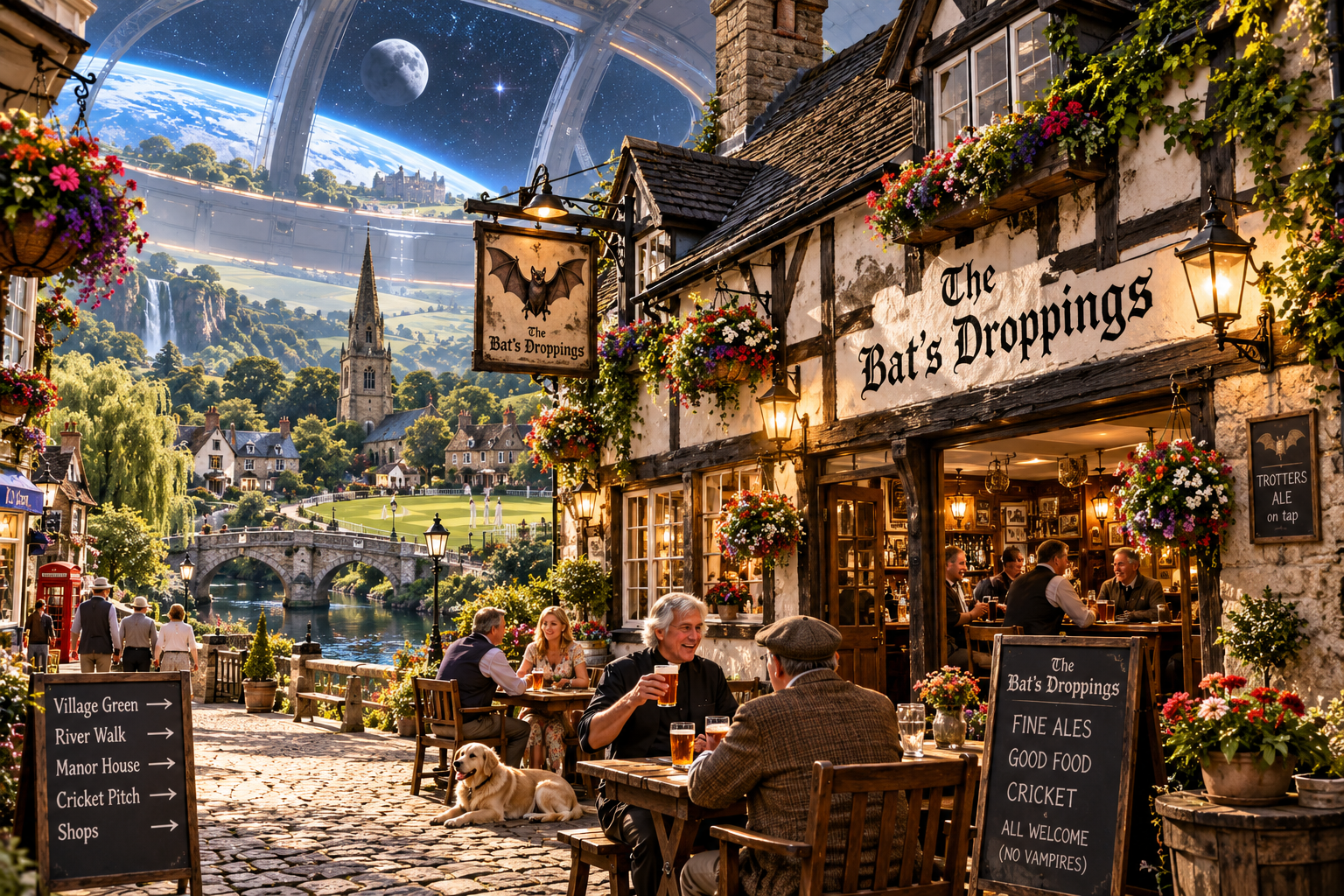
The Bat’s Droppings
By the time we returned to the village, my appetite had recovered sufficiently for me to contemplate lunch.
The Bat’s Droppings stood on the corner of the main street, a handsome two-storey building with dark oak beams, whitewashed walls and a magnificent collection of hanging baskets. An ancient sign creaked above the entrance, depicting a large bat in a somewhat compromising position.
The meaning was unmistakable.
So was the spelling.
Inside, the pub was a masterpiece of traditional British hospitality. Heavy timber beams crossed the ceiling, polished brass fittings gleamed in the afternoon light, and a cheerful fire crackled beneath a mantelpiece crowded with photographs. The air smelled of hops, leather, woodsmoke and roast beef.
Several patrons sat around wooden tables, reading newspapers and arguing about the cricket.
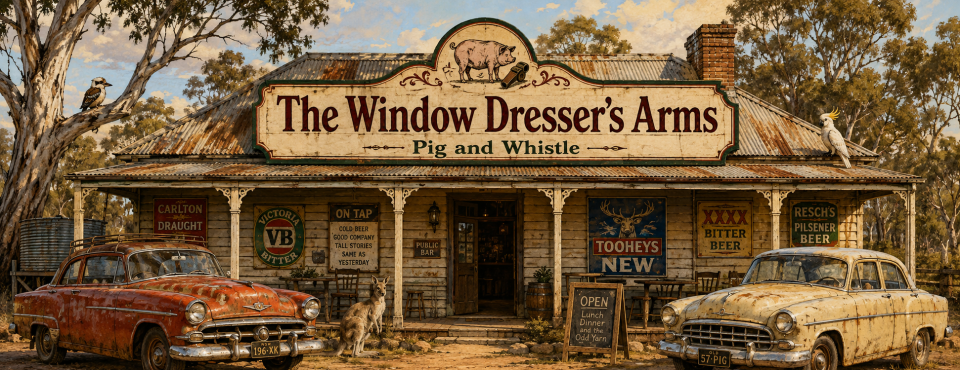
For a moment I could almost imagine myself back at the Pig’s Arms.
Almost.
The absence of Merv was immediately apparent. And the furniture was considerably cleaner.
Gordon was sitting in a secluded corner, wearing his customary white laboratory coat and flat cap. He had spread documents across the table and was examining them with the anxious concentration of a man who had misplaced something important.
Possibly a planet.
Before we could join him, a cheerful fellow emerged from behind the bar.
“Welcome, Father O’Way,” the publican said. “I’m Michael Jones. A pint of Trotters for you, I believe, and tonic water for the young lady?”
I stopped.
Trotters Ale. My favourite drink from the Pig’s Arms.
The bastard knew.
Michael noticed my expression but merely smiled as he reached for a glass. There was something decidedly unnatural about a publican who knew your order before you’d made it. On Earth that sort of familiarity generally resulted from years of diligent drinking. Here, apparently, it was included in the programming.
Belinda thanked Michael and accepted her drink. I took my pint, inspected the colour, inhaled the aroma and sampled it cautiously.
Perfect. Absolutely perfect.
Gordon might have been a questionable creator of universes, but his attention to beer was beyond criticism.
We joined him at the table.
“Gordon,” I began, “I’ve got so many questions I scarcely know where to start.”
He removed his cap, rubbed his forehead and reached beneath the table.
“First,” Gordon announced, “you’ll need to read this.”
He pushed a paperback towards me.
The cover displayed a cheerful cartoon astronaut floating past a planet. The title read:
SPACE NAVIGATION FOR DUMMIES
I turned it over. There were no reviews.
This was hardly surprising. Most people who had attempted to review it were probably still travelling.
SPIT: The Problem with Arriving All at Once
Before opening the manual, I asked Gordon about the little gadget that had brought us aboard.
He brightened immediately. From his coat pocket he produced the SPIT, a silver device about the size of a television remote control. It had one prominent button, two small lights and a warning label so tiny that reading it would have required a microscope.
“Small Personal Interplanetary Teleporter,” Gordon said proudly, turning it over in his hands. “It converts the traveller into a transmissible pattern, sends that pattern to a selected destination, and restores the traveller at the other end.”
Belinda leaned forward with interest.
“Does it hurt?” she asked.
“Not at all,” Gordon replied. “Ideally, the traveller doesn’t notice anything.”
“I noticed my elbows,” I said.
Gordon frowned. “What about them?”
“They arrived after I did.”
“That’s a physiological misinterpretation of instantaneous displacement.”
“Of course it is,” I replied. “Next time I’ll explain that to my elbows.”
Gordon pointed out that a SPIT could move a person across vast distances without the need for a conventional journey. Large objects, he added, required a different machine altogether.
He gestured towards a chapter in the book headed GOAT.
I was still examining the SPIT.
“Has one ever gone wrong?” I asked.
Gordon placed it carefully back into his pocket.
“Not in any way we’ve been able to confirm.”
This was a phrase that deserved several moments of consideration.
Belinda rescued him by asking about the book.
Space Travel for the Intellectually Challenged
The book was remarkably thin.
I had expected several thousand pages dealing with gravitational forces, propulsion systems, interstellar navigation and avoiding the occasional asteroid. Instead the accumulated wisdom of space travel had been condensed into approximately forty pages.
The table of contents was disturbing.
Chapter 1 — Avoiding BO
Chapter 2 — Watch Out for BOOBS
Chapter 3 — When to Use a GOAT
Chapter 4 — Five Questions You Should Ask a FART
Chapter 5 — Things You Need to Know About Space Travel
Chapter 6 — The Complete List of Space Acronyms
I closed the book.
“Gordon, you’re having a lend of me.”
He looked genuinely offended. “Certainly not, Sandy. That manual represents years of research.”
“Years?”
“Well, afternoons mostly. I had lectures in the mornings.”
Gordon settled back in his chair and began explaining the ship’s design.
The beautiful countryside we had explored belonged to an enormous biosphere: one of several self-contained environments aboard the spacecraft. Each possessed its own landscape, climate and recreational facilities. Rivers and waterways linked the various environments, allowing passengers to travel between them without constantly being reminded that they were hurtling through an airless void.
I thought of the sheep, the river and the magnificent oak trees.
It was an extraordinary achievement.
“Does the river ever flood?” I asked.
Gordon hesitated. “Not intentionally.”
I decided not to pursue the matter.
He opened the manual to the first chapter.
“Now, Sandy, the most important thing to remember is to avoid BO.”
I nodded knowingly. “Couldn’t agree more. Particularly in confined spaces.”
“Big Objects, Sandy. BO means Big Objects.”
Apparently space was full of them: planets, moons, asteroids and enormous wandering chunks of material left over from the construction of the universe. The general principle of navigation was to avoid colliding with anything larger than yourself.
It seemed sound advice, rather like being told not to stand in front of a moving train.
Then Gordon moved on to BOOBS.
I leaned forward. At last, a subject in which I possessed some expertise.
Unfortunately, BOOBS stood for Big Objects Out Back Side.
Gordon explained that a large object approaching from behind could be more dangerous than one directly ahead, since the crew might not notice it until the situation became irreversible.
“So the general advice,” I said, “is to watch your backside?”
“Exactly.”
“Been doing that for years.”
Belinda nearly swallowed her tonic water the wrong way.
A GOAT and a FART
Belinda pointed to the next heading in the manual.
“What about GOAT?” she asked. “Are we supposed to sacrifice one at full moon?”
Gordon smiled indulgently.
“Certainly not, Belinda. GOAT stands for Giant Object Atomising Teleporter.”
He explained that a GOAT could transport large objects onto or off the spacecraft without the inconvenience of moving them through a doorway. Machinery, buildings and other substantial objects could be broken down, transferred and reconstructed at the destination.
Impressive technology, I thought, and potentially disastrous in the hands of a man who occasionally had difficulty operating a kettle.
“Does it always work?” I asked.
“Usually,” Gordon replied.
There was that word again.
Usually.
It had become apparent that Gordon’s scientific vocabulary consisted largely of usually, probably, theoretically and oh dear.
I tapped the fourth chapter.
“Right. What about this FART?”
Gordon’s expression brightened. Here, apparently, was the crowning achievement of his scientific career.
“Find Appropriate Road Tollway,” he announced. “FART is the ship’s route-finding and navigation system. It identifies suitable passages through space and guides us towards a SPEW, which makes the really long journeys practical.”
“A what?” Belinda asked.
“A Space Particle Emissions Wavetable,” Gordon explained. “Think of it as a means of compressing the distance we need to travel. What might normally be an enormous journey becomes a much shorter one.”
I thought about this.
“So,” I said, “we find a road, take a tunnel and come out somewhere else?”
“Not precisely,” Gordon answered. “The geometry is more complicated.”
“Do we have to pay a toll?”
Gordon blinked. “What?”
“You called it a Road Tollway. I’m asking who collects the money.”
“No one collects money, Sandy. It’s an astronomical term.”
“Of course. And what happens when the FART picks the wrong road?”
A brief silence settled over the table.
Gordon became deeply interested in a biscuit.
Belinda smiled at me. “Don’t worry, Sandy. Gordon knows what he’s doing.”
I looked at Gordon.
Gordon looked at his biscuit.
For the first time in my life I found myself seriously concerned about the consequences of a misplaced FART.
Catherine Makes an Entrance
Lunch arrived shortly afterwards.
Michael appeared carrying three enormous plates of roast beef, Yorkshire pudding, vegetables and enough gravy to float a small fishing boat. It was a magnificent meal, prepared with the sort of care rarely encountered outside a country pub.
I was halfway through my Yorkshire pudding when I noticed something moving beneath a neighbouring table.
A cat.
A sleek black cat with bright green eyes, immaculate whiskers and the confident swagger peculiar to creatures who believe the world exists entirely for their convenience.
I have never liked cats.
Dogs are straightforward creatures. They greet you enthusiastically, appreciate a decent meal and generally refrain from judging your personal shortcomings.
Cats are different.
A cat can sit silently in a room for hours while making everyone present feel inadequate.
This particular cat approached our table, jumped gracefully onto an empty chair and settled itself beside Gordon.
Gordon appeared delighted.
“Ah, excellent timing,” he announced. “Sandy, Belinda, I’d like you to meet Catherine.”
I looked at the cat. Then at Gordon. Then back at the cat.
“Catherine?”
“Yes.”
“The computer?”
“Precisely.”
There was something deeply unpleasant about being scrutinised by a domestic animal capable of controlling an interstellar spacecraft.
Catherine stretched, extended her claws and yawned.
Then she spoke.
“Good afternoon, Father O’Way. Miss Belinda.”
Her voice was smooth, cultured and unmistakably female.
I nearly dropped my fork.
Belinda, on the other hand, appeared delighted.
“You’re beautiful!” she exclaimed, reaching forward to stroke Catherine’s head.
The cat accepted the compliment with the gracious indifference of someone who had been hearing it for several million years.
Catherine explained that she occasionally assumed physical forms when moving around the spacecraft. The cat was particularly useful for exploring narrow passages, observing the crew and catching rats.
Rats.
Aboard a spaceship.
I looked towards Gordon.
“Why would you have rats on a spaceship?”
Gordon opened his mouth, but Catherine answered first.
“For much the same reason we have priests, Father. Nobody is entirely sure how they got aboard.”
Belinda dissolved into laughter.
I was beginning to dislike this computer intensely.
Catherine turned her enormous green eyes towards me.
“Do you have a problem with cats, Father O’Way?”
I considered my response.
The creature before me controlled the air supply, gravity, temperature, lighting and possibly the plumbing.
A diplomatic answer seemed advisable.
“Not at all, Catherine. Lovely animals.”
She watched me for several uncomfortable seconds.
Then she smiled.
I had never seen a cat smile before. It was not an experience I wished to repeat.
“How reassuring,” Catherine replied. “I’m sure we’ll get along famously.”
With that, she leapt from the chair and sauntered towards the doorway, her tail held high.
At the entrance she paused.
“One small thing, Father.”
I looked up.
“Yes?”
“The next time you describe me as a control freak, remember that I control the temperature of your shower.”
Then she disappeared.
A Very Long Afternoon
For a long time I sat staring at the doorway.
Gordon quietly resumed eating his lunch. Belinda was still smiling.
Around us, the Bat’s Droppings continued its cheerful afternoon business. Glasses clinked, conversations drifted between tables, and the jukebox began playing a particularly dreadful rendition of an old Beatles song.
Outside, sunlight warmed the cobblestones of a village that existed inside a machine hurtling through space.
The whole arrangement was completely ridiculous.
Yet there was something rather wonderful about it.
An English village, a beautiful woman, a comfortable manor, a splendid pub and the prospect of travelling to places no human being had ever visited.
Perhaps Gordon wasn’t entirely mad.
Perhaps this extraordinary adventure would turn out to be the experience of a lifetime.
I glanced at the navigation manual.
BO. BOOBS. GOAT. SPIT. FART.
Then I remembered that the spacecraft was controlled by a cat who knew what I was thinking.
On balance, I decided Gordon was completely mad.
Still, the beer was excellent.
And as I have discovered throughout my rather peculiar career, life is considerably more tolerable when the beer is excellent.
Gordon finished his coffee and rose from the table.
“Right then,” he announced cheerfully. “Shall we go and see the Moon?”
Belinda was on her feet immediately.
I remained seated.
Through the open window came the gentle sound of the village church bells, followed by the distant crack of a cricket ball striking willow.
It was peaceful. It was civilised. It had a pub.
And we were about to abandon it in favour of travelling around the Moon with a man whose spacecraft operated according to principles that apparently included flatulence.
I drained the last of my Trotters Ale.
“One question, Gordon.”
He stopped beside the table.
“Yes, Sandy?”
“Has anyone actually tested this FART of yours?”
Gordon smiled.
“Of course.”
“Successfully?”
His smile faded. He began examining his fingernails.
From somewhere above us, Catherine’s voice drifted through the ceiling.
“Perhaps you’d better bring a change of trousers, Father.”
I sighed.
It was going to be a very long afternoon.
END OF EPISODE
Next: Giving O’Way More Space 3
Editorial continuity note: SPIT = Small Personal Interplanetary Teleporter. FART = Find Appropriate Road Tollway, following the original 24 September 2009 published expansion. “Find Appropriate Roadway Tunnel” is the later recollection, recorded as a variant in the companion dictionary. Herbert, Gordon’s mother and the green parallel-universe door do not enter this original-timeline episode.